No. ANATOLIA-001
Athenian Sabazios mysteries (Glaukothea / Aeschines)
Greece · Classical Athens, mid-4th c. BC · Europe · Mediterranean
Restricted
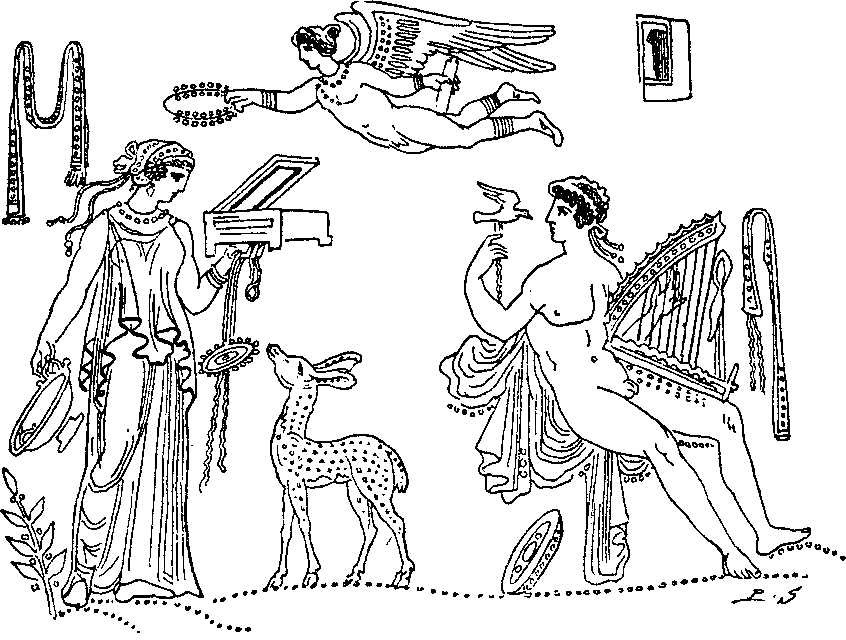
konos / rhombos
konos ("cone, pine-cone") and rhombos ("whirled thing, spinning-top"): Greek names for small whirled objects among the toys of the child Dionysus.
Etymology. konos means "cone, pine-cone"; rhombos, "whirled thing, spinning-top."
An ancient scholiast on Clement of Alexandria pauses to explain one of the toys handled in the Dionysiac mysteries: the konos, a bit of wood on a string that roars when it is whirled round. The mystery world in which such objects moved is preserved in Demosthenes' attack on the orator Aeschines, whose mother Glaukothea ran initiations in Athens. By night, Demosthenes says, Aeschines mixed the libations, wrapped the novices in fawn-skins, and scoured them with clay and bran — the daub that myth traced to the Titans, who had painted themselves with clay so as not to be known when they tore the child Dionysus to pieces. By day he led the revelers crowned with fennel and white poplar, squeezing fat-cheeked snakes above his head and crying euoi saboi, hyes attes, the ritual shouts of Sabazios and the Mother of the Gods. Demosthenes names the fawn-skins and the snakes but not the konos; the whirled wood belongs to the scholiast's catalogue of Bacchic toys, and it is on that ground that Glaukothea's rite is read as a Greek instance of the roaring cord.
The κωνος is a little piece of wood, to which a string is fastened, and in the mysteries it is whirled round to make a roaring noise.
Ancient scholiast on Clement of Alexandria, quoted in Lang, Custom and Myth (1884), ch. "The Bull-Roarer"
Particulars
- Object
- Small wooden konos/rhombos whirled on a cord to make a roaring noise in nocturnal Sabazios-mystery initiations conducted in private houses.
- Function
- Sound-element of telete (initiation) alongside fawn-skin wrapping, clay-daubing, and the cries of the Sabazian rite.
Source
Demosthenes, De Corona 18.259-260; scholiast on Clement, Protrepticus 2.17 (Lobeck Aglaophamus 1829 p.700ff); Lang, Custom and Myth (1884) ch. The Bull-Roarer