No. SAMER-002
Cubeo (Kobeua / Kubeo)
Colombia · Upper Vaupés · Cuduiarí and Querarí rivers · South America · Northwest Amazonia
Restricted
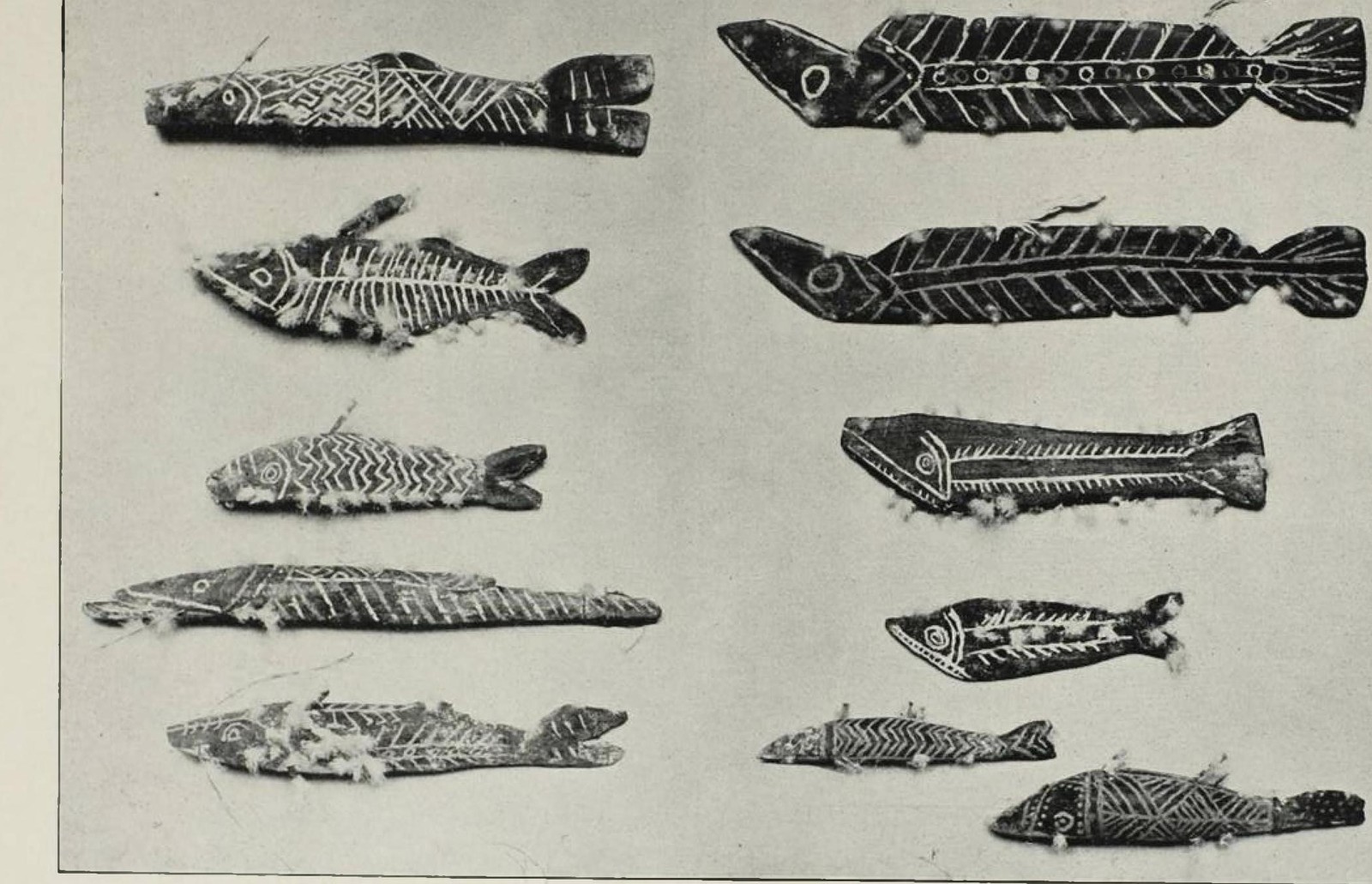
Among the Cubeo of the upper Vaupés — the Kobéua whom Theodor Koch-Grünberg lived with on the Cuduiarí in 1904 — a carved, painted, fish-shaped piece of wood is figured as figure 90 in his Zwei Jahre unter den Indianern (1909-10). Koch-Grünberg recorded it as a dance-ornament; it is Alfred Métraux who, reading the same figure, classed it among the South American bull-roarers, noting that fish-figures of this form from the Bakairi and Kobeua “are used as dance ornaments and as ‘devils’ (bull-roarers).” Koch-Grünberg himself watched the Kobéua dance with painted wooden fish-figures slung on strings between paired dancers, and he sat through the men's secret Yurupary rites, where the whirled and blown instruments stood for demons that women were forbidden not only to see but even to know existed; even to him the men would say only that the instruments were spirits. Those rites belong to a serpent cosmology: the Cubeo count themselves children of the ancestral anaconda, which swam up the Vaupés with the first people inside its body and set them out along the riverbanks. The same masked impersonations of animal and demon spirits filled the Cubeo death festival, the mourning ceremony later documented as the Óyne. And the whirled instrument was no stranger on this river: a generation later Irving Goldman recorded that a Cubeo shaman kept a stone bull-roarer, whirled so that its distant victim suffered as if struck with a machete.
„Es sind Dämonen (Yurupary) mit verschiedenen Namen und verschiedenen Stimmen.“
"It is demons (Yurupary) with various names and various voices."
Theodor Koch-Grünberg, Zwei Jahre bei den Indianern Nordwest-Brasiliens (1921; revised edition of Zwei Jahre unter den Indianern), p. 221.
Particulars
- Object
- Carved-wood, fish-shaped bull-roarer used as a dance ornament.
- Function
- Whirled as a spirit-voice ('diable') and worn as ornament in masked mourning dances.
Sources
- Theodor Koch-Grünberg, Zwei Jahre unter den Indianern: Reisen in Nordwest-Brasilien 1903/1905 (Berlin: Wasmuth, 1909-1910), vol. 2, p. 153, fig. 90, via Métraux 1928, p. 265
- Alfred Métraux, La civilisation matérielle des tribus Tupi-Guarani (Paris: Geuthner, 1928), p. 265
- Otto Zerries, 'The Bull-roarer among South American Indians,' Revista do Museu Paulista n.s. 7 (1953), p. 284 n. 4 View · archived
- Theodor Koch-Grünberg, Zwei Jahre bei den Indianern Nordwest-Brasiliens (1921, revised edition), p. 221