No. GRENAND1982-001
Wayãpi ancestral rhombe, Oyapock-Amapá region
Brazil · Oyapock · Amapá and French Guiana · South America · Guianas
Sacred / spirit
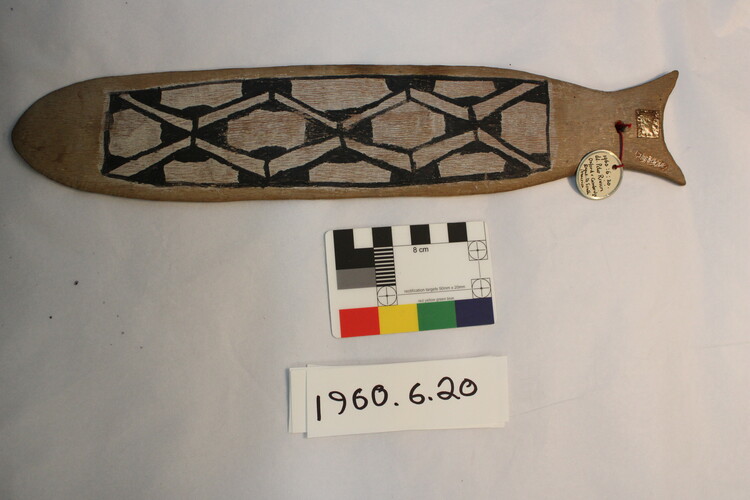
Source term: rhombe; /kulumuli/ bamboo
rhombe is Grenand's French instrument term; /kulumuli/ names the bamboo material (Guadua latifolia, per Grenand's footnote).
Wayãpi myth remembers a missed eternity: after the creator Yaneya broke with humanity, the flood Ipolu remade a world where death is never natural and the forest belongs to the ayã spirits. In a story told by the grandmother Péicô at Trois Sauts in 1974, the hero Anilawa circled the village whirling a bamboo bullroarer until the mũmũ spirits answered, growling just as it did; he seized one of them and would not let go as it became jaguar, bushmaster and millipede, until it yielded kãyɨma ku'i, the flour that made warriors invisible. The magic is lost today, among a people Grenand calls 'warriors without a war.'
Il attacha un morceau de bambou /kulumuli/ à une ficelle pour appeler les esprits. Il parcourut le cercle du village en faisant tournoyer son rhombe.
He tied a piece of kulumuli bamboo to a string to call the spirits. He walked the circle of the village whirling his bullroarer.
Pierre Grenand, Ainsi parlaient nos ancêtres (1982), p. 386.
Particulars
- Object
- A piece of kulumuli bamboo (Guadua latifolia) tied to a string and whirled.
- Function
- Whirled to call the spirits: in the ancestral story the shaman-hero Anilawa ties kulumuli bamboo to a cord and circles the village whirling his rhombe until the mũmũ spirits answer; Beaudet adds its historic place in the war complex. No access restriction is recorded, and by the late twentieth century the Wayãpi no longer made the instrument.
Source
Pierre Grenand, Ainsi parlaient nos ancêtres: essai d'ethnohistoire wayãpi (1982), p. 386 (annexe 8; told by Péicô at Trois Sauts, September 1974); Jean-Michel Beaudet, 'Un art du souffle,' in Musiques en Guyane (1989), p. 31