No. JUDD1959-001
Pueblo del Arroyo elk-bone bullroarer
United States · Pueblo del Arroyo · Chaco Canyon · undated within site · North America · Southwest
Weather / fertility magic
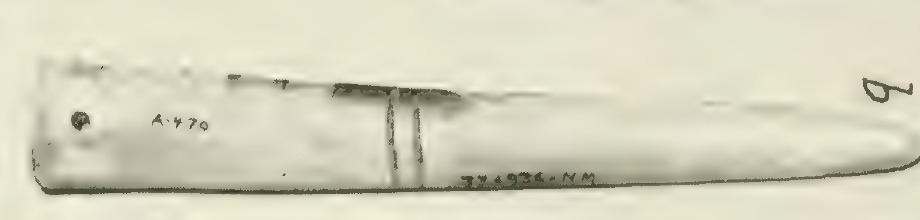
Source term: bull roarer
Digging at Pueblo del Arroyo, Neil Judd's crew turned up a long blade cut from an elk leg bone, pierced near one end and crossed by two incised bands. Zuni workmen on the dig recognized it as a bullroarer, though it was bone rather than the usual lightning-riven wood, and bore incised bands rather than lightning symbols. To them it was still a prayer device, twirled on a cord to voice wind and invite rain. No find context or cord survived, so whether Chaco's own builders used it the same way is unknown.
recognized by some of our Zuñi workmen as a 'bull roarer'
Judd 1959:133
Particulars
- Object
- Long, flat elk cannon-bone blade with nearly parallel sides, a gently rounded distal end, one circular perforation near the opposite end, and two transverse incised bands; no cord or measurements survive.
- Function
- A prayer device, twirled at the end of a cord to simulate the wind and thus invite rain, as Zuni workmen on the dig identified it.
Source
Neil M. Judd, Pueblo del Arroyo, Chaco Canyon, New Mexico, Smithsonian Miscellaneous Collections 138(1) (1959), p. 133 and Plate 37 q