No. AFR-001
Uukwaluudhi omathila rain and sowing Big Birds
Namibia · Owamboland · Omusati region · Africa
Restricted
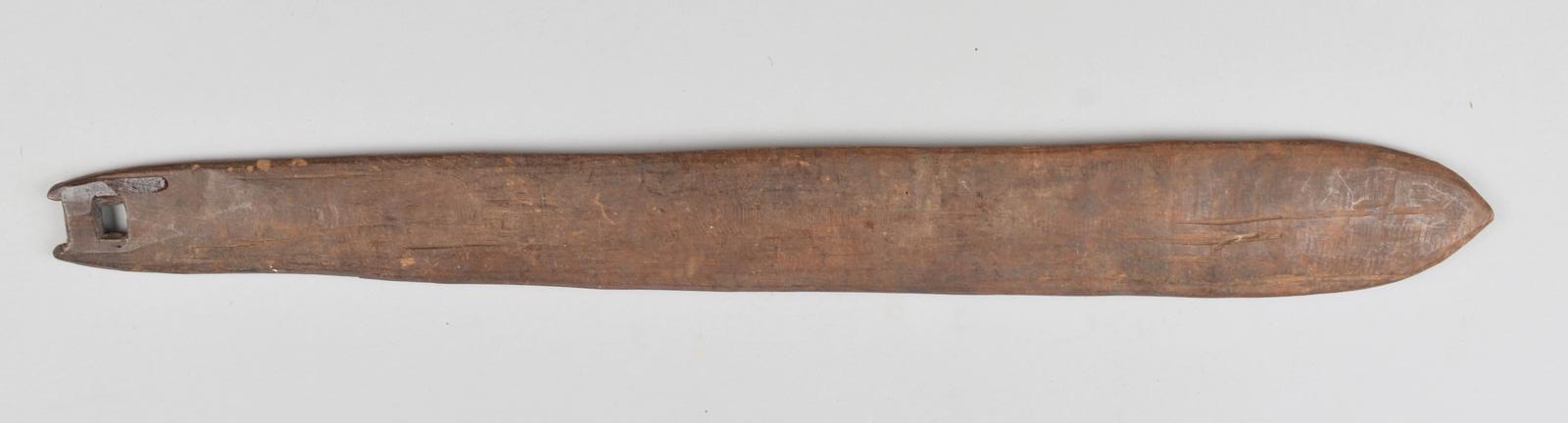
omathila / Big Birds
Source term: omathila; bullroarer-like whirled instrument
omathila: "the Big Birds," the Uukwaluudhi rain and sowing spirits whose whirring voice the instrument produced (related forms omazila/omadhila, singular eedhila/eethila). oshimbo: the sacrificial rite on the final day, when the stock taken during the four-day march is killed to the omathila.
Etymology. omathila translates as "the Big Birds," understood to be spirits; the whirled blade's sharp whirring represented the noise of the wings of huge flying birds, to whom stock was sacrificed. Related forms: omazila/omadhila, singular eedhila/eethila.
Among the Uukwaluudhi of Owamboland, a rain and sowing rite was carried out in the name of the omathila, the Big Birds: spirits thought to fly over the country making frightening noises, whose voice was a flat piece of wood, roughly six inches by two, fixed to the end of a whip-like lash. Four or five old men, the ekanjo, "men who call the clouds for rain," were appointed by the king to keep the custom alive; he summoned them to his kraal and set them to make the preparations, and they moved over the land in a secret procession after dark. At first light they marched east to greet the rising sun and passed among the kraals whirling the instruments above their heads to imitate the beating wings of huge flying birds. No one might address them or even look upon them, for to do so would bring misfortune on the offender and his crops. The ceremony ran four days; small stock met along the way was driven off and by custom became the property of the ekanjo, and on the last day the stock was sacrificed to the omathila. The first procession fell in September or October, the time of the Small Rains and of sowing, and was greatly feared; a second, more relaxed one came when the crops were well established and the Big Rains were expected. By then the men carried long sticks tipped with ostrich feathers, and people in the fields greeted them with cries of "Rain, rain," then drove their hoes harder into the ground as if the rain had already fallen.
No one is allowed to address them or even to set eyes upon them as this will bring bad luck to such persons and their crops.
C. H. L. Hahn 1928, p. 4, quoted in Salokoski 2006, p. 230
Particulars
- Object
- Rain/sowing Big Birds rite with whirled bullroarer-like instruments representing huge flying birds.
- Function
- Uukwaluudhi omathila rain ritual was related to sowing and initiated by the king; two processions are keyed to the Small Rains/sowing and to crops already established.
Sources
- Märit Salokoski, How Kings Are Made – How Kingship Changes (University of Helsinki, 2006), pp. 229-231 View · archived
- C. H. L. Hahn, “The Ovambo,” in H. P. Smit (ed.), The Native Tribes of South West Africa (1928), pp. 1-36, at p. 4, via Salokoski 2006, p. 230; Harding 1973, pp. 41-42; Davies 1994, ch. 6, pp. 35-36
- Harding, 'The Bull-roarer in History and in Antiquity,' African Music 5(3) (1973), pp. 41-42
- Gwyneth Davies, The Medical Culture of the Ovambo, PhD thesis, University of Kent at Canterbury (1994), ch. 6, pp. 35-36 View · archived