No. EXH2026-050
Korana burubush, swung by its cord
South Africa · Middle Orange River (!Kora country) · Southern Africa
Play / practical
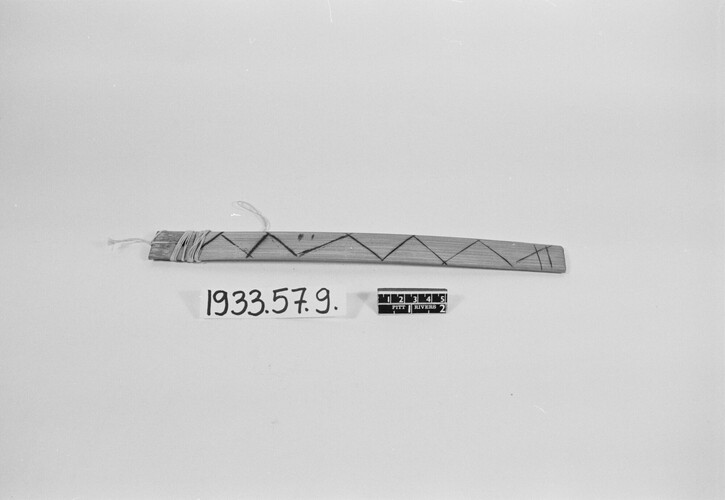
burubush
Source term: burubush (bull-roarer)
burubush — Korana (!Kora Khoekhoe) name for the bull-roarer.
A Korana boy at Bloemhof held the cord itself as he whirled his bullroarer. Kirby photographed him with the instrument: a crudely made blade, its string left free of the handle used on the other roarers he illustrated. The Korana called it burubush, a name whose rolling sound has close companions in the seburuburu of the Tswana and the sevuruvuru of the Sotho.
There are to-day, so far as I can discover, no rituals in which the instrument is used, and no taboos regarding its employment... For the most part it is nowadays looked upon as a child's toy.
P. R. Kirby, The Musical Instruments of the Indigenous People of South Africa (1934; 3rd ed. 2013), "Bull-Roarers and Spinning-Disks" (ch. 4), p. 98
Particulars
- Object
- A crudely made bull-roarer swung by its cord alone, with no handle; Kirby photographed the Korana boy who owned it holding the instrument.
- Function
- A boy’s plaything; Kirby observed it in use at Bloemhof.