MEN2007-001 - museum specimen
Ngangela kasolo and kahulihuli
Ngangela country, south-eastern Angola (then Portuguese Angola) - Southern Africa
Function not recorded
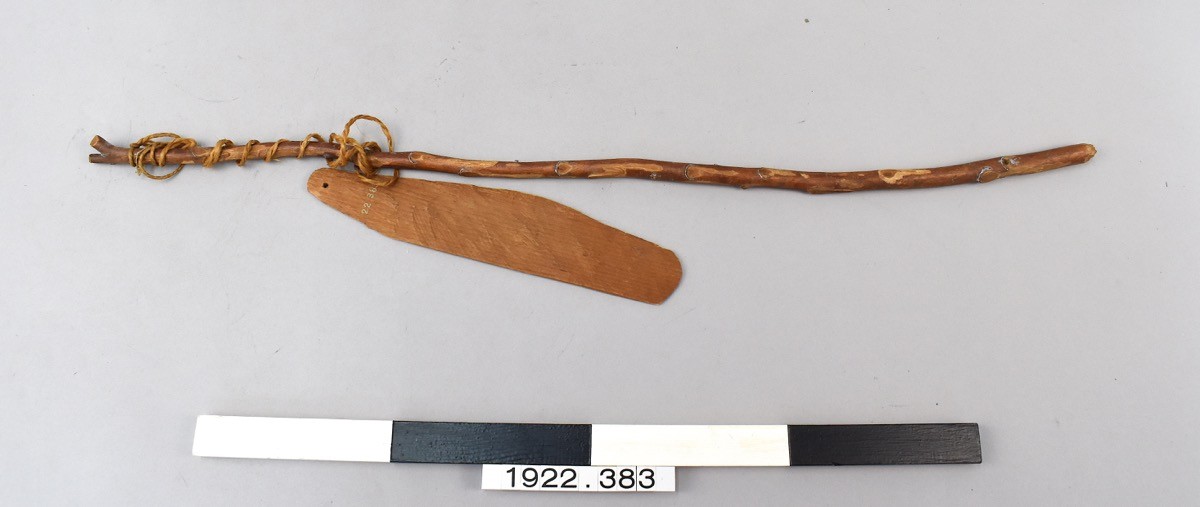
kasolo; kahulihuli
Source term: rhombe
kasolo; kahulihuli — Ngangela names for the two instruments; their meanings are unrecorded. rhombe — French for bullroarer.
The Ngangela pair turns contrast into a kind of duet: kasolo is a plain rectangle with its cord wound tight around one end, while kahulihuli narrows into a long taper pierced at the tip.
- Object
- Two contrasting blades: kasolo is rectangular, with its cord wound around one end; kahulihuli is long and tapered, pierced at its narrow end for a loose cord.
- Function
- Not recorded.
- Source
- Musée d'ethnographie de Neuchâtel, inv. III.C.5524 (Rhombe kasolo) and III.C.5525 (Rhombe kahulihuli), Ngangela, Angola, 1933; both listed in the plate caption "PANOPLIE DE SIFFLETS ET MASQUE" in the exhibition publication Retour d'Angola (MEN, Texpo 12bis), printed p. 20, and both drawn on Delachaux's preparatory sheet for the African musical-instrument…
- Source location
Page references
printed p. 20 (PDF p. 22); inv. III.C.5524, III.C.5525
- Source confidence
- low Broad Ngangela culture-area anchor in south-eastern Angola (Cuando Cubango / Moxico / south-eastern Bié). The museum records only "Ngangela, Angola, 1933" with no village; Vila da Ponte and the Kubango are deliberately not inferred from other objects in the same mission.