No. KIRBY1934-002
Venda tshivhilivhi, the lion and Grandfather
South Africa · Venda (Vhembe, northern Limpopo) · Southern Africa
Restricted
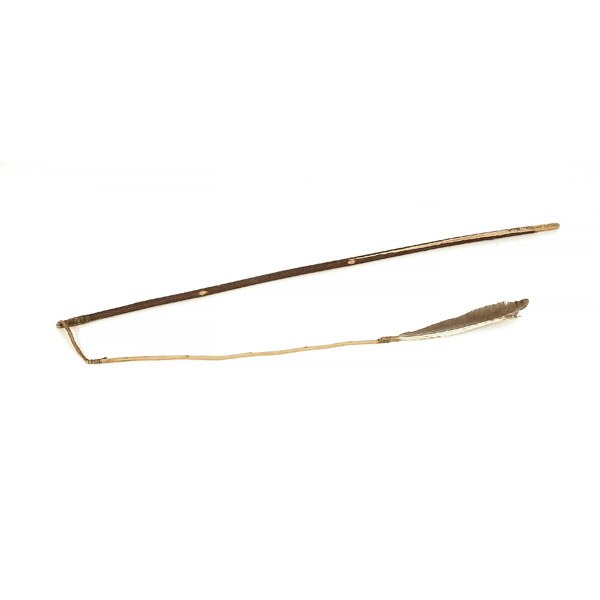
tshivhilivhi / luvuva
Source term: bull-roarer
In the murundu, the circumcision school the Venda took up in the nineteenth century, a lion seemed to whimper behind the boys' huts. It was men whirling *tshivhilivhi*, and while the frightened novices listened, others raised a pole about thirty feet high in the enclosure, capped with baboon or rabbit skin. The boys were brought out and told it was their *makhulu*, their grandfather; every morning and evening until the school ended they danced around it, and the bold climbed it to shout from the top. On the last night the roarers sounded again while the pole was cut down and burnt. Called out to find it gone, the boys shouted that Grandfather was dead. Outside the lodge, children made their own: a slat swung from a handle, and a disk spun on a doubled string, both called *luvuva*.
The noise frightens the boys, who think that it is a lion whimpering, and do not hear anything of the erection of the pole.
Stayt, The Bavenda, p. 134
Particulars
- Object
- Made by children in both classes: a swung slat with a handle, and a twisted spinning-disk. The Venda specimens are described as particularly crude; no dimensions recorded.
- Function
- Made by children as a plaything. In the murundu circumcision school, men hidden behind the boys' huts whirl tshivhilivhi so the novices, who take the noise for a whimpering lion, do not hear the makhulu ('grandfather') pole being raised; on the last night the roarers cover its cutting down and burning.
Source
Percival R. Kirby, 'Bull-Roarers and Spinning-Disks,' in The Musical Instruments of the Indigenous People of South Africa, 3rd ed. (Johannesburg: Wits University Press, 2013), p. 101; John Blacking, 'Songs, Dances, Mimes and Symbolism of Venda Girls' Initiation Schools, Part Three: Domba,' African Studies 28(3) (1969): 149–199; Hugh A. Stayt, The Bavenda (London: Oxford University Press, 1931), pp. 133-135