No. EXH2026-051
Tswana (seburuburu)
Tswana country (SE Botswana · NW South Africa) · Southern Africa
Play / practical
seburuburu
Source term: seburuburu (bull-roarer)
Setswana name for the bull-roarer — the same word, Kirby notes, as Sotho sevuruvuru.
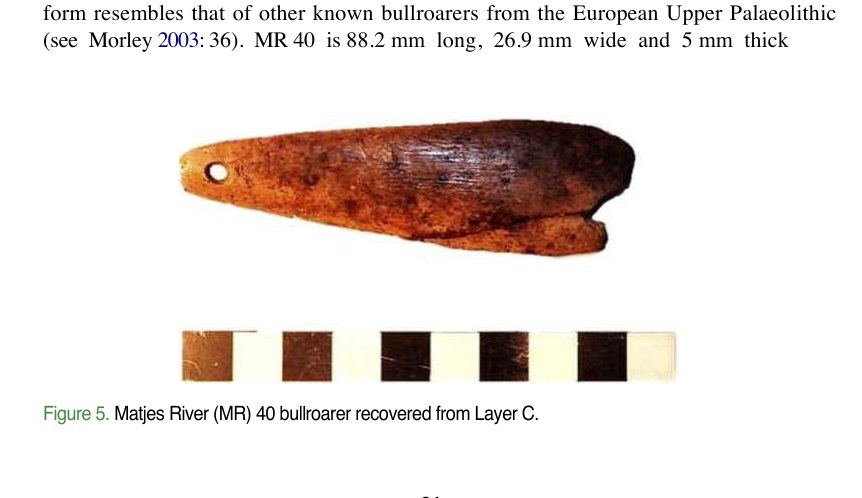
The oldest musical instrument ever recovered from the ground in Botswana is a bull-roarer, the seburuburu. It was unearthed at the Early Iron Age site of Matlapaneng, on the outskirts of Maun, where the archaeologist James Denbow worked the southern margin of the Okavango Delta. Carved from a roughly worked bone fragment, it had been broken and mended, and carried holes drilled through both ends — some of them repairs — where a string was threaded so it could be whirled around the head to make its roaring sound. It is a little more than a thousand years old and shows the marks of long and careful use. Among the Tswana of more recent record the seburuburu is set down plainly as a child's plaything: J. Tom Brown's Secwana dictionary glosses it as "a whirling toy," and twentieth-century instrument catalogues list it the same way.
The oldest musical instrument recovered from excavations in Botswana is a bull roarer (seburuburu) made of a roughly carved bone fragment. It was unearthed at an Early Iron Age site at Matlapaneng on the outskirts of Maun. This artifact, which had been broken and repaired, had holes drilled through both ends (some as repairs), where it would have been attached to a string and whirled around the head to make a roaring sound; it is a little more than 1,000 years old.
Denbow & Thebe, Culture and Customs of Botswana (2006), p. 195
Particulars
- Object
- Roughly carved bone, broken and mended, with holes drilled through both ends for a whirling string. The Tswana seburuburu Kirby saw was 'very roughly constructed' too, like the Korana one; he photographed a Bangwaketse boy from Kanye holding his.
- Function
- A child's toy among the Tswana in Kirby's day.
Sources
- James Denbow & Phenyo C. Thebe, Culture and Customs of Botswana (Westport: Greenwood, 2006), p. 195, n. 10 at p. 219 View · archived
- Sibyl Marcuse, Musical Instruments: A Comprehensive Dictionary (1964), s.v. seburuburu
- Levine, pp. 159–160
- Percival R. Kirby, The Musical Instruments of the Indigenous People of South Africa (1934/1968; 3rd ed., Wits University Press, 2013), p. 100, figs. 4.1 and 4.2 nos. 5, 9