WURZ2008-001 - archaeological depiction
Orange Springs painted trance-dance bullroarer
South Africa - Eastern Free State - Caledon River valley near Modderpoort and Ladybrand - Southern Africa
Sacred / spirit Candidate only
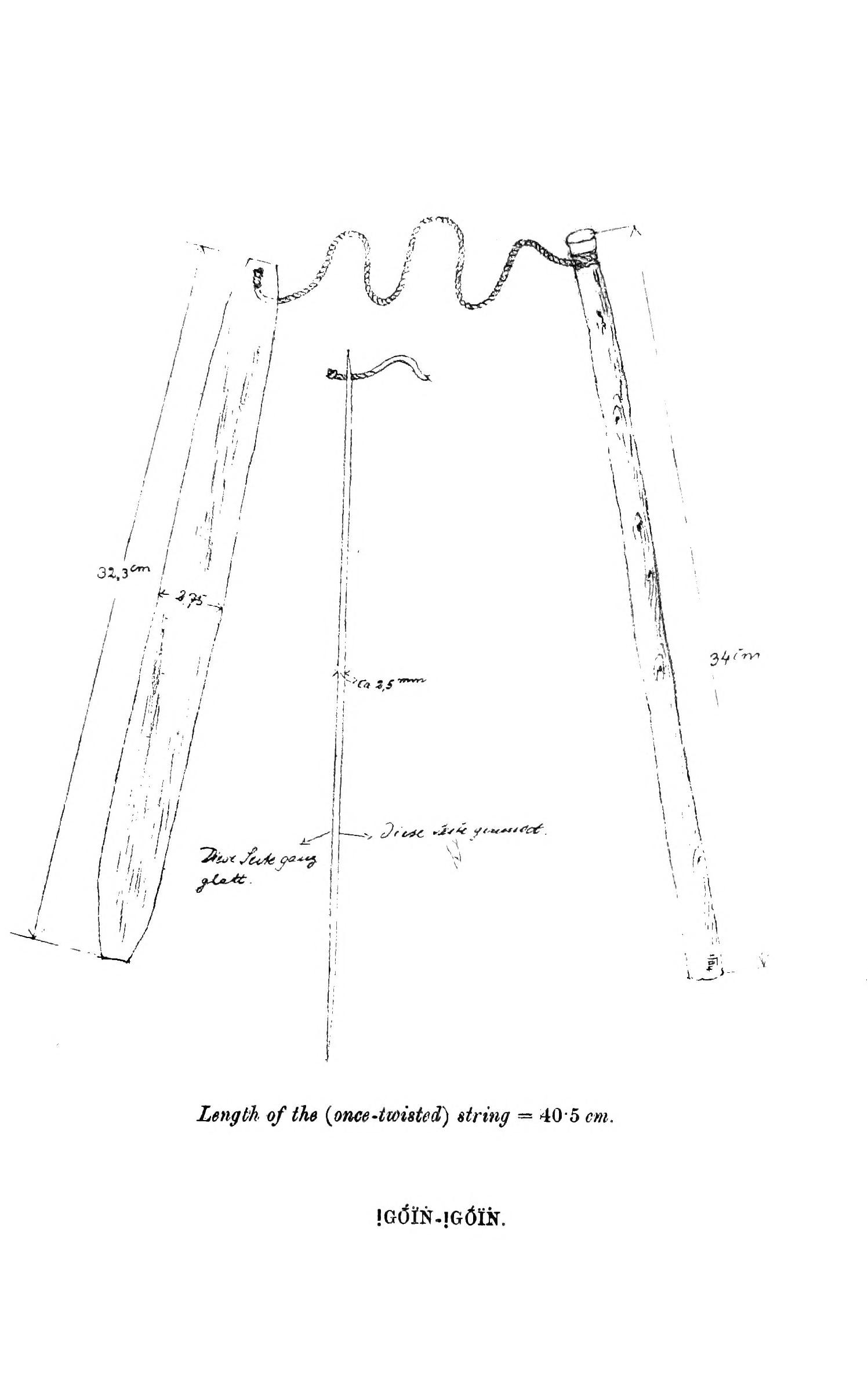
!goin !goin
Source term: bullroarer ... or !goin !goin
!goin !goin (|Xam): the bullroarer, a blade whirled on a cord to produce a buzzing sound; see SAFR-004 for the ethnographic row carrying the same term.
In 1906 Helen Tongue travelled to the eastern Free State and copied in watercolour a dance she found painted on the wall of a shelter above the Caledon River: ranks of people clapping, dancers doubled over, one man flung out horizontal in the air. Low in the composition, set apart from the rest, a small figure stands with both arms lifted and an elongated pale thing held above his head. Sarah Wurz and Petro Keene think he is holding a bullroarer, a !goin !goin, the whirring blade the |Xam described, and a later account of the same picture has him twirling it on a string. The scene cannot be dated within the roughly 3,000-year span of surviving Maloti-Drakensberg San painting, but it was already on the rock by 1906.
appears to be holding a bullroarer (Le Quellec 2004) or !goin !goin
Wurz and Keene 2008, ASAPA poster
- Object
- A San trance-dance scene painted in an overhanging rock shelter on the Caledon River, in which one lower figure stands apart with both arms raised, holding an elongated pale object above the head; surrounding implements are discussed as sticks or possible medicine-people's equipment. The scene is known through Helen Tongue's watercolour copy titled 'The Dance', made after her 1906 field visit and published in 1909, now in Iziko Museums' Pre-colonial Archaeology Section. No object was recovered.
- Function
- A painted figure in the scene appears to hold, or twirl on a cord, a bullroarer or !goin !goin.
- Source
- Wurz and Keene 2008, ASAPA poster
- Source location
Page references
Wurz and Keene 2008 ASAPA poster, unpaginated; Bradfield 2024 report, caption to the Tongue reproduction
- Source confidence
- low Published coordinate for Modderpoort, eastern Free State, the mission locality from which Tongue and Dorothea Bleek were directed to the shelters in 1906; the Orange Springs I 46 farm coordinate is not published in the sources consulted.