No. HAD1898-007
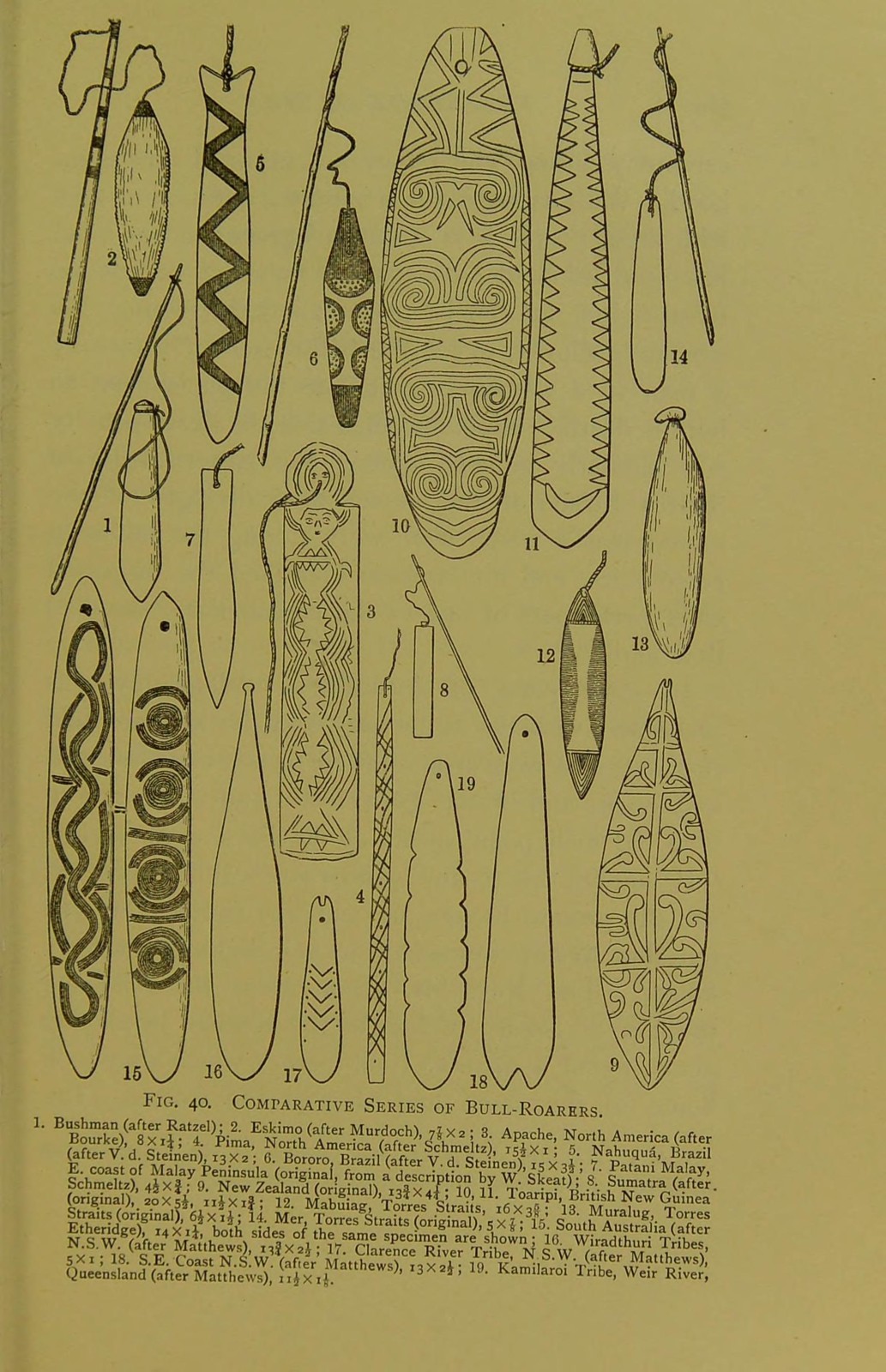
Bushman / San rain and hunting bullroarer
Botswana · Namibia · South Africa · Southern Africa
Weather / fertility magic
going-going
Source term: bull-roarer
The Bushmen of South Africa, Haddon reports, made a bull-roarer that widens slightly toward its free end before tapering to a point; the attached end carries a button-like knob with a circular notch, and the cord is tied there and fastened to a stick. It was spoken of as a rain-charm, and was said to be used as a clapper in driving game and to "charm their luck in hunting." For the hunting use he ventured an explanation: the cattle and game evidently mistook the buzz for the gad-fly or bot-fly and bolted, which he supposed would also serve these "little hunters" well in their raids on the cattle of the Zulus. The instrument was still alive when the geographer Siegfried Passarge crossed the Kalahari: at 'Gau, a Batawana town on the Tauche, he watched a child of unmistakable Bushman descent sweep one through figure-eights in the air until the feather bound to its far rod hummed. The name he learned for it, Ssewéwe, was the Bechuana one.
It certainly would prove a useful instrument if these little hunters could by its means drive their game so crazy that they would not know which way to turn.
Haddon 1898, The Study of Man, p. 326
Particulars
- Object
- One such instrument survives in the musée du quai Branly, Paris, inv. 71.1932.88.491: a narrow southern African blade 41 by 4 centimetres and a centimetre thick, thirty-four grams, on a single cord with a wooden handle.
Source
Haddon 1898, The Study of Man, Ch. X "The Bull-Roarer," after Ratzel, The History of Mankind (Eng. ed., trans. A. J. Butler, Macmillan), vol. ii, pp. 275-276 (Bushman bull-roarer text); vol. i, frontispiece (figure); independent field observation: Siegfried Passarge, Die Buschmänner der Kalahari (Berlin: Dietrich Reimer, 1907), pp. 97-98 with Abb. 22