No. MUS2026-181
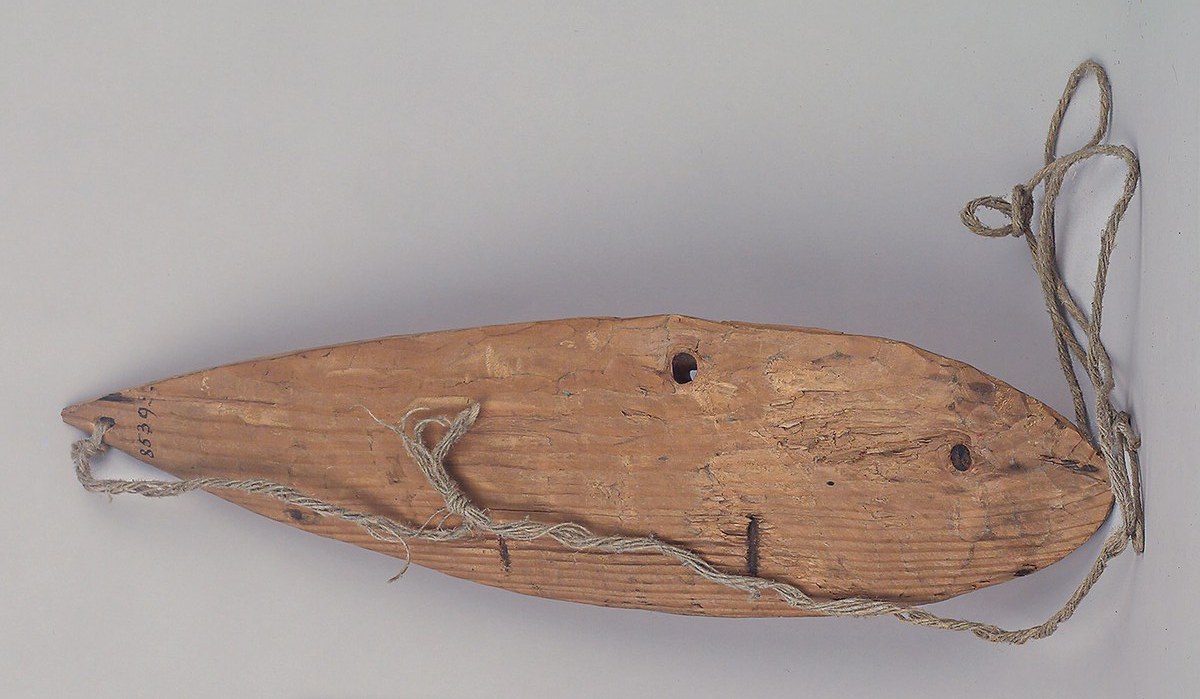
Oas San healer's bullroarer, Omaheke
Namibia · Oas farm · Omaheke sandveld · Kalahari, German South-West Africa · Southern Africa
Sacred / spirit
Source term: Schwirrholz
Schwirrholz: German, 'whirring wood' — the standard museum term for a bullroarer; no San name was recorded for this blade.
When someone fell ill at Oas, a farm deep in the Omaheke sandveld, the healer's answer was sound: he swung a pointed wooden blade on its cord until the wood cried out, and a voice beyond the human joined the cure — a voice the 1909 Vienna card, in stark colonial German, calls Satan. The blade was improvised sacred equipment, cut from a European packing crate, bored at the tip, and strung with trade twine.
Wenn ein Mensch krank ist, so schwingt der "Doktor" das Holz und läßt das Holz ertönen. Dann spricht der Satan.
When a person is ill, the "doctor" swings the wood and makes it sound. Then Satan speaks.
Weltmuseum Wien accession card, Post IX 1909, inv. 85393
Particulars
- Object
- Pointed-oval blade of European crate wood, 30.5 cm, flat and very slightly convex, pierced at the pointed end and threaded with a long European twine cord; the complete rig survives in the museum photograph. Three further Pöch blades from the same 1908 Oas collection event are photographed in Vienna: 85394, 85396 and 85397.
- Function
- Swung by a healer when a person was ill; the roar was heard as a supernatural being speaking.
Source
Weltmuseum Wien inv. 85393, 'Thunder Stick/ Medicine' (Schwirrholz); geography Namibia / Kalahari, Omaheke / Oas; collector Rudolf Pöch, c. 1908, museum entry 1909 (accession card Post IX 1909, Nr. E 12)