No. SUBSAH-033
!goin!goin bull-roarer of the Kalahari San (Kirby collection)
South Africa · Southern Kalahari (Gordonia district, Northern Cape), around Twee Rivieren · Southern Africa
Sacred / spirit
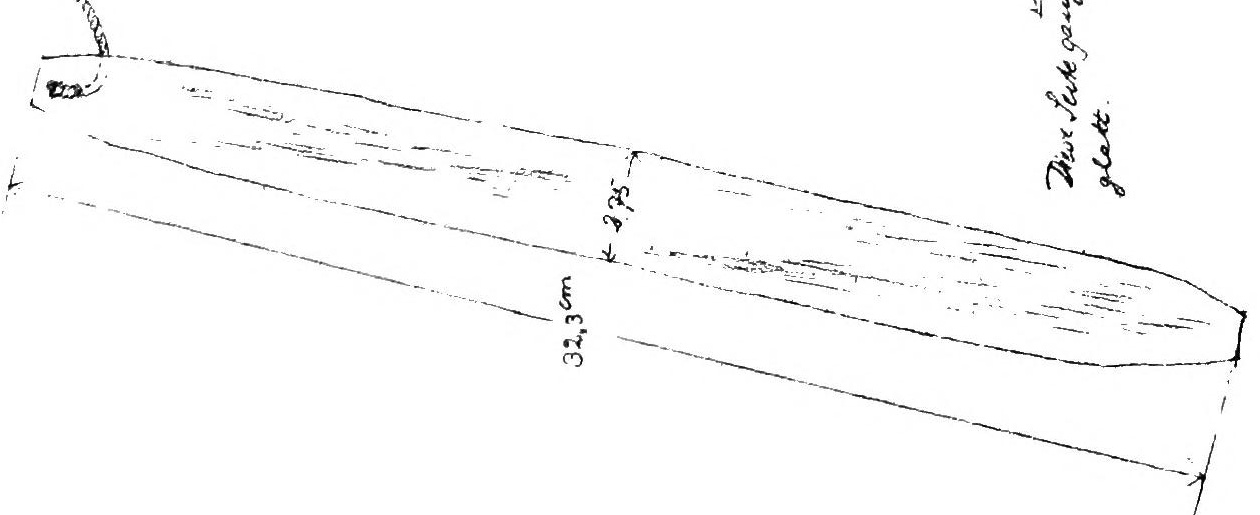
!goin!goin; fur fur
Source term: rhombe
!goin!goin and fur fur are San (Khoisan) onomatopoeic names for the whirled blade; rhombe is French for bullroarer.
In 1936 the musicologist Percival Kirby joined a University of the Witwatersrand expedition into the southern Kalahari, to Twee Rivieren, where |'Auni and ‡Khomani Bushmen had been gathered, and brought back their bull-roarers. The San called the whirled blade !goin!goin; the dune communities also kept a variant they named fur fur. Several of the slats survive in his collection at the University of Cape Town. What the roar was for, the San had already told Bleek and Lloyd in 1878: the people beat the !goin!goin so that the bees may become abundant and go into the other people's places, so that the people may cut honey and put it away in bags. The whirring imitates a swarm, and Kirby gave the same account.
The people beat the |gómǀgóm, (in order) that the bees may become abundant for the people ... that the people may cut honey, that they may put honey away into bags.
|hanǂkass'o, dictated January 1878, in W. H. I. Bleek and L. C. Lloyd, Specimens of Bushman Folklore (London, 1911), pp. 353-355; cf. Kirby 1934, p. 179
Particulars
- Object
- Flat wooden slat whirled on a cord so that it roars (a bull-roarer; Kirby grouped it with the spinning-disks). The Percival Kirby collection at the University of Cape Town holds several southern-Kalahari specimens recorded under two San names: !goin!goin (KK 48, 50, 51, 52, 55) and fur fur (KK 57, 58), catalogued among the Khomani and 'Red Dune' Bushmen.
- Function
- Beaten so that the bees may multiply and go into the people's places, and honey be cut.
Sources
- Emmanuelle Olivier, "Archives Khoisan : l'histoire comme champ de la musique," Afrique & Histoire 2006/2 (vol. 6), pp. 195-224, note 34 View
- P. R. Kirby, "The Musical Practices of the |?Auni and ‡Khomani Bushmen," Bantu Studies 10 (1936), pp. 373-431 View
- P. R. Kirby, The Musical Instruments of the Native Races of South Africa (Oxford University Press, 1934), p. 179 View
- W. H. I. Bleek and L. C. Lloyd, Specimens of Bushman Folklore (1911), pp. 353-355 View