No. DEHEUSCH1982-001
Mbunda ndumba, the ancestor at night
Mbunda country, upper Zambezi (western Zambia and eastern Angola) · South-Central Africa
Restricted
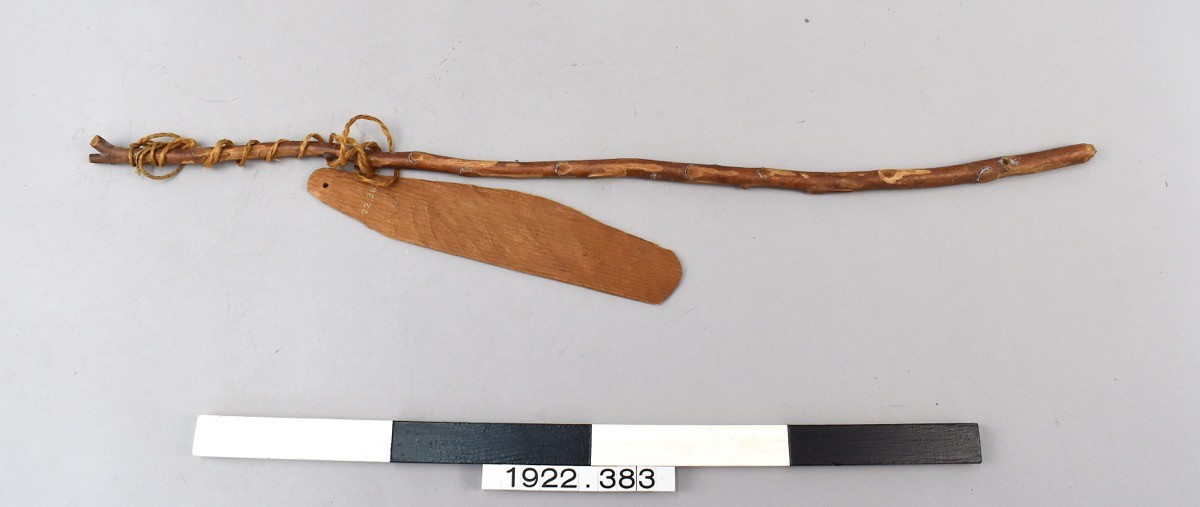
ndumba
Source term: bull-roarer
ndumba: Mbunda name of the bullroarer in mukanda. mukanda: the boys' circumcision and seclusion camp. mingongi: the novices' ritual batons. liula: the beaten-bark sound that announces the first bath.
After dark, out past the last houses, the ndumba throbbed. Mbunda boys shut away in mukanda, the circumcision camp, took it for the fearsome voice of an ancestor; only later in the rite were they shown what made it. Among the Mbunda it was never heard by day. The camp lived by sound. Each morning the novices clapped their batons, mingongi, like the wingbeats of the bird that draws up the sun, singing that the sun was up, they would eat, and the elders were coming to beat them — and the kicks duly followed. After the night of the genet came a day of silence, when the mothers were told a cannibal monster had eaten their sons. At dawn a guardian beat a piece of bark, and the boys ran to the river for their first bath, their mothers straining past the guardians to touch them.
at first the novices are frightened by this unusual sound, which they take for the fearsome voice of an ancestor
Luc de Heusch, The Drunken King (1982), p. 218, after Vrydagh 1969
Particulars
- Object
- Not recorded.
- Function
- Sounded only at night on the outskirts of the village during mukanda; the novices first take it for the fearsome voice of an ancestor and later learn what it is.
Sources
- Luc de Heusch, The Drunken King, or The Origin of the State, trans. Roy Willis (Indiana University Press, 1982), pp. 216–219
- Paul-André Vrydagh, Mbunda and Old Mbunda Makisi Masks and Dances, doctoral thesis, Université Libre de Bruxelles (1969), p. 69
- P.-A. Vrydagh, 'Makisi of Zambia', African Arts 10(4) (1977) View