No. LLOYD1879-001
Xam, the roarer a lion answers
Namibia · Kavango, west of Rundu along the Okavango (bordering southern Angola) · Southern Africa
Play / practical
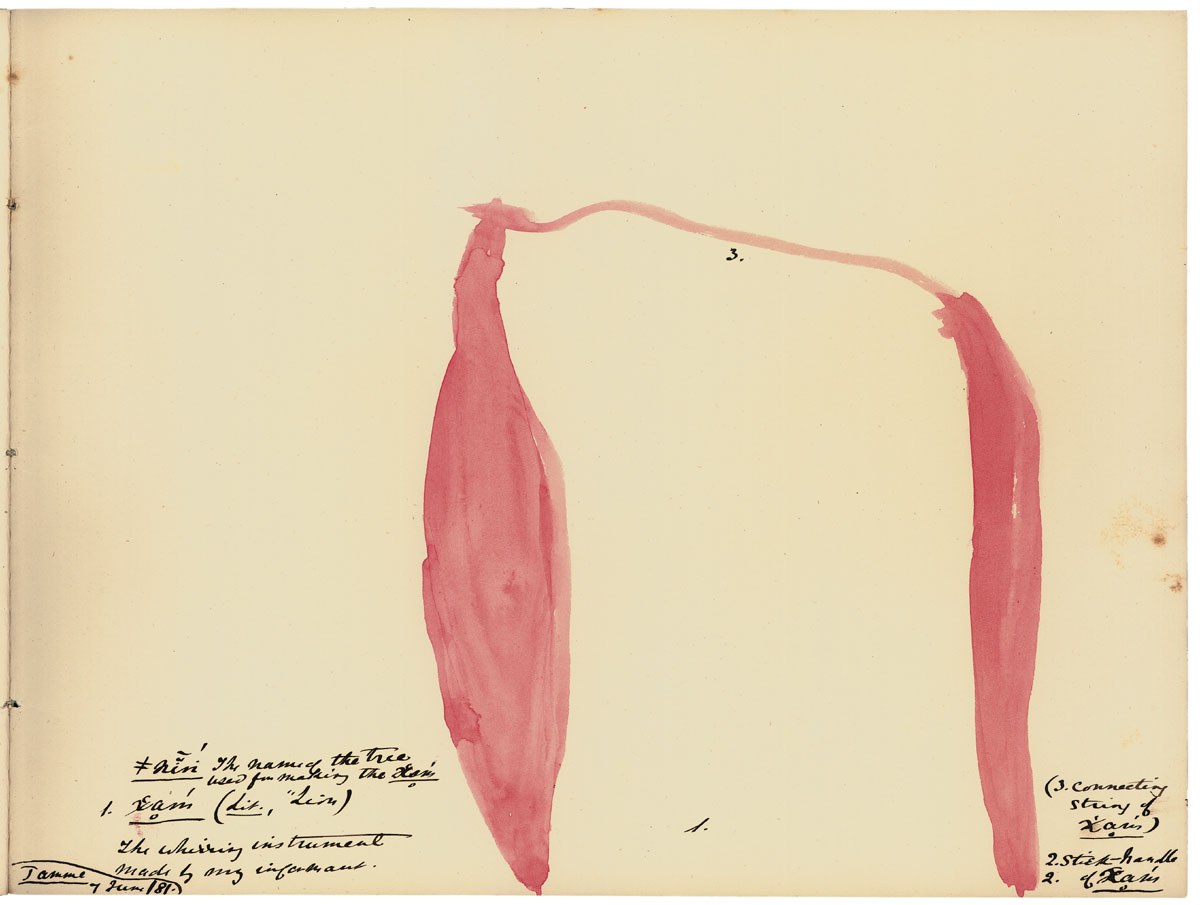
Xam; !ne
Source term: whirring instrument
Xam: "lion", the instrument's name in Tamme's 1881 watercolour. !ne: the respectful name used for the lion in place of xam, and the instrument's name in 1879. ǂnin: wild teak, Pterocarpus angolensis.
The !xun would rather not say the lion's name. Xam was avoided for fear of offending the animal, and the lion was called !ne instead; the whirring instrument carried both names. Sounded at night, it made so loud a noise that a lion answered, taking it for another lion, and then the players stopped. In 1879 two !xun boys from the Okavango, !nanni and Tamme, living far from home in Cape Town, said it was made from half of a large, sharp, flat seed-pod. Two years later Tamme made one from the wood of the ǂnin tree, the wild teak, and painted it in watercolour: a blade, a stick handle, the string between them, and above them the word Xam, 'lion'.
which makes such a loud noise, used at night, that the lion answers, believing it another lion
!nanni, Tamme and Lucy Lloyd, !kun notebook BC151 A2.1.109 (1879), quoted in du Toit 2024, p. 5
Particulars
- Object
- A whirring instrument made from half of a large, sharp, flat seed-pod (1879); in Tamme's 1881 watercolour, a wooden blade of ǂnin (wild teak) on a string from a stick handle.
Sources
- Tamme, watercolour 'Xam' (7 June 1881), Iziko SAMLB TaBook1_012, Digital Bleek and Lloyd View
- !nanni, Tamme and Lucy Lloyd, !kun notebook BC151 A2.1.109, p. 9042 (1879) View
- Magdaleen du Toit, 'Convening Context: Reading the Bleek and Lloyd !xun Collection Digitally', Journal of the Digital Humanities Association of Southern Africa 5(1) (2024), p. 5 View