No. SAFR-005
Doring River rock-art bullroarer players
South Africa · Cederberg · Doring River valley · Southern Africa
Sacred / spirit
Source term: bullroarer aerophones
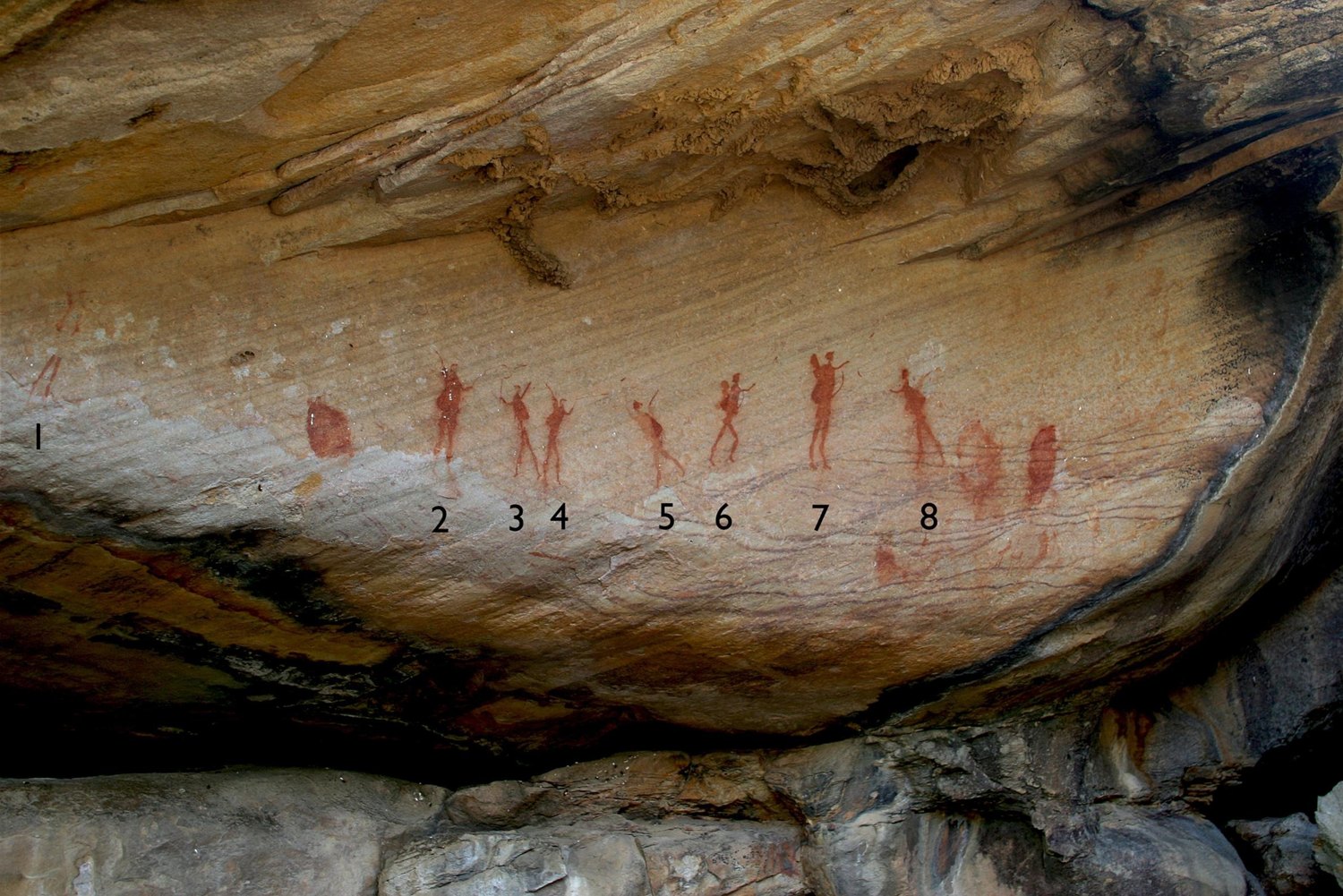
Eight ochre figures whirl bullroarers on a sandstone shelter wall in the Doring River valley. The panel, Neil Rusch and Sarah Wurz argue, combines two painting events, with the scene dating back at least two thousand years. They connect it to “working with rain”: acting on !Khwa, who in |Xam belief took shape as a cow, bull or eland. Ritual specialists captured this rain-beast, !khwa-ka xoro, and led it across the country so rain would fall wherever it went. Its leading thong rang like a bullroarer passing across the sky; later |Xam descendants also described the water bull as a snake. Dia!kwain drew that water-bull in May 1875, while Wilhelm Bleek and Lucy Lloyd recorded |Xam narratives at the Cape. The painting brings the roarer into the same effort to draw water to the arid Karoo.
The painting and the sound-making depicted is most likely related to 'working with rain', an intervention aimed at influencing !Khwa and the hydrology in the arid Karoo region.
Rusch and Wurz 2020, Journal of Archaeological Science: Reports 33:102511 (abstract)
Particulars
- Object
- Rock-art panel of eight human figures playing bullroarers.
- Function
- Group bullroarer playing in a rain-working rite.
Source
Neil Rusch and Sarah Wurz, Journal of Archaeological Science: Reports 33 (2020), article 102511; Neil Rusch, Cogent Arts & Humanities 3 (2016), 1233615, p. 5; Sullivan and Low, Arts 3 (2014), p. 226; Hoff 1998, pp. 111 and 121