No. KIRBY1934-001
Pedi kgabududu of girls' initiation
South Africa · Transvaal (Sekhukhuneland, Limpopo) · Southern Africa
Restricted
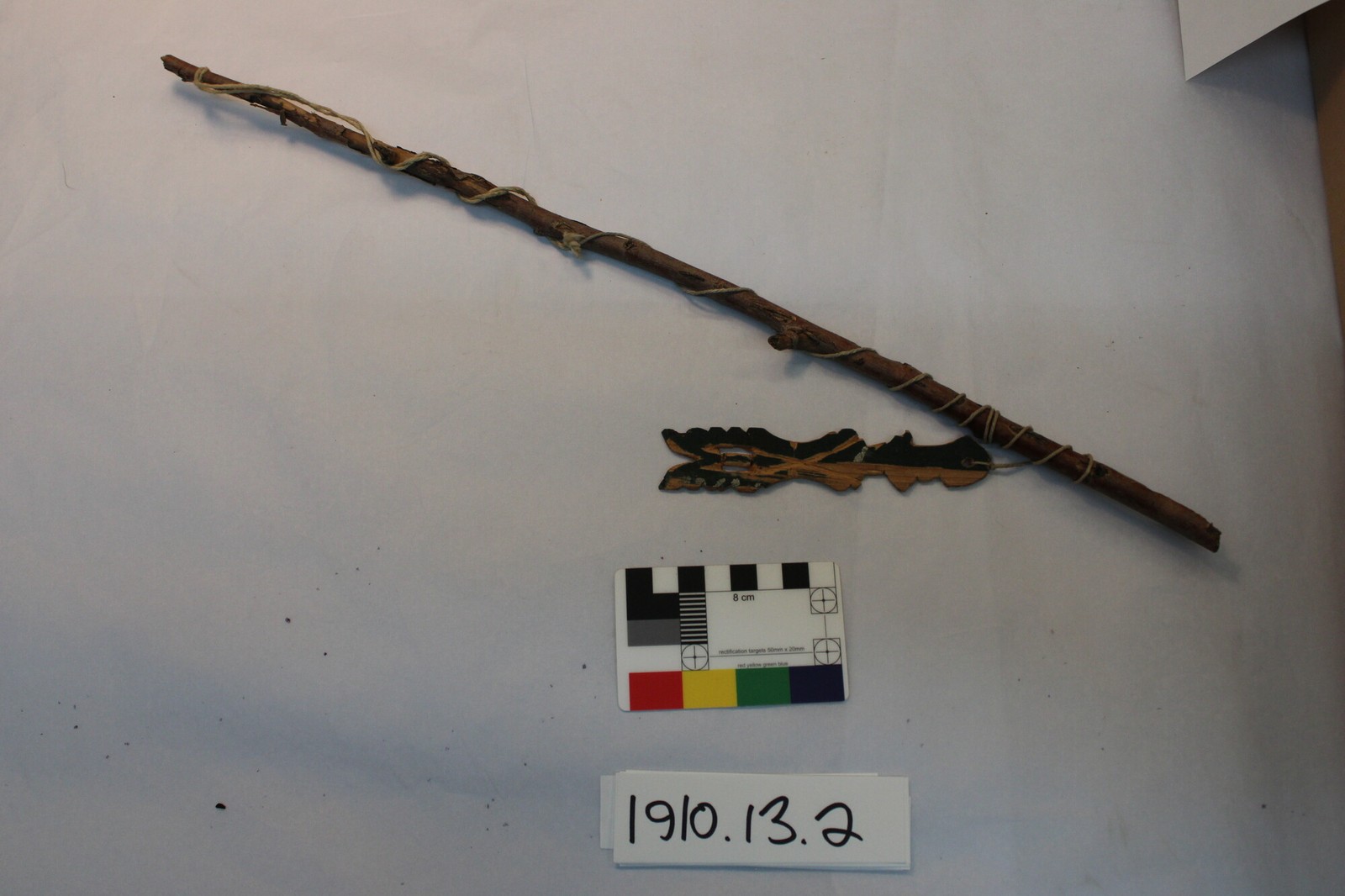
kgabududu / kgabudubudu
Source term: bull-roarer
kgabududu / kgabudubudu — Kirby’s Pedi bullroarer names; kgabubu — the name in H. O. Mönnig’s account of Pedi girls’ initiation (1967).
Among the Pedi the bullroarer had a place beyond play: it was used in girls' initiation. Their Molepo neighbours let boys and girls alike swing it as a toy. Kirby heard the Pedi names *kgabududu* and *kgabudubudu*: their rolling syllables belong to a southern African family that includes Korana *burubush*, Tswana *seburuburu* and Venda *luvuvu*.
The Pedi also make a bull-roarer, which they call kgabududu or kgabudubudu.
Kirby, Bull-Roarers and Spinning-Disks, p. 101
Particulars
- Object
- Pedi bullroarer, called kgabududu or kgabudubudu.
- Function
- Used in Pedi girls' initiation; a children's toy among the neighbouring Molepo.
Sources
- Percival R. Kirby, “Bull-Roarers and Spinning-Disks,” in The Musical Instruments of the Indigenous People of South Africa, 3rd ed. (Johannesburg: Wits University Press, 2013), p. 101. View · archived
- Johan Abraham van Schalkwyk, Die tegniese skeppinge van die Molepo van Thabamoopo (MA, University of Pretoria, 1985), p. 169, citing H. O. Mönnig, The Pedi (1967), p. 127. View · archived