No. SAFR-003
Ju|'hoansi and !Kung initiation bullroarers
Namibia · Tsintsabis · Oshivelo and wider Kalahari source chain · Southern Africa
Restricted
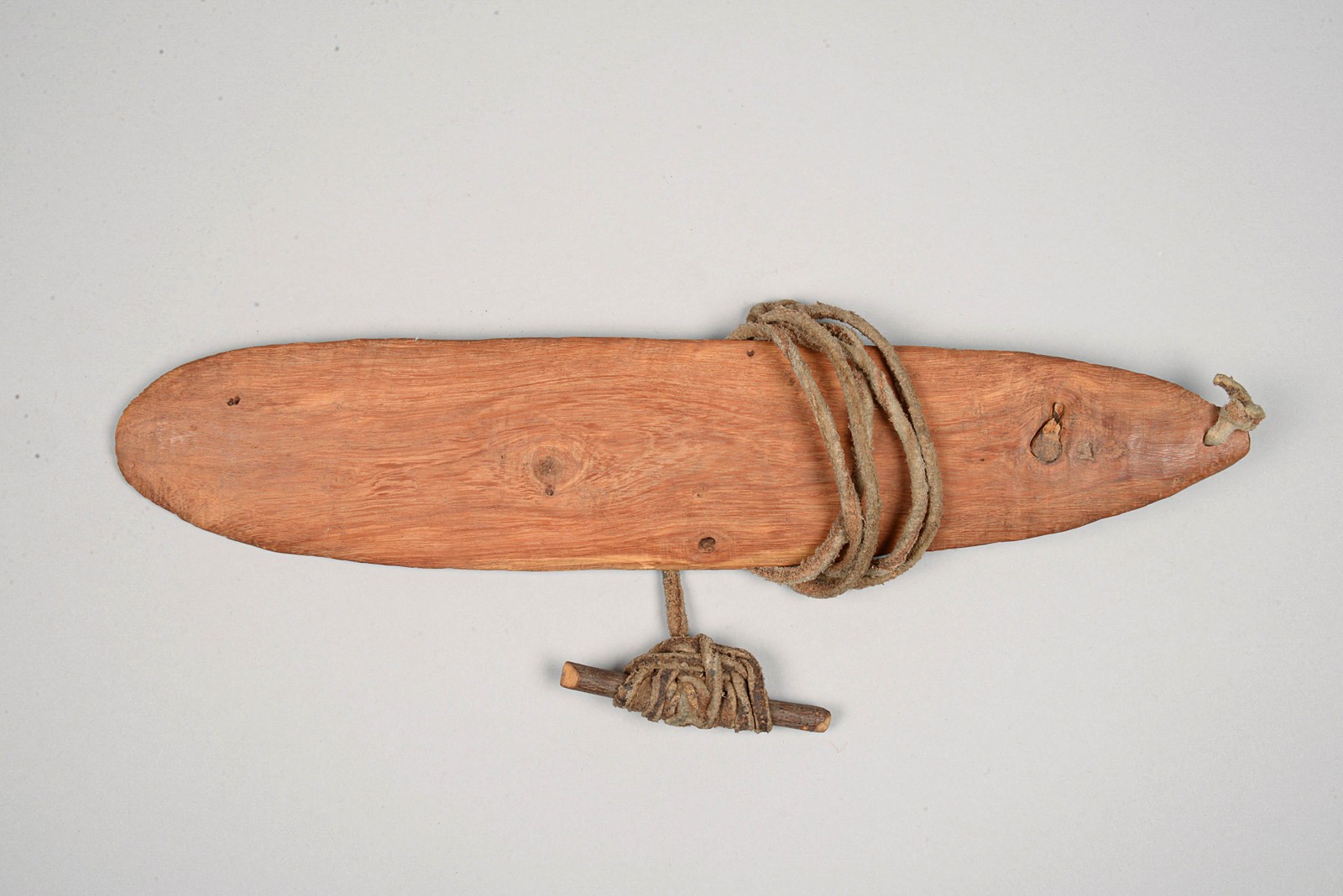
!xoe; n≠ àbí; !goin !goin
Source term: bullroarer
San names for the bullroarer across groups: !xoe (!Kung), n≠àbí, and !goin !goin (|Xam) — the |Xam whirring being identified with the buzzing of bees.
Among the Ju|'hoansi of the Namibian Kalahari, elderly men play the bullroarer in secret during male initiation and burn it when the rite is over; its sound is associated with the mythical creators. Among the !Kung the instrument is the !xoe, and when an old man sounds it at an initiation it indicates the presence of god. Further south the |Xam knew the bullroarer as the !goin !goin and put it to a more practical end: they beat it to drive bees, so that swarms would go to other people's places and honey could be cut and stored.
The people beat the !goiŋ!goiŋ in order that the bees may become abundant for the people, in order that the bees may go into the other people's places, that the people may eat honey.
Bleek and Lloyd 1911, Specimens of Bushman Folklore: 354–355 (transcribed in Kirby, Musical Instruments of the Indigenous People of South Africa)
Particulars
- Object
- Kumbani et al. summarize Namibian/Kalahari ethnographic records in which Ju|'hoansi and !Kung bullroarers are secret male-initiation instruments tied to mythical creators or divine presence.
- Function
- Elderly Ju|'hoansi men play a secret bullroarer during initiation and burn it afterwards; among the !Kung, !xoe at initiations marks divine presence.
Sources
- Kumbani, Bradfield, Rusch & Wurz, “A functional investigation of southern Cape Later Stone Age artefacts resembling aerophones,” Journal of Archaeological Science: Reports 24 (2019):693–711, pp. 695, 708 View
- Bleek and Lloyd, Specimens of Bushman Folklore (1911), pp. 354–355, transcribed in Kirby, The Musical Instruments of the Indigenous People of South Africa
- England (1995), via Mans and Olivier (2005), via Kumbani et al. (2019)