No. BATCH4-015
G|ui, the elders’ secret summons
Botswana · Central Kalahari Reserve · Southern Africa
Restricted
gíg/ù
Source term: bull-roarer
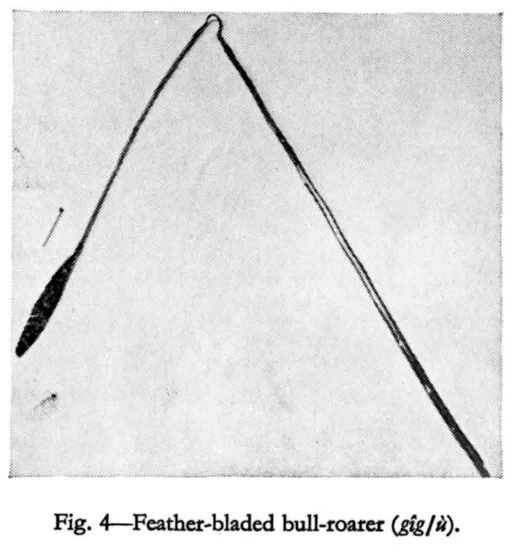
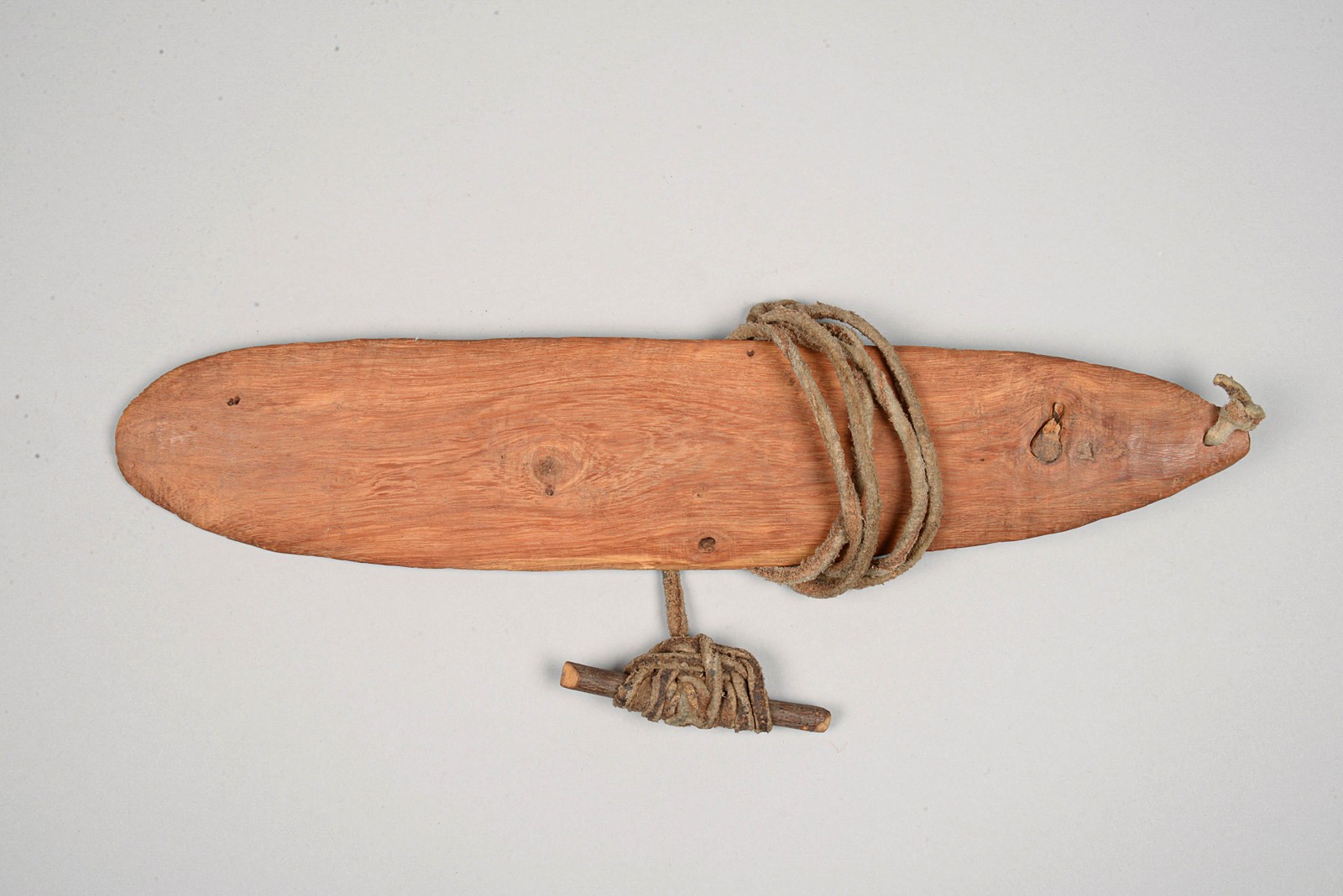
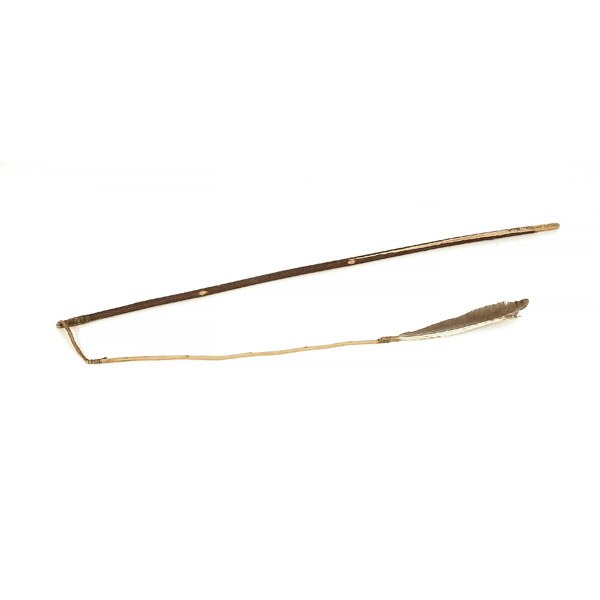
gíg/ù: Nurse's G/wi-G//ana name for the feather-bladed bullroarer, with high tone on the i. The Geneva museum labels its G/wi specimen g/ang/an.
A G|ui man who caught a kori bustard could roast it, hide it in a tree, then slip out at night as though going to the toilet. He lit a little fire and swung a bullroarer: the old men understood and ran through the darkness to eat. Kireho told Kazuyoshi Sugawara this secret summons belonged to horoha, a men’s initiation whose name meant having the bustard’s crest. Sugawara and Jiro Tanaka arranged a reenactment in 1984. Children had bullroarers too. G. T. Nurse watched G/wi and G//ana boys whirl a rotor tipped with a trimmed korhaan tail feather while girls and boys clapped, hummed or sang. The adults found his wish to buy one ridiculous: these were children’s things, though men made them.
A bull-roarer ... was played only by young boys. It was capable of being whirled around in several different rhythms.
Nurse, African Music 5.2 (1972), p. 26.
Particulars
- Object
- A slender 30 cm handle with about 5 cm of free leather lace and a thinner 15 cm rotor tipped with a carefully trimmed korhaan tail feather.
- Function
- Children's rhythmic toy among the G/wi and G//ana; among the G|ui, a secret signal of the men's horoha initiation, calling elders to a kori-bustard feast.
Sources
- Kazuyoshi Sugawara, “The Emergence of the Past in ‘Now-and-Here’ through Narratives: Discourse Analysis among the G|ui Foragers,” Intercultural Communication Review 13 (2015), pp. 7-20, at pp. 13-15
- G. T. Nurse, “Musical Instrumentation among the San (Bushmen) of the Central Kalahari,” African Music 5(2) (1972), pp. 23-27, at p. 26, fig. 4 View
- Musée d'ethnographie de Genève, ETHMU 040238