No. GUENTHER1986-001
Naro (Nharo) hisi — //Gauwa's voice at initiation
Botswana · Ghanzi farm block, Ghanzi District (Bechuanaland Protectorate at the time of the earlier reports) · Southern Africa
Restricted
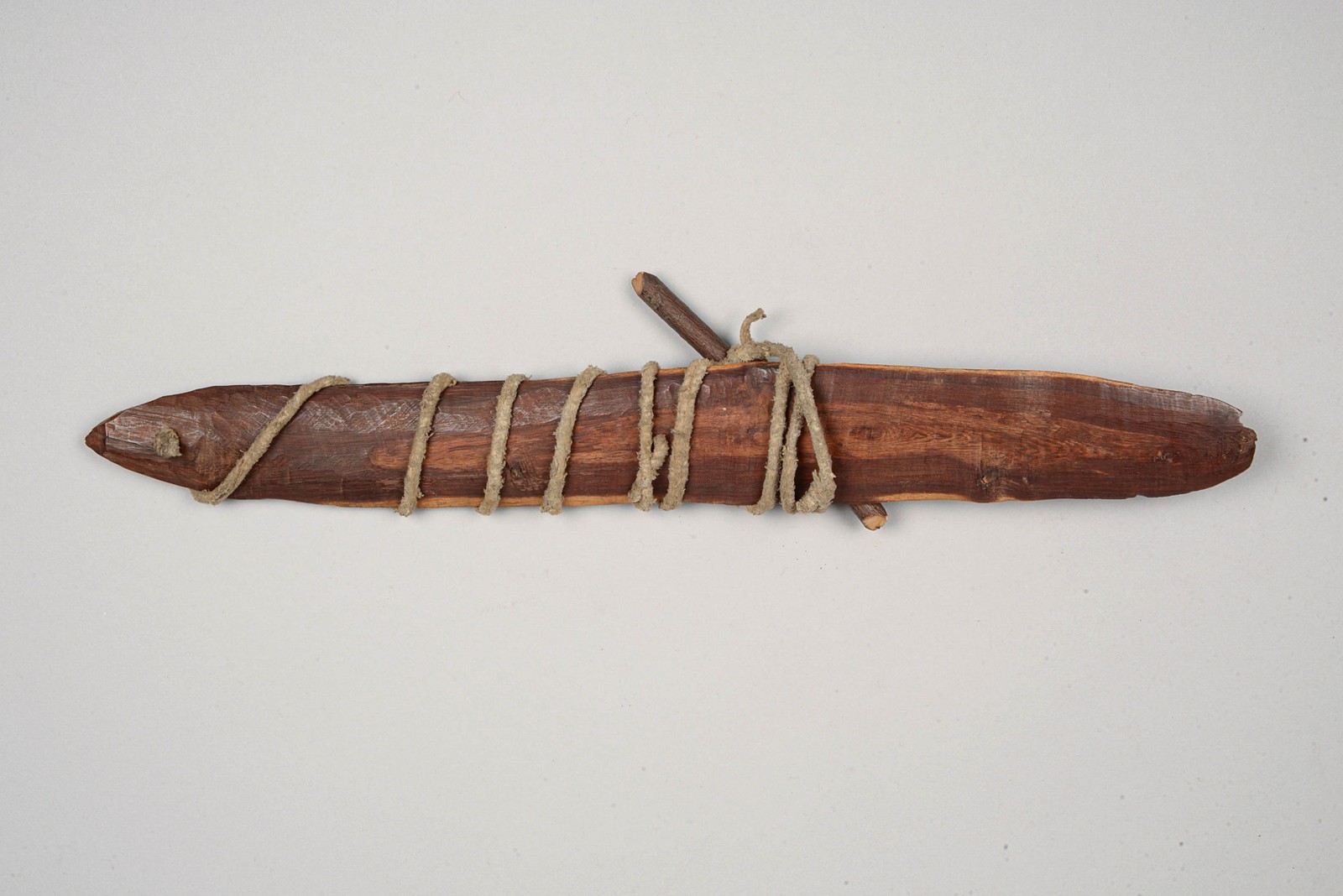
Hisi
Hisi: the Naro name for the bullroarer, recorded from Guenther's 1986 Nharo ethnography. In Dorothea Bleek's 1921 Naron notebook the instrument whirled at the marking dance is written !gõin!gõin, the bullroarer word also known from southern San.
Naro boys came out of initiation having met a god who was never there. The old men waited until dark, whirled a bullroarer somewhere out in the veld, and let the sound stand for //Gauwa — the trickster who works the bush, the counterpart of Hise the sky-maker — or for Hise himself. Then they walked the boys out to a small grass hut, built in secret by one of the elders, and told them it was //Gauwa's house. The instrument supplied the voice and the hut supplied the address: between them the initiands were given a god with a body, a residence and a reason to keep quiet about the men who had made both. And the trickster the old men conjured could, among the Naro, show up in female guise. An older Naron account joins the whirled voice to the marking of the body: an old man cut and burned a black mark into the forehead; there was a big dance, and they whirled the !gõin!gõin; a buck was killed, and more cuts followed.
the encounter with //Gauwa or Hise, whose presence the old (Nharo) men might simulate by whirring a bull roarer at night and leading the boys to a small grass hut one of the old men had secretly built out in the veld, and claiming that it was //Gauwa's house
Guenther, 'Tricksters and Trancers' (1999), citing Lebzelter 1934: 70 and Guenther 1986a: 277
Particulars
- Object
- Whirled bullroarer.
- Function
- Sounded at night by the old men during male initiation to simulate the presence of the trickster-god //Gauwa (or the sky-creator Hise) for the initiands.
Sources
- Mathias Georg Guenther, The Nharo Bushmen of Botswana: Tradition and Change (Hamburg: Helmut Buske, 1986), p. 277, via Guenther (1999) and Kumbani et al. (2019), table 2
- Mathias Georg Guenther, Tricksters and Trancers: Bushman Religion and Society (Indiana University Press, 1999), male-initiation section View · archived
- Kumbani, Rusch, Bradfield and Wurz, 'A functional investigation of southern Cape Later Stone Age artefacts resembling aerophones,' Journal of Archaeological Science: Reports 24 (2019): 693-711, table 2
- Viktor Lebzelter, Eingeborenenkulturen in Südwest- und Südafrika (Leipzig: Hiersemann, 1934), p. 70, cited by Guenther (1999)
- Dorothea Bleek, Auen and Naron notebook IV (1921), BC 151 A3.15, pp. 218v-219, Digital Bleek and Lloyd, University of Cape Town View
- Vibeke Maria Viestad and Justine Wintjes, 'Teaching Through Making: |xam and !xun Material Culture of the Bleek and Lloyd Collection,' Museum Anthropology 50(1) (2027), e70045, §1.3.6 View