No. SA-Z1953-009
Mehinaku upper-Xingu clubhouse bullroarer
Central Brazil · South America
Restricted
matapu
Source term: Schwirrgerät / Schwirrholz / bullroarer
matahu (var. matapu): the Mehinaku and Nahuqua name for the bullroarer; among the Mehinaku, Matapu is also the spirit of the hummer.
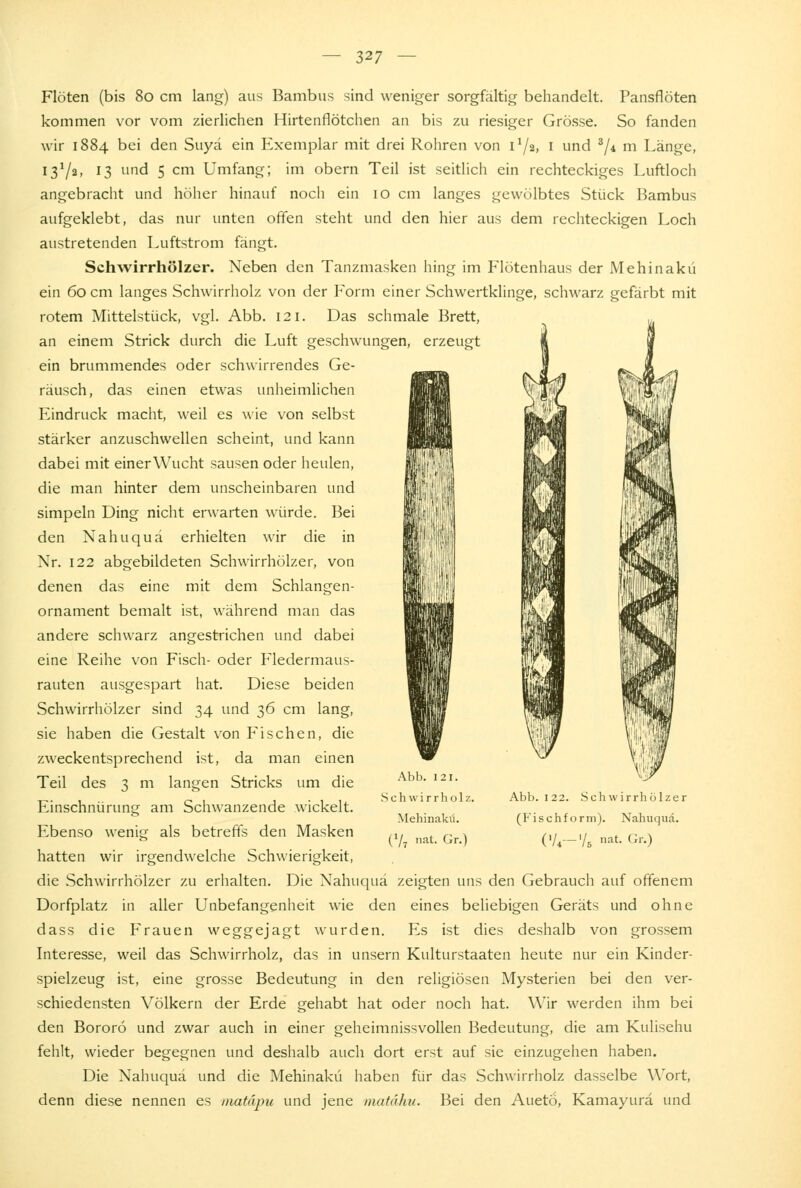
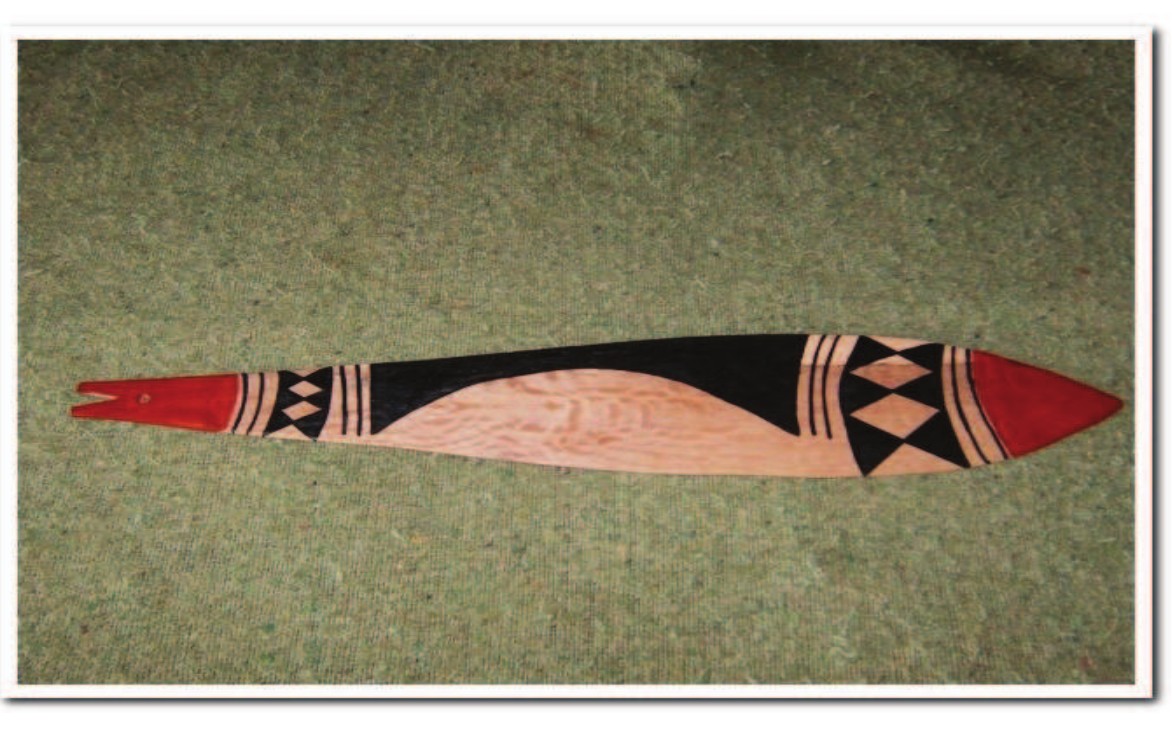
When Karl von den Steinen reached the Mehinaku on the upper Xingu during his second Brazilian expedition of 1887-88, he stepped into their flute-house and found, hung along a ladder-like rack beside twenty masks and a few straw pendants, a single bullroarer: sixty centimeters long, painted black and red, and shaped like a sword-blade. The Mehinaku and the neighboring Nahuqua called it matahu, or matapu; the Nahuqua instruments were carved in the shape of a fish and ornamented with the zigzag that stands for a snake. Von den Steinen noticed that no idea of secrecy clung to the thing — the masks and the bullroarer alike were handed over to him without hesitation, and among the Nahuqua the men whirled it openly on the village square without driving the women away — so that here, unlike on the Australian or New Guinea pattern, it was not a weapon hidden from the women. Among the upriver Bakairi the same kind of board went by yelo, their word for thunder, named (he was told) for its droning hum; and in later Mehinaku accounts the word matapu also names the spirit of the hummer, focus of a three-day ritual in which villagers make humming-boards, hang them in the men's house, and keep them at a distance from the women. Braida, living with the Mehinaku in the 2000s, recorded the rite the hanging board belonged to: at the pequi festival two men whirl the zunidores at once, a paired couple of spirit-fish whose wind-roar summons the Matapu, the river-master spirit. The boards are painted as named fish — walaku the piau, alapayakumã the bicuda, yuetsiniri the voadeira, puitxa the matrixã. Women may not see them being made, on pain of sudden death or wasting illness, and only when the boards stop turning do they hand over the roasted fish, mingau and beiju for the spirits' feast.
Das schmale Brett, an einem Strick durch die Luft geschwungen, erzeugt ein brummendes oder schwirrendes Geräusch, das einen etwas unheimlichen Eindruck macht, weil es wie von selbst stärker anzuschwellen scheint, und kann dabei mit einer Wucht sausen oder heulen, die man hinter dem unscheinbaren und simpeln Ding nicht erwarten würde.
The narrow board, swung through the air on a cord, makes a humming or whirring noise that leaves a somewhat uncanny impression, because it seems to swell louder as if of its own accord; and it can whiz or howl with a force one would never expect from so plain and simple a thing.
von den Steinen 1894:327
Particulars
- Function
- Sacred Matapu instrument of the pequi festival: whirled in pairs to summon the river-spirit whose voice it is; its making is hidden from women on pain of sudden death or grave illness. Von den Steinen saw one hanging openly with the caiman masks in the flute-house in 1887.
Source
Karl von den Steinen, Unter den Naturvölkern Zentral-Brasiliens: Reiseschilderung und Ergebnisse der zweiten Schingú-Expedition 1887-1888 (Berlin: D. Reimer, 1894), pp. 81, 104, 307, 327-328; Roberta Garcia Anffe Braida, Objetos Mehinako: entre o rito, a retribuição e o mercado (PhD thesis, PUC-SP, São Paulo, 2012), pp. 176-181