No. WELCH2013-001
Potter Valley Pomo Thunder Ceremony bullroarer
United States · Potter Valley · Mendocino County, California · North America
Weather / fertility magic
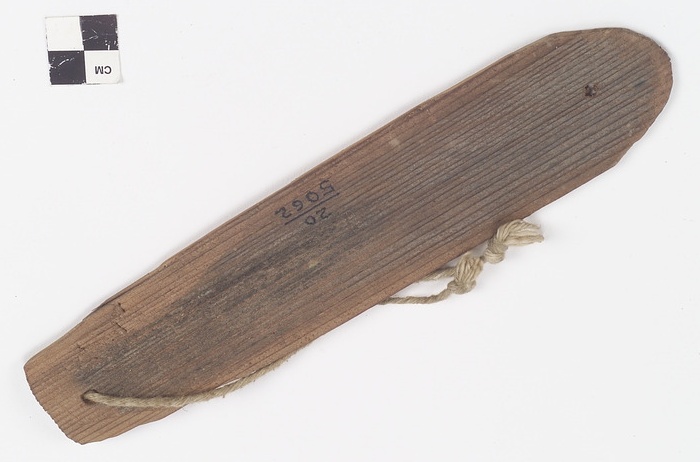
Source term: bullroarer / Thunder stick
A' la hai' tcil: Hudson's Northern Pomo name for the Thunder Ceremony, glossed by him as a ceremony for rain and praying; no separate local instrument name is given.
About May first, the Potter Valley Pomo gathered at dusk in the assembly house while four Thunder-stick wielders took position at the four cardinal points. At high priest Yum-ta's signal, the drummer sprang onto his foot drum and rolled it with his heels, the lightning-stick clapper struck a loud slap, and the bullroarers roared for about two minutes to draw the gods' attention. When the noise stopped, Yum-ta prayed for rain. Ukiah physician John Hudson, who married the painter Grace Hudson and then gave up medicine to study Pomo life, wrote down its name: A' la hai' tcil — Thunder Ceremony, or ceremony for rain and praying.
Northern Pomoans considered the sound to be the voice of the thunder deity.
James R. Welch, Sprouting Valley (2013), p. 159, after Loeb 1926
Particulars
- Object
- Wooden staves swung in circles to produce a thunderous sound; Northern Pomo bullroarers were made of manzanita, Fremont's cottonwood or oak, about 8 by 30 cm.
Source
James R. Welch, Sprouting Valley: Historical Ethnobotany of the Northern Pomo from Potter Valley, California (2013), p. 159; reconstructing John W. Hudson’s unpublished Potter Valley fieldnotes; comparative Loeb (1926)