Atlas Essay —
The Pattern Lowie Saw
In 1920 Robert Lowie said the bullroarer forbidden to women was one rite, carried round the world. A century later, counted in 977 cultures, the pattern holds.
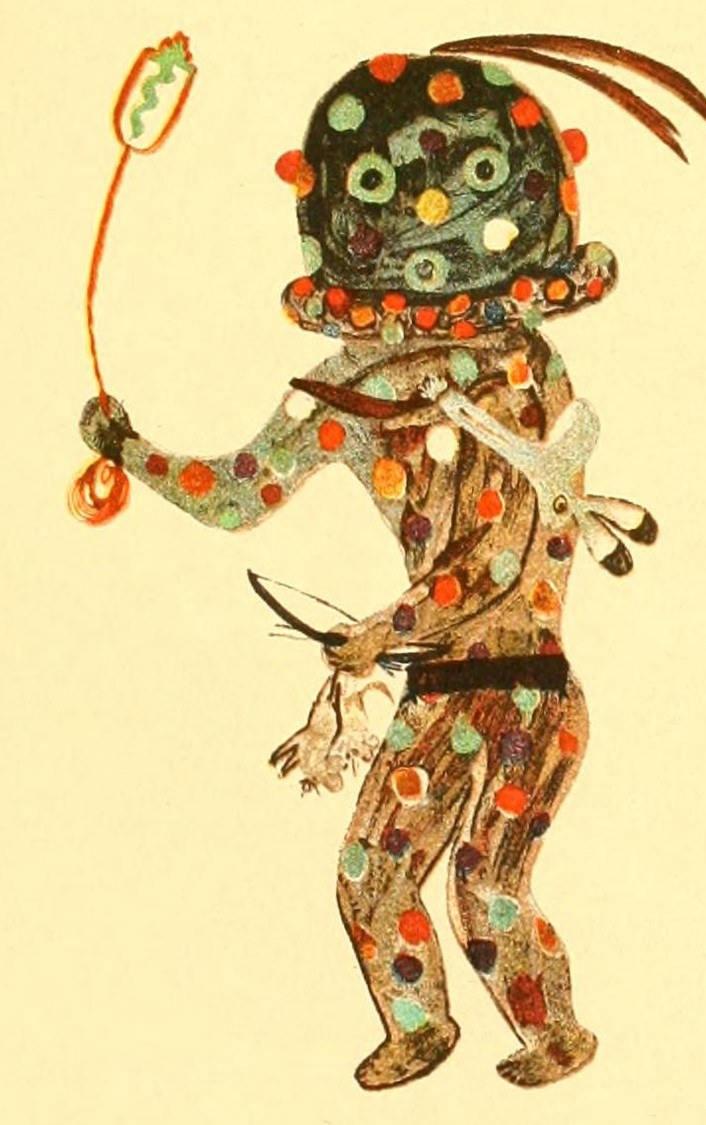
A hundred years ago Robert Lowie made a prediction he had no means of checking. The bullroarer that women are forbidden to see, he said, is a single rite that spread from one centre to Australia, Africa, Oceania and Brazil. He had a few dozen tribes and his own reading. This atlas has 977 cultures, each coded from its sources page by page, and the statistics to tell a pattern from an accident. The pattern he saw is there.
The pattern Lowie saw in 1920 holds. The ban on women, the boys’ initiation, the cut, the death and return, the spirit’s voice and the masked men are reported together 721 times across 977 cultures. Chance gives 583. The surplus stands on every continent where the secret bullroarer is found, and it stands across 38 language families. There are two bullroarers, an open one that people invent for themselves and a secret one that was taught and carried.
In brief
- Where the bullroarer is hidden from women (298 peoples), 69 in 100 sound it at initiation and 40 in 100 call it a spirit’s voice. Where it is open (259 peoples) the figures are 18 and 13, and three in ten know it as a toy.
- The surplus over chance appears separately in Africa (213 against 175), New Guinea and the Pacific (224 against 187), Australia (201 against 180), North America (51 against 18) and Latin America (24 against 14).
- It survives every check: one people drawn from each language family, first-hand reports only, and a chance model that holds fixed how well each people is documented.
- The six elements avoid the open bullroarer’s work. They turn up beside wind, rain, crops, hunting and play a quarter less often than chance allows.
- Nineteen peoples in New Guinea, Africa and Australia both stage the boy’s swallowing by a monster and tell the women and children that the roar is a monster eating boys. Chance gives fewer than five.

Lowie’s prediction
By 1920 the bullroarer had been argued over for forty years. Andrew Lang had said that any people with a stick and a string could invent it, and most anthropologists agreed. Lowie, a Vienna-born ethnologist at the American Museum who had lived with the Crow and watched Hopi priests whirl the thing in front of their women, answered that they were arguing about the wrong question.
But this is to mistake the problem. The question is not whether the bull-roarer has been invented once or a dozen times, nor even whether this simple toy has once or frequently entered ceremonial associations. I have myself seen priests of the Hopi Flute fraternity whirl bull-roarers on extremely solemn occasions, but the thought of a connection with Australian or African mysteries never obtruded itself because there was no suggestion that women must be excluded from the range of the instrument. There lies the crux of the matter.
Why do Brazilians and Central Australians deem it death for a woman to see the bull-roarer? Why this punctilious insistence on keeping her in the dark on this subject in West and East Africa and Oceania? I know of no psychological principle that would urge the Ekoi and the Bororo mind to bar women from knowledge about bull-roarers and until such a principle is brought to light I do not hesitate to accept diffusion from a common center as the more probable assumption.
Robert H. Lowie, Primitive Society (1920), p. 313
Lowie had sorted the world’s bullroarers into two piles with one test: may a woman see it? Nine years later his Berkeley colleague Edwin Loeb went through every initiation rite in the literature and reported what lay in the second pile beside the ban.
Nor does the bullroarer travel alone in connection with male initiation rites. This paper has demonstrated the fact that a form of tribal marking, a death and resurrection ceremony, and an impersonation of ghosts or spirits is found among male tribal initiation rites as the usual concomitants of the bullroarer. There is no psychological principle involved which would necessarily group these elements together, and they therefore must be regarded as having been fortuitously grouped in one locality of the world, and then disseminated as a complex.
Edwin M. Loeb, Tribal Initiations and Secret Societies (1929), p. 285
Six things, then: the ban on women, the boys’ initiation, a death and return, a mark on the body, a spirit’s voice, and men dressed as spirits. Lowie and Loeb said these travel together because they were carried together. That is a claim about numbers, and neither man had the numbers. For 977 peoples, everything the bullroarer is said to do is now on record in this atlas with its page, and the map above shows the ones named here.
The count, a century later
Sort the 977 by Lowie’s test: may a woman see it? For 298 peoples the sources say that the bullroarer is kept from women or from the uninitiated. For 259 others they describe one or more of the uses below and no such restriction. Set the two side by side and ask what else the sources report.
| What the sources report | Where it is hidden (298 peoples) | Where it is open (259 peoples) |
|---|---|---|
| Sounded at boys’ initiation or a secret society | 69% | 18% |
| The roar is a spirit’s voice | 40% | 13% |
| A mark on the body: circumcision, a tooth, scars | 32% | 8% |
| Masked or painted men as spirits | 15% | 4% |
| The boy dies and returns | 13% | 3% |
| A toy | 5% | 29% |
| Brings or stops the wind | 1% | 11% |
| Brings rain | 3% | 10% |
| Hunting and fishing luck | 2% | 7% |
| Crops | 8% | 14% |
The table turns over after the fifth row. Above the turn is Loeb’s list, each line three to five times commoner where the bullroarer is hidden. Below it is the open bullroarer’s work, each line commoner where it is not. These are two instruments that happen to be made the same way.
A well-studied people has more of everything on record, and Australia is full of initiations whatever the bullroarer does. Both are easy to allow for. Count, pair by pair, how often two of the six elements are reported for the same people: 721. Then deal the reports out again at random, keeping the number of things known about each people and the number of times each element is reported on each continent. The random deal gives 583. The real world is a quarter denser, and the gap is ten times the spread of the random deals.
| Region | Elements reported together | By chance |
|---|---|---|
| Africa | 213 | 175 |
| New Guinea and the Pacific | 224 | 187 |
| Australia | 201 | 180 |
| North America | 51 | 18 |
| Latin America | 24 | 14 |
| All 977 peoples | 721 | 583 |
Each region shows the surplus alone. It is largest in North America, where the secret bullroarer is rare and the open one everywhere, so that the few peoples who hide it, the Pomo and their Californian neighbours and the Kwakwaka’wakw, stand out with nearly the whole package at once.
Neighbours copy each other and cousins inherit alike, so draw one people at random from each of the world’s language families and count again. The surplus rises to a third. Peoples with three or more of the six elements come from 38 different language families. Throw out every later summary and keep only what the first witnesses printed: 613 reports together against 487 by chance. And the six elements keep away from the open bullroarer’s work. They turn up beside wind, rain, crops, hunting and play a quarter less often than chance allows.
Across Europe and Asia the count finds no people at all who hide the bullroarer from women. There it scares birds, turns the weather and amuses children. Loeb saw this too; his only European case was the mysteries of ancient Greece. Europe is where the oldest bullroarers on earth have been dug up, and where the instrument has had longest to fall from god to toy; the bone record is laid out in The Original Spin.
The open bullroarer
Behind the right-hand column of that table are peoples like the Hopi, the ones Lowie set aside. Fewkes, who recorded the Hopi Flute ceremony at Walpi, wrote that the priest “sounds his whizzer — to imitate the thunder which accompanies the rain.” Captain John Bourke had been told the same at the Snake Dance in 1881: “by making this sound they compelled the wind and rain to come to the aid of the crops.”
South of the Hopi, in the Sonoran desert, the Norwegian explorer Carl Lumholtz was shown the bullroarer of the Tohono O’odham harvest feast in 1910. The note had to be right. It “should be deep, in imitation of the thunder, which brings rain; if the sound is shrill, lightning only will follow.” The same blade called the people together and told them when the meeting was over.
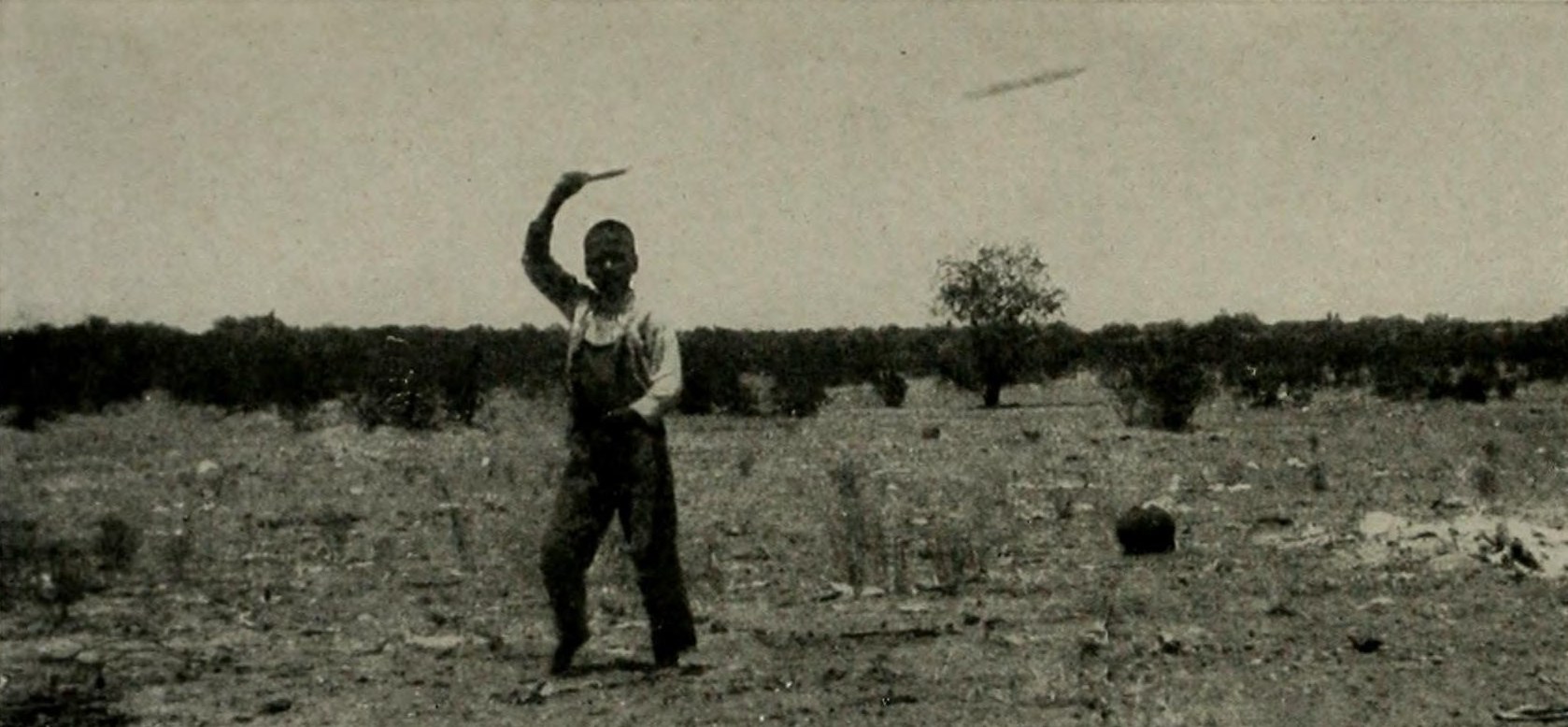
Go north and the work changes with the weather. Among the Northern Paiute of Surprise Valley in California, “a man whirls a bullroarer to bring a warm wind to melt the snow,” and the thing is “a boy’s toy as well as a magical device.” The Ktunaxa of the Rocky Mountain trench use it to call the Chinook wind. Across the Pacific the Ainu of Hokkaido whirl it for “a favourable wind” and “for hunting deer.” In Aberdeenshire it was the thunner-spell, a slat of deal that boys swung to keep the thunder off and to frighten the cattle. In the Ethiopian highlands the Amhara swing it “to scare birds away from seeds and mature crops.”
On Mabuiag in the Torres Strait, between Australia and New Guinea, Alfred Haddon found the open bullroarer at full strength. Before the canoes went out for turtle “the men took a bull-roarer from the agu and swung it over the canoe.” Men “went round the garden swinging the bull-roarers to make the plants in the garden grow.” And when the catch was good a lookout on the hill told the village: “he whirled a small bull-roarer and the women knew the fishers had been lucky.” Here the roar is a message to the women.
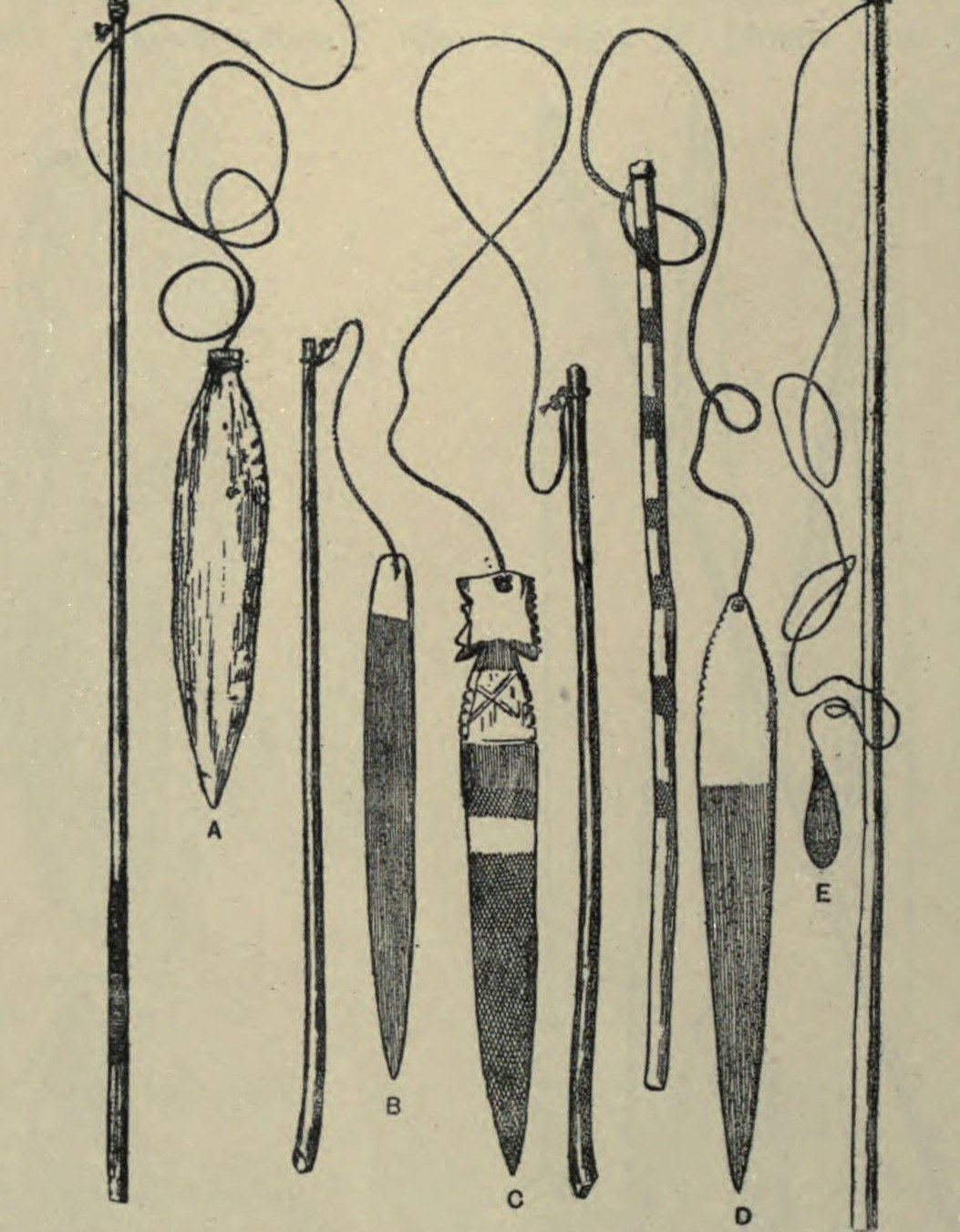
Every one of these peoples takes the bullroarer seriously. None hides it. And none of them cuts a boy, kills him in play, or dresses a man as a ghost when it sounds.
The secret bullroarer
Behind the left-hand column is the rite Lowie meant, the same on each continent.
Australia. Among the Wiradjuri of New South Wales the surveyor R. H. Mathews recorded the boys’ school, the Burbung, in the 1890s. “The sound of the bullroarer represents his voice,” the voice of Dhurramoolan, and the women were to go on believing “that he came and took the boys away and burnt and resurrected them.” Among the Wiradjuri of the Riverina, A. W. Howitt recorded, an old man jerked out each boy’s front tooth with his own teeth. Mathews’s boys “were cautioned against revealing anything connected with the secret ceremonies to the women or uninitiated on pain of death.” Fifteen hundred kilometres to the north-west, among the Arrernte of Central Australia, Baldwin Spencer and Frank Gillen found the blades “never allowed to be seen by women or uninitiated men,” and at the cutting “the bull-roarer sounds in the darkness all round the ceremonial ground.” Their neighbours the Anmatyerr gave the reason the women were told: “Both women and children believe that in some way Twanyirika kills the youth and later on brings him to life again.”
New Guinea. On the Tami Islands, in the Huon Gulf on the north-east coast of Papua New Guinea, the missionary Georg Bamler wrote in 1911 that “the whirring of the bullroarer is taken as the roaring of Kani,” that Kani “must swallow the boy,” and that the circumcision wound “is therefore called Kani’s tooth.” A man who betrayed the secret faced “the terrible punishment” of death. Five hundred kilometres west, on the Sepik River, the Iatmul bullroarer is the crocodile’s voice; “crocodile spirits were said to consume neophytes,” the initiators “sliced neophytes with bamboo blades,” and a masked figure bullied the boys. Inland from the south coast, among the Marind of the upper Bian, the rule ran: “Should a woman or child by accident see a man’s ezam, the owner is obliged to kill that woman or child.”
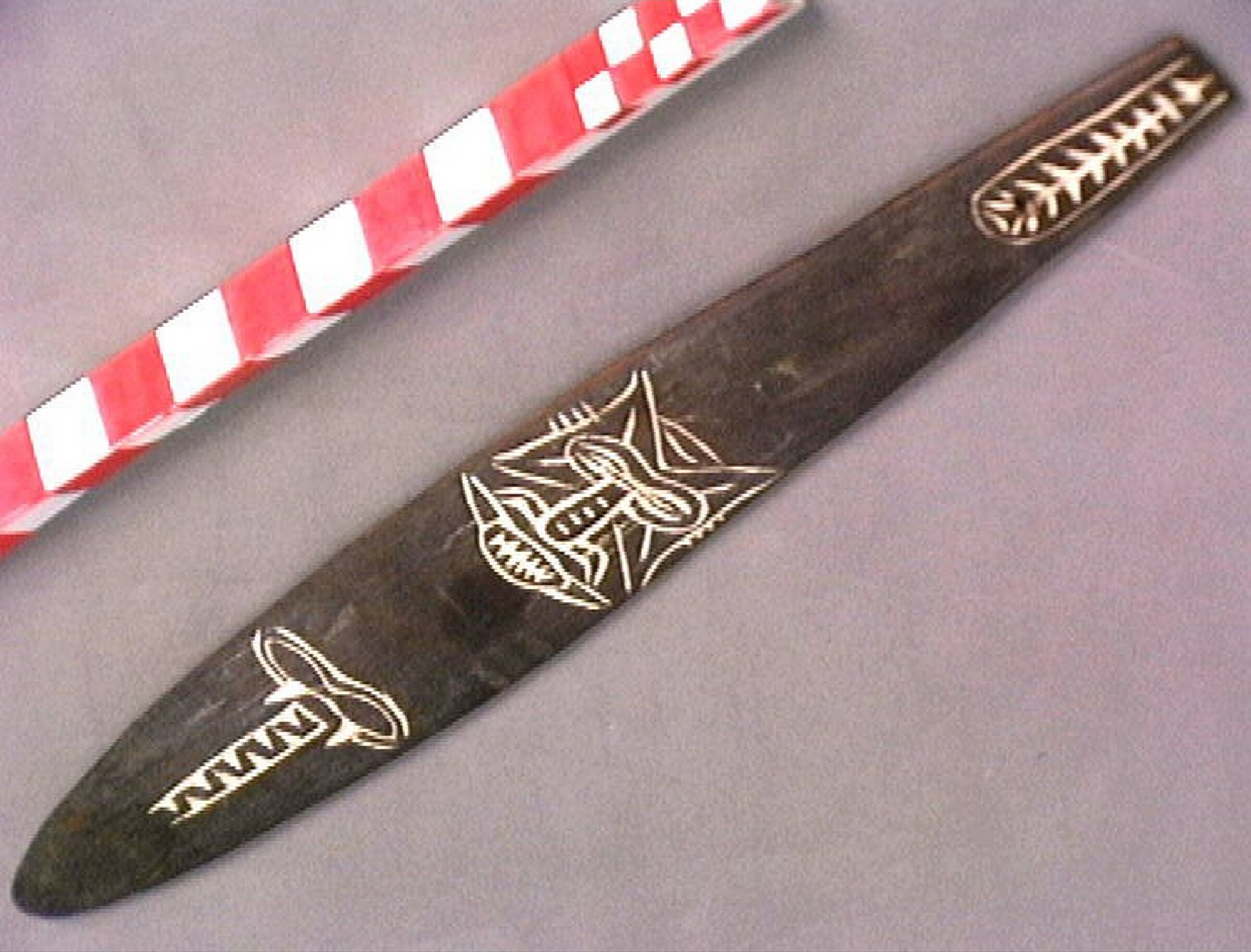
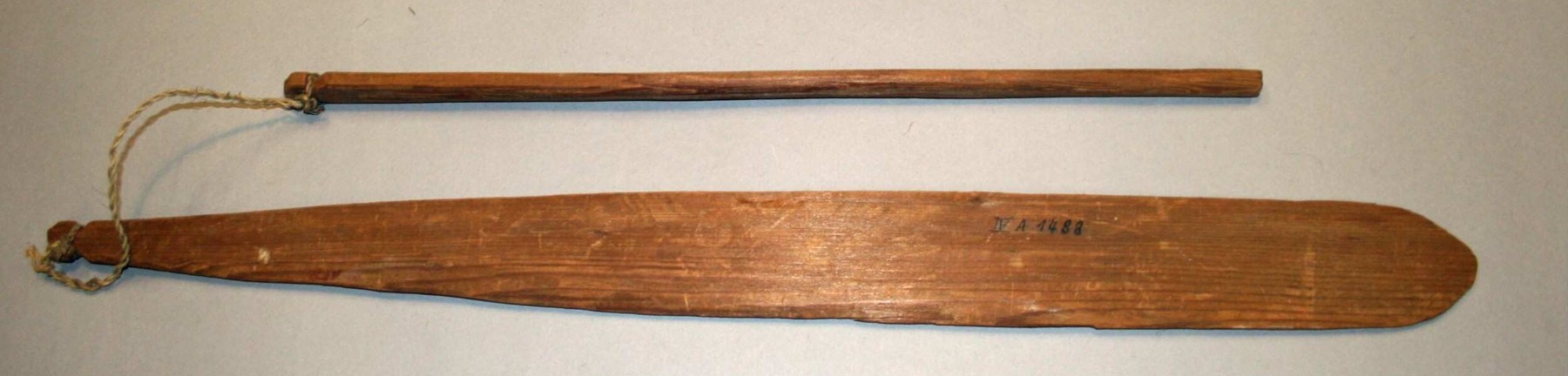
Africa. In the Liberian forest the Dan and their neighbours told George Schwab, recording for Harvard’s Peabody Museum, about the devil of the Poro bush: “He talks in a heavy voice. He uses a bull-roarer.” His colleague is “the cutting devil, the one who cuts the boys in the Bush,” and a boy may die “when the devil ‘eats him.’” Four thousand kilometres east, in the Ituri forest of the Congo, the priest Paul Schebesta recorded the Nkumbi of the Mbuti. “In the Nkumbi the initiates are made acquainted with the bullroarer.” The man who circumcises them “represents Endekoru, the first ancestor; he wears a mask before his face, his body is wrapped in a robe of leaves.” The boys are bound to silence, “above all toward the women. If a curious woman is caught spying on the Nkumbi, she is killed.”
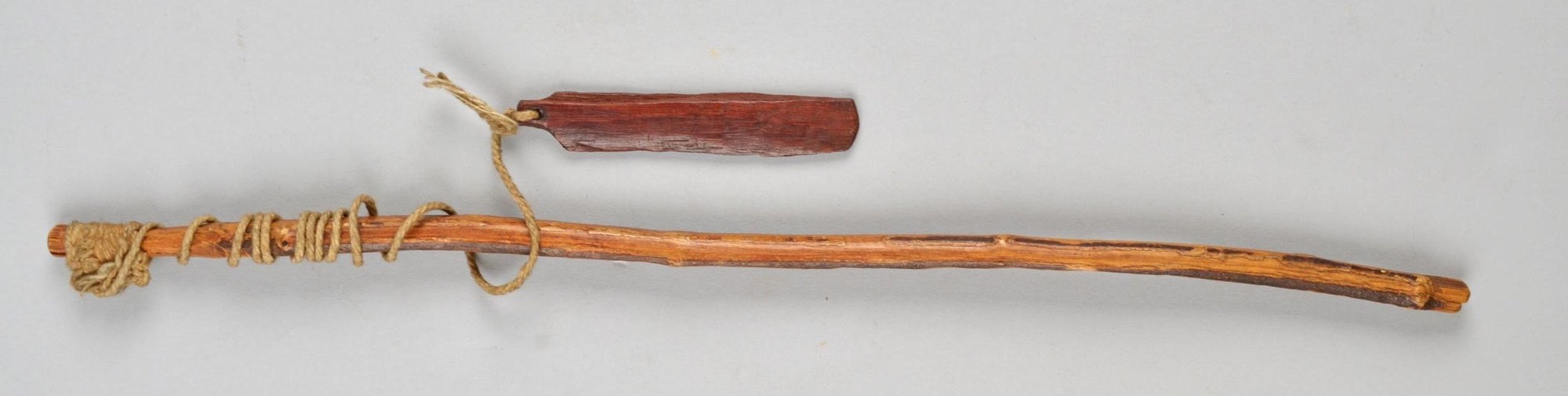
North America. Among the Pomo of northern California the bullroarer was “the voice of Makila,” Thunder man. “Women and children not allowed to see.” Loeb himself recorded the ghost house where the boys “were covered with straw and remained as though dead.” In the Pomo secret school the pupils had their noses and ears pierced, and ghosts striped red, black and white ran in whirling the blades. On the coast of British Columbia, in the winter ceremony of the Kwakwaka’wakw, Franz Boas, working with the Kwakwaka’wakw writer George Hunt, set down how it was done: “a number of men secretly climb the roofs of the houses of the village,” and the noise of their sticks “is supposed to be the voice” of the spirit “who comes to take away another novice.”
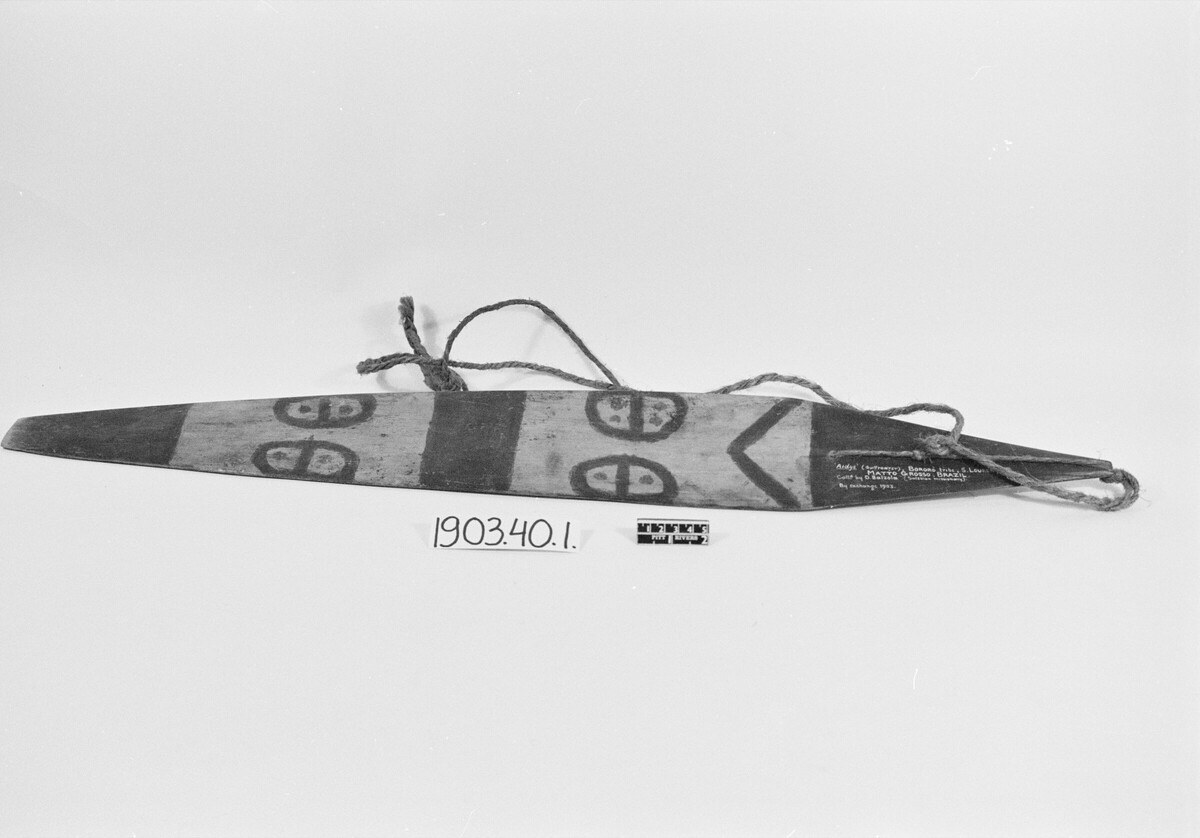
South America. Lowie’s own example was the Bororo of Mato Grosso in central Brazil. Their blades make “a hum which for the Bororo is like the cry of the aije itself,” a monster of the water, and boys who have reached puberty are initiated to it at the end of a funeral. At the Bororo village of Tadarimana an elder told the researcher Leila de Souza, in our own century: “Women couldn’t see it, only the men could see it.” On the upper Xingu, also in central Brazil, the Wauja women “are not permitted to see the matapu in motion,” and later in the same festival the men come into the village covered in leaves, shouting.
A tooth in New South Wales, a foreskin in the Congo, a pierced ear in California. A thunder being, a crocodile, an ancestor in leaves. The details are local. The frame is one frame.
What the mothers are told
A secret needs outsiders, and outsiders need to be told something. That much any secret society would arrive at. No secret society had to arrive at this.
Among the Yanyuwa of the Gulf of Carpentaria in northern Australia, Spencer and Gillen wrote in 1904, the women are told that the roaring “is the voice of a great spirit called Gnabaia, who has come to swallow up the boy,” and who “afterwards disgorges the boy in the form of an initiated youth.” In Arnhem Land, on the north coast, the Yolngu women were told, of the great python: “All the young boys have gone to-day; Julunggul has swallowed them up.” On the Huon Gulf the Kâte women heard that the roar was “a fearful spirit who has come to ‘swallow’ the boys,” and inside the rite a man “imitates the retching and spits the water down on the boy.” Their neighbours the Bukawa were to picture “an insatiably cruel monster that pitilessly swallows every boy,” and when it spits them out again “it bites or scratches them”: the circumcision.
In western Kenya a Gusii mother frightened a small child with it: “You come outside and I’ll give you to the Beast!” Of the boys in seclusion it was announced, “Enyabububu has vomited up the novices!” On the Angolan border the Kwanyama boys “and their mothers at home believed that its humming sound was the voice of a giant bird called edila which swallowed the candidates.” In Zambia the Ndembu women were told “a monster had come to swallow up their sons.” In the forests of Guinea the Kissi women knew it as “a great ferocious beast, fallen from the sky, that devours their children in the sacred forest.” Among the Ngbaka of the northern Congo the novices are told of “fabulous animals come to swallow them and then vomit them up as initiates.”
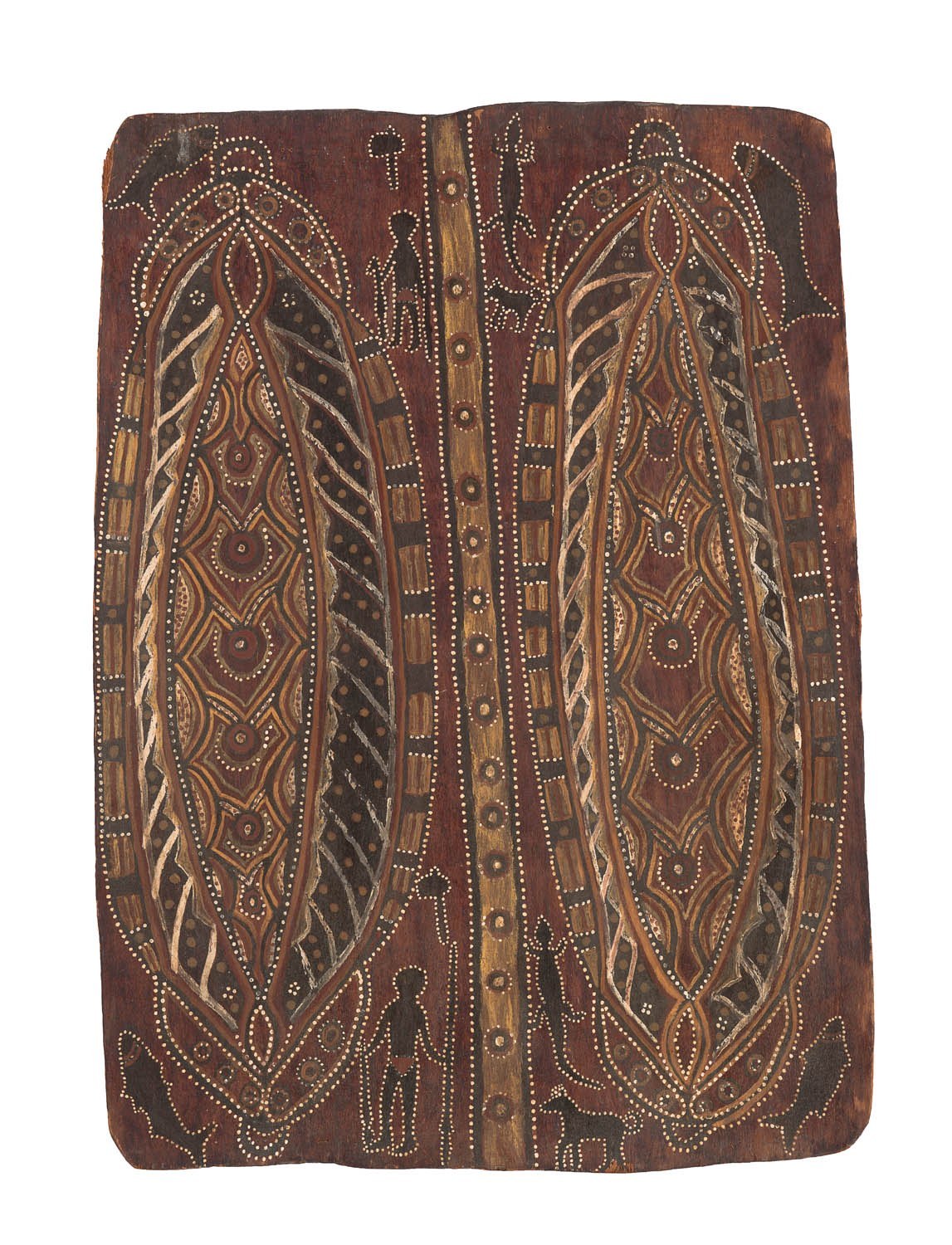
In the whole count, 26 peoples stage the boy’s swallowing and 29 tell the women and children that the roar is a being that eats or kills boys. If the two had nothing to do with each other, fewer than five peoples would have both. Nineteen do: nine in New Guinea, five in Africa, five in Australia. The bullroarer needs no monster to make its noise, and a monster needs no vomiting. Yet the Gusii of Kenya and the Kâte of the Huon Gulf, with the Indian Ocean between them, speak of the same swallowing, vomiting beast and then act it out on the boys. The atlas follows the swallower home in The House That Swallows Boys and The Teacher Who Eats Boys.
The rule that came with it
Lowie asked for a psychological principle that would make the Ekoi of Nigeria and the Bororo of Brazil bar women from the bullroarer, and promised to hold to diffusion until someone produced one. The principle on offer since has been that a noisy thing swung in the dark is frightening, and frightening things get used to frighten.
The open bullroarer answers that. It is just as loud on Mabuiag, on the Hopi mesas and in a Paiute winter, and nobody there thought to hide it, to kill for it, or to cut a boy under it. They thought of the weather. Left to themselves, people who own a roaring slat use it for wind and rain and give it to the children. That is the bullroarer human nature produces, and it is all over the map.
The secret bullroarer is something else: a set of instructions. Take the boys from their mothers. Tell the mothers a spirit has them, and that the roar is its voice. Let it kill the boys, or swallow them. Cut them, and call the cut its bite. Bring them back as men, show them the slat, and tell them that the woman who learns of it dies. The count finds the ban, the boys’ rite, the cut, the spirit’s voice and the masked men together in Africa, in New Guinea, in Australia and in both Americas, in 38 families of languages, in the first reports as in the last. It finds the swallowing and the bite running from Australia through New Guinea to Africa. And it finds all of it keeping clear of the weather magic that grows up wherever the bullroarer is left alone. Lowie called that diffusion from a common center on the strength of a few dozen tribes. With 977, it is the same answer.
Key sources
- Lowie, Robert H. 1920. Primitive Society. New York: Boni and Liveright, pp. 311–313; the passage quoted is on p. 313.
- Loeb, Edwin M. 1929. Tribal Initiations and Secret Societies. University of California Publications in American Archaeology and Ethnology 25(3): 249–288; the complex, p. 285.
- Fewkes, J. Walter. 1900. “Tusayan Flute and Snake Ceremonies.” 19th Annual Report of the Bureau of American Ethnology, pp. 999, 1011. Fewkes 1903, Hopi Katcinas Drawn by Native Artists, 21st Annual Report, p. 61 and pl. III. Bourke, John G. 1892. “The Medicine-Men of the Apache.” 9th Annual Report, p. 476.
- Lumholtz, Carl. 1912. New Trails in Mexico. New York: Scribner, p. 95.
- Kelly, Isabel T. 1932. Ethnography of the Surprise Valley Paiute. UCPAAE 31(3), pp. 177, 202. Messing, Simon D. 1957. The Highland-Plateau Amhara of Ethiopia, p. 440. Ray, Verne F. 1942. Culture Element Distributions XXII: Plateau, p. 184. Munro, Neil Gordon. 1962. Ainu Creed and Cult, p. 117.
- Haddon, A. C. (ed.) 1904. Reports of the Cambridge Anthropological Expedition to Torres Straits, vol. V, pp. 331, 332, 346. Gregor, Walter, in Gomme, A. B. 1898. The Traditional Games of England, Scotland, and Ireland, vol. II, p. 291.
- Mathews, R. H. 1896. “The Burbung of the Wiradthuri Tribes.” Journal of the Anthropological Institute 25, pp. 298, 311; Mathews 1898, p. 56. Howitt, A. W. 1904. The Native Tribes of South-East Australia, p. 586.
- Spencer, Baldwin & Gillen, F. J. 1899. The Native Tribes of Central Australia, p. 128; 1904. The Northern Tribes of Central Australia, pp. 343, 373, 497, 501.
- Berndt, Ronald M. 1951. Kunapipi. Melbourne: Cheshire, p. 41. Stanner, W. E. H. On Aboriginal Religion (2014 edition), p. 6.
- Bamler, G., Keysser, Ch. and Lehner, S., in Neuhauss, R. 1911. Deutsch Neu-Guinea, vol. III: Bamler on the Tami, pp. 494, 496; Keysser on the Kai, pp. 36, 38; Lehner on the Bukaua, pp. 405, 407.
- Szabó 2026, pp. 250–253, on the Iatmul waak as the crocodile’s voice. Silverman, Eric K. 2016. “The Waters of Mendangumeli.” Journal of American Folklore 129(512): 171–202, p. 179. Bateson, Gregory. 1936. Naven, p. 163 n. 1. Boelaars, J. 1953. Nieuw-Guinea, uw mensen zijn wonderbaar, p. 62.
- Schwab, George. 1947. Tribes of the Liberian Hinterland. Papers of the Peabody Museum 31, pp. 272, 279, 280.
- Schebesta, Paul. 1948. Die Bambuti-Pygmäen vom Ituri, vol. II, pp. 489–490.
- Mayer, Philip. 1953. “Gusii Initiation Ceremonies.” Journal of the Royal Anthropological Institute 83, p. 20. Loeb, Edwin M. 1948. “Transition Rites of the Kuanyama Ambo.” African Studies 7(1), p. 27. Turner, Victor. 1967. The Forest of Symbols, p. 231. Schaeffner, André. 1951. Les Kissi, p. 75. Omasombo Tshonda, Jean (dir.) 2013. République démocratique du Congo: Sud-Ubangi. Tervuren: MRAC, p. 134.
- Loeb, Edwin M. 1926. Pomo Folkways. UCPAAE 19(2), p. 340; 1932. The Western Kuksu Cult. UCPAAE 33(1), pp. 4–6. Gifford, E. W. & Kroeber, A. L. 1937. Culture Element Distributions IV: Pomo, p. 186.
- Boas, Franz. 1897. The Social Organization and the Secret Societies of the Kwakiutl Indians. Report of the U.S. National Museum for 1895, p. 610.
- Novaes, Sylvia Caiuby. 1994. “Aije — a expressão metafórica da sexualidade entre os Bororo.” Revista de Antropologia 37: 183–201, pp. 187, 195. Souza, Leila Aparecida de. 2014. Bakaru na comunidade indígena Bororo da Aldeia Central de Tadarimana. UFMG, p. 107. Mello, Maria Ignez Cruz. 1999. Música e Mito entre os Wauja do Alto Xingu. UFSC, p. 142. Piedade, Acácio Tadeu de Camargo. 2004. O canto do kawoká. UFSC, p. 98.