No. EA-AINU-001
Ainu rera-suyep wind-raising bullroarer
Japan · Hokkaido · Tokachi · East Asia
Weather / fertility magic
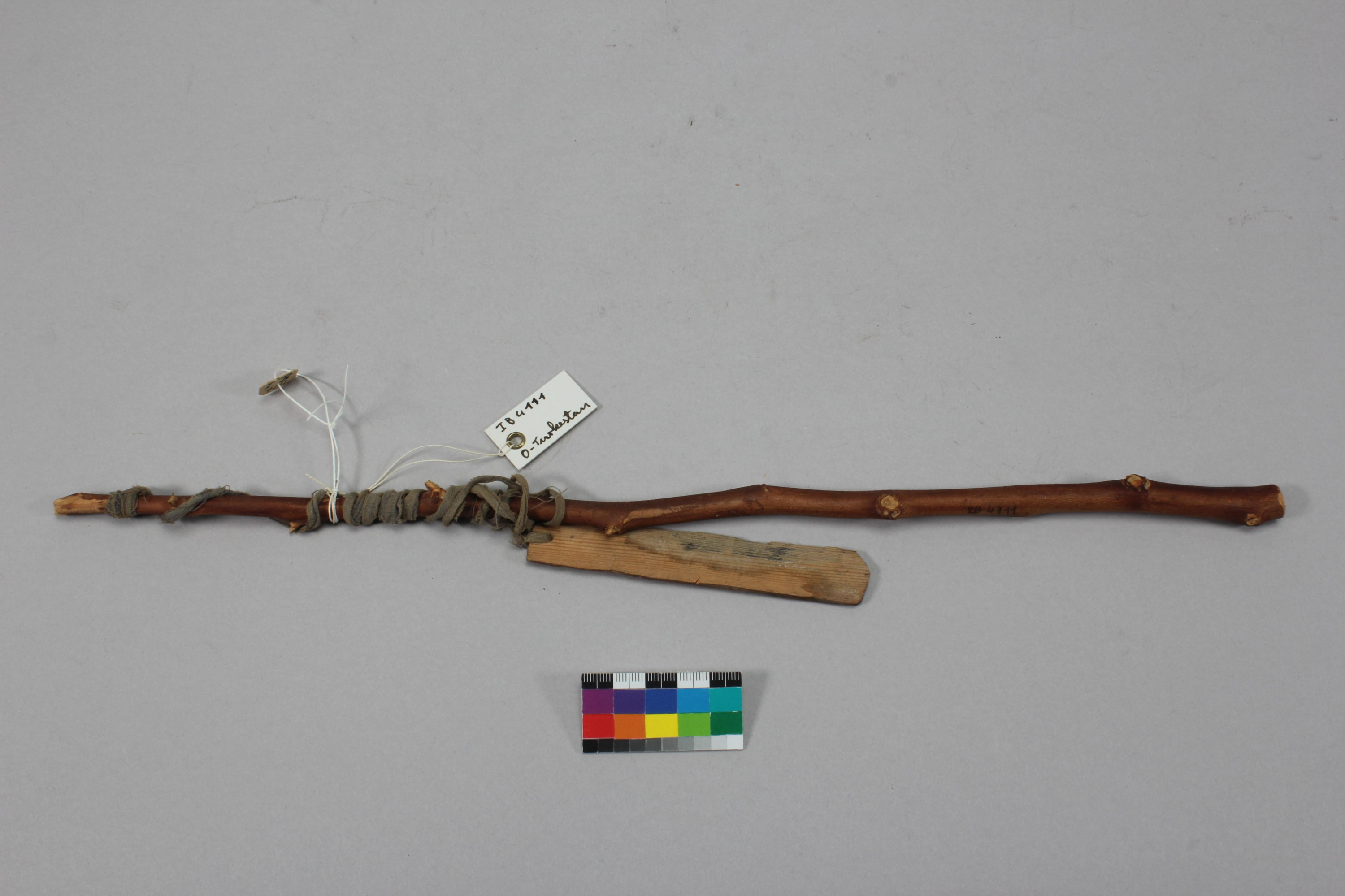
rera-suyep / rera suyep; Japanese gloss うなり板
Source term: レラ スイェプ (rera suyep); うなり板
rera-suyep: Ainu, literally "wind-swinger" (rera "wind" + suye "to swing/shake" + -p nominalizer); "wind-raiser" is Munro's functional gloss for its use in raising a favourable hunting wind. The spatula-shaped board was also likened to the attush-para (spatula).
Etymology. Ainu rera 'wind' + suye 'to swing/shake/sway' + -p (nominalizer): literally 'the thing swung/shaken in the wind' — a board sounded by being whirled (Japanese うなり板 unari-ita, 'roaring board'). It was swung in weather-magic to raise a favourable hunting wind, the sense behind Munro's older functional gloss 'wind-raiser.' (National Ainu Museum dictionary: suye 'to shake/swing/sway', cf. rérasuye 'to flutter in the wind'.)
When the Ainu of Hokkaido wanted a favourable wind for hunting deer, they swung a spatula-shaped board on a cord until it boomed. Neil Gordon Munro, the Scottish physician who spent decades in Japan and his last years in an Ainu village, saw one at Shiraoi in 1916 and judged it a bull-roarer; it looked like an attush-para, the Ainu spatula. Years earlier in northern Yezo he had come on a similar object called rera-suyep, the wind-raiser. When he described it to an aged woman, Tekatte Fuchi, she at once mimed the swing of the arm and made its sound, and recalled that as a child she and the other children were forbidden to swing a spatula lest they raise a storm; the same act was also said to arrest an epidemic. Munro's account met flat disbelief for half a century, until a report from Obihiro in Tokachi described the rite still remembered there: a cord tied to a stick, a hera-shaped board three to five shaku long — up to a metre and a half — at the cord's other end, and a swing that made a great noise, after which the wind would begin to blow.
At Shiraoi in 1916 I saw a magical device which produced a booming sound and so may be called a bull-roarer.
N. G. Munro, Ainu Creed and Cult (1962)
Particulars
- Object
- Spatula-shaped (hera) wooden board 3–5 shaku (roughly 90–150 cm) long, lashed by a cord to the tip of a stick and whirled; it made a tremendously loud sound, after which the wind was said to rise. Munro likened the form to the attush-para spatula.
- Function
- Wind-raising magic, worked for the hunt and in farm work; the same swing was said to halt an epidemic.
Source
N. G. Munro, Ainu Creed and Cult (1962); Hideo Fujimoto, 「うなり板のことなど」, Hikaku Minzoku Kenkyu 11 (1995): 1–3; N. A. Mamcheva, Mir muzyki ainov (2025), sect. 5.4.1.2, p. 493