No. HAD1898-001
Scotland thunder-spell bullroarer
United Kingdom · Scotland · Europe · British Isles
Weather / fertility magic
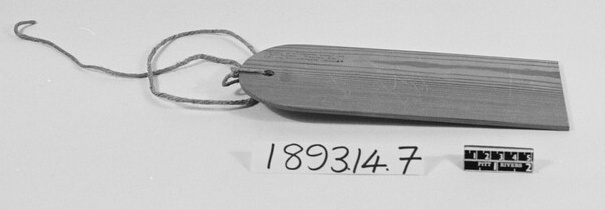
thunder-spell
Source term: thunder-spell / thunder-bolt
thunner-spell: north-east Scots name for the bull-roarer.
Etymology. A north-east Scots name for the bull-roarer, after its weather-charm use: it was whirled during thunderstorms to make the thunder cease or the thunderbolt miss. The "thunner" element is plain; "-spell" is undetermined — either "charm" or the Scots word for a thin shaving of wood (English "spill").
In the north-east of Scotland, when thunder rolled, boys took a thin slat of wood about half a foot long, bored a hole in one end, tied a few yards of twine through it, and whirled it round their heads to throw off a buzzing roar - in the belief that the thunder would cease, or that the thunderbolt would spare them. The minister-folklorist Walter Gregor set it down from first-hand observation in his 1881 Folk-Lore of the North-East of Scotland, naming it the "thunner-spell." In a fuller version of the entry that Gregor supplied to Alice Gomme's Traditional Games, he added that he had "used it with this intention" himself, at Keith; that herd-boys at Udny turned the same instrument to a blunter purpose, swinging it to terrify cattle into the byre; and that he had sent one specimen, in use at Pitsligo, to the Pitt Rivers Museum at Oxford. Haddon gathered the Scottish names "thunder-spell" and (in Aberdeen) "thunder-bolt" from this material in his Study of Man, alongside English and Irish forms.
During thunder it was not unusual for boys to take a piece of thin wood a few inches wide and about half-a-foot long, bore a hole in one end of it, and tie a few yards of twine into the hole. The piece of wood was rapidly whirled round the head, under the belief that the thunder would cease, or that the thunderbolt would not strike. It went by the name of "thunner-spell."
Walter Gregor, The Folk-Lore of the North-East of Scotland (1881), p. 153
Particulars
- Object
- Thunner-spell; Gregor's surviving Pitsligo specimen is a flat, very broad slat of deal, 265 mm long, rounded at one end and pierced there for the knotted string, squared at the other.
- Function
- Toy and weather charm; Haddon reports use during thunder-storms and by herd-boys.
Source
Walter Gregor, The Folk-Lore of the North-East of Scotland (London: Folk-Lore Society, 1881), ch. XXI, p. 153; Pitt Rivers Museum 1893.14.7 (Pitsligo)