No. MUS2026-012
Furfurcabue, whirled against evil spirits
Araucanía, Chile · South America · Southern Cone
Sacred / spirit
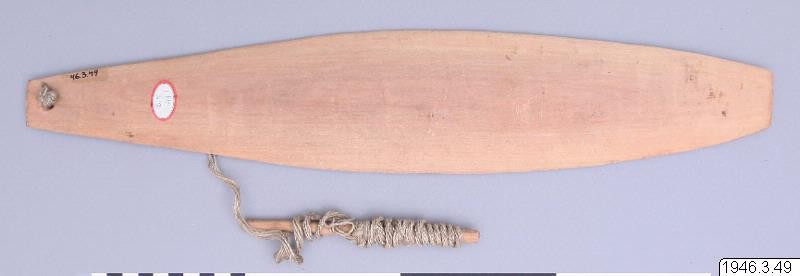
Furfurcabue
Source term: bull-roarer
farfarun (Mapudungun): the whirring/whistling noise made in the air by a whirled rod.
Bring it into the house and you would call up the huecufe, the evil one. Rodolfo Medina remembered his Mapudungun-speaking grandfather breaking the droning stick if a boy carried it indoors, because its whirr summoned him. Outdoors, the sound served to frighten malign spirits away. In the Temuco communities it was the wüf wüf, in Chilean Spanish the runrun. Around Lumaco, four or five boys of fourteen climbed a hill to sound thin alerce slats together; afterwards it rained, though they had not gathered to make rain. Medina also remembered scattering choroy parrots at sowing and harvest. In Chiloé, a long strap of huiro seaweed was whirled at midnight against the trauco: its noise was said to drive the woodland spirit mad.
Una especie de "run run" que era, o es, antes que un instrumento músico, un instrumento para espantar a los malos espíritus.
A kind of "run run" that was, or is, before being a musical instrument, an instrument for frightening away evil spirits.
Oreste Plath (1955), quoted in José Pérez de Arce, Música mapuche (2007), p. 294
Particulars
- Object
- Mapuche bullroarer in the Smithsonian's National Museum of Natural History. A second Mapuche blade at Harvard, acquired in 1909, is flat and perforated, of coligue wood, 38.1 x 2 x 0.4 cm, and labelled Furfurcabue, 'spun-round.'
Source
Smithsonian National Museum of Natural History, E325863-0; Peabody Museum, Harvard, 09-21-30/74707; José Pérez de Arce, Música mapuche (Santiago, 2007), p. 294, quoting Oreste Plath, 'Algunos aspectos de la tecnología araucana,' América Indígena 15 (1955); José Pérez de Arce, Sonidos de la América precolombina (2025), p. 1816