No. KELLY1932-001
Surprise Valley Paiute wind bullroarer
United States · Surprise Valley, northeastern California and Warner Valley, Oregon · North America · Great Basin
Weather / fertility magic
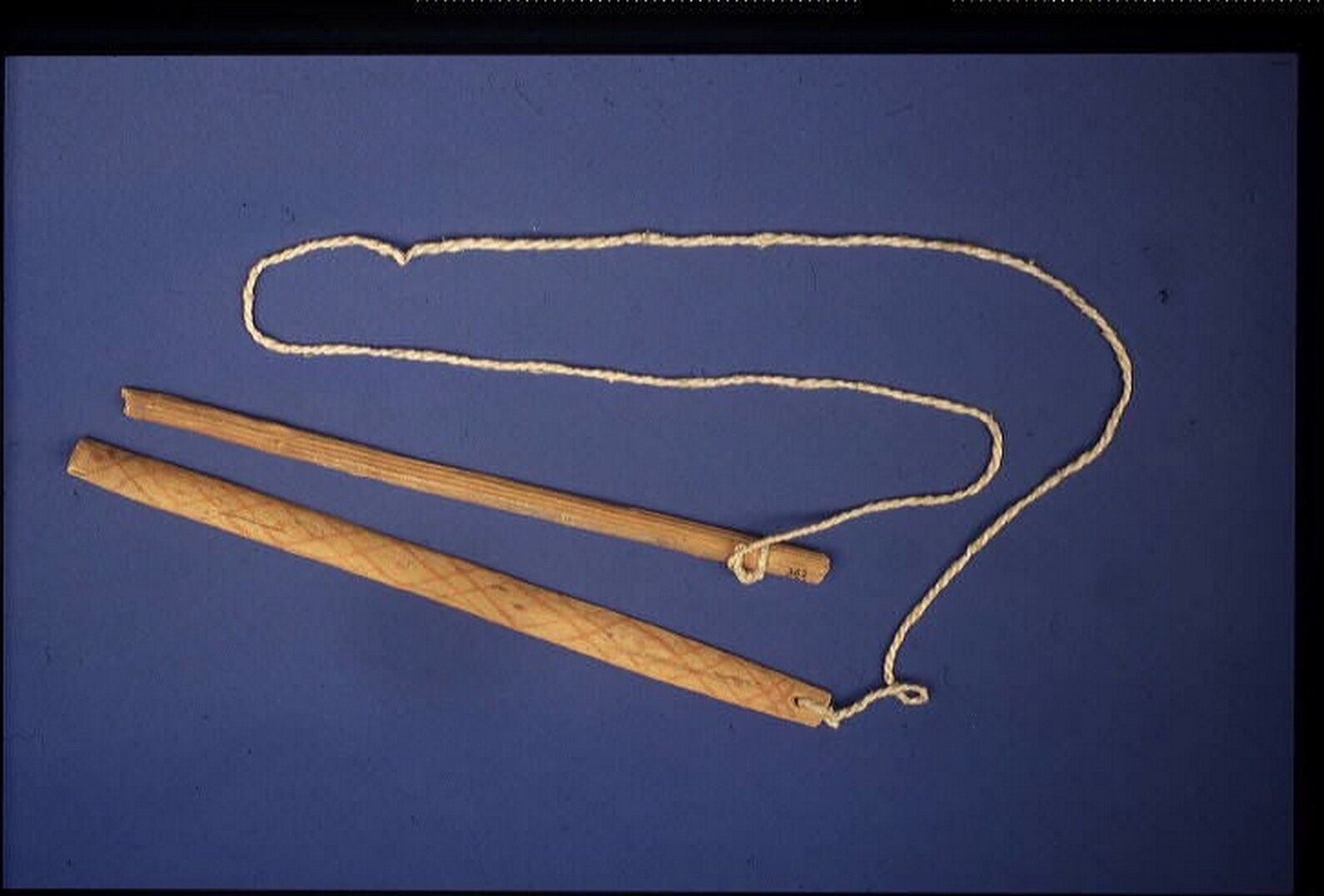
kwi'mo
Source term: bullroarer
kwi'mo is Kelly's term for the bullroarer; tüsa'ibidun names the wind-calling rite (and once a separate whirled stake), with uncertain spelling.
When snow lay deep over Surprise Valley and would not melt, a man whirled the kwi'mo bullroarer to bring the warm south wind. Isabel Kelly's Kidütökadö informants remembered the object as a boy's toy too: a juniper blade marked with black spots or lines, tied loosely with deer hide to a wand-like handle. The wind-calling rite, tüsa'ibidun, was specialist work — performed for payment in beads or a belt, sometimes by a man born in summer, sometimes with nothing more than an eight-inch whirled stake.
A man whirls a bullroarer (kwi'mo) to bring a warm wind to melt the snow.
Kelly 1932, p. 202.
Particulars
- Object
- Juniper bullroarer, decorated with black spots or lines, tied loosely with deer hide to a wand-like handle.
Source
Isabel T. Kelly, 'Ethnography of the Surprise Valley Paiute,' University of California Publications in American Archaeology and Ethnology 31(3) (1932), pp. 177 and 202; Omer C. Stewart, 'Culture Element Distributions: XIV, Northern Paiute,' Anthropological Records 4:3 (1941), p. 401