No. LEVINE1966-001
Gusii eng'iti enene, the Big Beast of Outside
Nyansongo, Kisii highlands, Nyanza Province (now Kisii and Nyamira counties), western Kenya · East Africa
Restricted
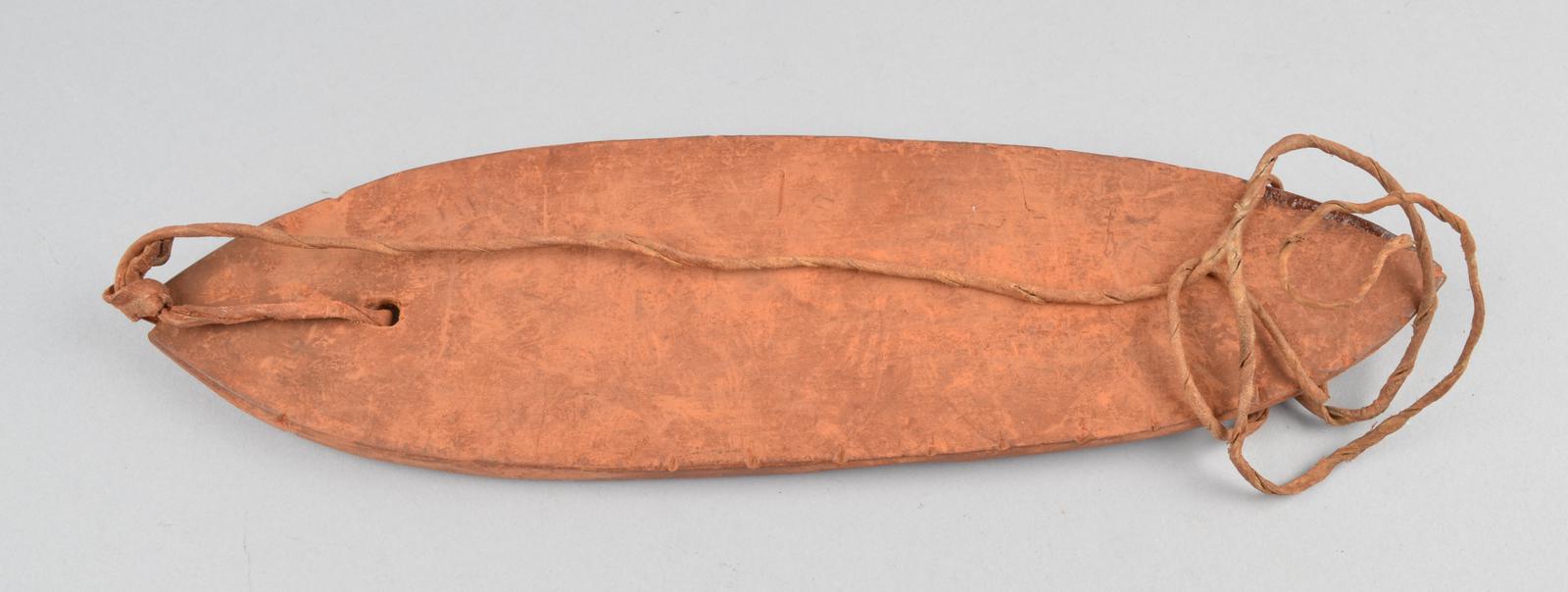
eng'iti enene ('Big Beast of Outside'); enyabububu (the beast itself, onomatopoeic)
Source term: bull-roarer
eng'iti enene - 'Big Beast of Outside', the Gusii name for the bullroarer itself. enyabububu - the swallowing beast whose voice it is; Mayer calls the name onomatopoeic. ogosicha - 'taming the Beast', the act of sounding it. Distinguish eng'iti enene ya nyomba, 'Big Beast of the House', which is a friction drum, not a roarer.
A Gusii boy was circumcised and then shut away, and while he was healing the beast came for him. It is called enyabububu, a name that imitates the sound it makes, and it swallows initiates; its wooden voice is eng’iti enene, the Big Beast of Outside, a flat piece of wood under a foot long, drilled at one end and twirled on a cord. Swinging it is ogosicha, “taming the Beast.” Philip Mayer, who watched this in the 1940s, was firm that frightening the boys was not the point: the beast is brought in as soon as possible, to entertain them and take their minds off the pain. Outside the hut a second roarer sounded, and with it word to the women and children to keep away.
Certainly it is not expected to terrify the novices seriously... the best thing is to introduce it as soon as possible after the mysteries, so as to entertain and distract from the pain.
Mayer, "Gusii Initiation Ceremonies," JRAI 83 (1953), p. 20.
Particulars
- Object
- A flat piece of wood about half an inch thick and under a foot long; a cord is fastened through a hole at one end for whirling.
- Function
- Male initiation. The wooden “Big Beast of Outside” gave voice to enyabububu, the swallowing beast; sounding it was ogosicha, “taming the Beast.” It was brought in as soon as possible, to entertain the novices and draw them off the pain rather than to terrify them. A second roarer sounded outside the hut, with a warning to women and children.
Source
Philip Mayer, 'Gusii Initiation Ceremonies,' Journal of the Royal Anthropological Institute 83(1) (1953): 9-36, at p. 20; Robert A. LeVine and Barbara B. LeVine, Nyansongo: A Gusii Community in Kenya (New York: Wiley, 1966), ch. 16