No. NAMER-012
Pa-doch, voice of Thunder man
United States · Northern Pomo territory, upper Russian River drainage, Mendocino County, California · North America
Restricted
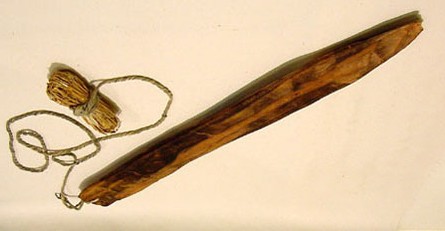
ma-dim / pa-doch
Source term: bull roarer
ma-dim and pa-doch, the Northern and Eastern Pomo names for the bullroarer (Loeb's madim and padok).
A black-painted wooden slat almost three-quarters of a metre long, made by Sam Tony, a Northern Pomo man, and collected in California on Stewart Culin's 1906 Brooklyn Museum expedition. The Large Black Bull Roarer, as the museum titles it, carries two Pomo names, ma-dim and pa-doch, and no account of its use. Among the Pomo such slats were the secret gear of the guya, the ghost society: kept concealed in moss between ceremonies, their nature unknown to women and children, their roar passed off on outsiders as the voice of the dead. Carried later into the Kuksu cult's Thunder ceremony, they became the voice of Thunder man, and the Eastern Pomo called the instrument kalimatoto padok, the doll of Thunder man. An Eastern Pomo initiate remembered looking at the whirling bull roarers and being told it was "the voice of Thunder God," and that he would die if he spoke of what he saw to the non-initiated. The same padok, holding thunder's power, was whirled to cure those whom thunder had frightened. Pomo myth kept the bullroarer's Thunder-voice close to another great being: Bagil, the water-serpent, whose brother, the cannibal dragon Gilak, was invoked in war-prayer in the same breath as Thunder man and the bull roarer itself; the Northern Pomo called the rainbow Bagil's breath.
These instruments, when not in use, were always kept carefully concealed in moss. The nature of the padok was unknown to women and children. When the padok were heard at the time of the ghost dance the outsiders were told that it was the voice of the dead.
E. M. Loeb, Pomo Folkways (1926), p. 341.
Particulars
- Object
- A long, flat, black-painted wooden slat, 72.5 cm long and 9.5 cm wide.
- Function
- Whirled by bull roarer initiates, padok matu'tsi, in the ghost and Thunder ceremonies; also a powerful curing agent.
Sources
- Brooklyn Museum, Sam Tony, Large Black Bull Roarer (ma-dim or pa-doch), accession 06.331.8127 View
- E. M. Loeb, Pomo Folkways (1926), p. 341