Atlas Essay — 2026-09-13
What Travels When the Bullroarer Doesn’t?
In Kiwai, the initiate meets the bullroarer beyond a fence. Haddon set it down in 1904: at Iasa the madubu is shown to each novice “in a tabooed and fenced-in portion of the bush,” and its sound is then tied to the crops. Elsewhere the roar is a spirit’s voice, the gate into knowledge a man may not repeat, the thing a woman dies for seeing. On the Sepik the same spirit sings through giant flutes hidden in the men’s house; among the Dogon of Mali it walks out as the Great Mask, and the roarer is its voice. The blade is the smallest part of this. Each people holds a worn piece of something older and larger, and each has reworked its piece in its own way. Laid side by side, the pieces give back the whole.1
That whole has drawn diffusionists for more than a century. Leo Frobenius, Fritz Graebner, W. H. R. Rivers, and Felix Speiser traced instruments, masks, secret societies, and initiation rites travelling together. Yuri Berezkin and Julien d’Huy later used comparative myth to follow a still larger inheritance: stories of women’s former sacred authority and the rites that now belong to men. Each of them was reconstructing the same institution from a different handful of fragments.
For the instrument’s broader ritual history, read The Bullroarer: a history of man’s most sacred ritual object at Vectors of Mind. This essay reconstructs the complex the instrument belonged to, and names what travelled with it.
The world’s bullroarers are fragments of one ancient ritual complex: a spirit made present by men, with the roarer and the sacred flute for its voice and the mask for its body; boys initiated on hidden ground; women kept from the secret on pain of death; and a myth that women owned it first. Its survivals are sparse, decayed, and remixed, yet together they reconstruct the whole, and where the roarer has dropped away the flute and the mask carry the complex on without it.
In brief
- The world’s bullroarers are fragments of one ancient ritual complex: a spirit made present by men, with the roarer and the sacred flute for its voice and the mask for its body; boys initiated on hidden ground; women kept from the secret on pain of death; and a myth that women owned it first. Its survivals are sparse, decayed, and remixed, yet together they reconstruct the whole, and where the roarer has dropped away the flute and the mask carry the complex on without it.
- Inside one cult the instruments divide the spirit’s work. At Ilahita in Papua New Guinea boys meet the roarers first and the giant Nggwal flutes last; the Murik call the roarer the flute’s elder brother; the Dogon name the roarer the voice of the Great Mask; the Elema of the Gulf of Papua call roarer and mask elder and younger brother.
- Women owned every part first. An Ilahita woman makes the first roarer and men kill her for it; Mundurucú women of Amazonia find the sacred trumpets; Dogon women find “an iron rhombe and the wooden mask.” Berezkin’s motif F38 gathers these stories across three continents, and d’Huy carries it back to Ice Age Europe.
- The same sentence guards all three instruments. A woman who saw the Arunta churinga of Central Australia, the Juruparí pipes of the Uaupés, or the Yoruba Oro roarer faced death.
- Where the roarer drops out, the flute or the mask takes its place. Gourlay found sacred flutes replacing bullroarers in much of New Guinea; Zerries wrote a chapter on the roarer’s substitutes; the Selk’nam of Tierra del Fuego ran the whole men’s rite with masked spirits and no blade.
- Frobenius, Schurtz, Webster, and Loeb already treated roarer, mask, and men’s society as one travelling complex. “Nor does the bullroarer travel alone,” Loeb wrote in 1929.
The first maps of a ritual world
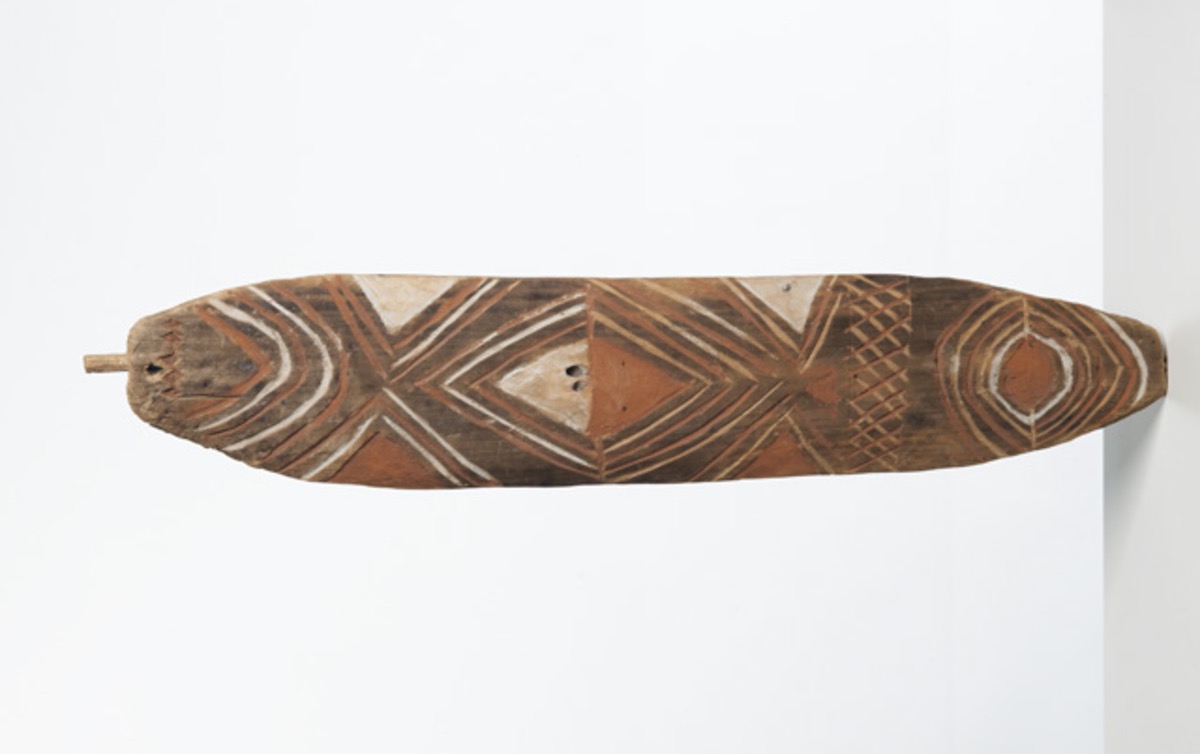
In 1898, Leo Frobenius compared African masks and secret societies with ceremonial forms elsewhere. In Die Masken und Geheimbünde Afrikas, he argued for a “Malayo-Nigritic” source behind African masks; his companion Der Ursprung der afrikanischen Kulturen set the comparison within a wider culture-historical account. Masks, spirit manifestations, secret societies, and their instruments belonged, for Frobenius, to connected histories. He counted the bullroarer among the attributes of the masked men themselves. He was tracing the movement of a whole ceremonial world.2
Fritz Graebner gave the question an Oceanian and Australian setting in 1905. His discussion of cultural circles and layers treats the bullroarer’s distribution as a clue to relations between Oceanian secret societies and Australian institutions. The instrument mattered because it appeared inside a larger organization of ritual life.3
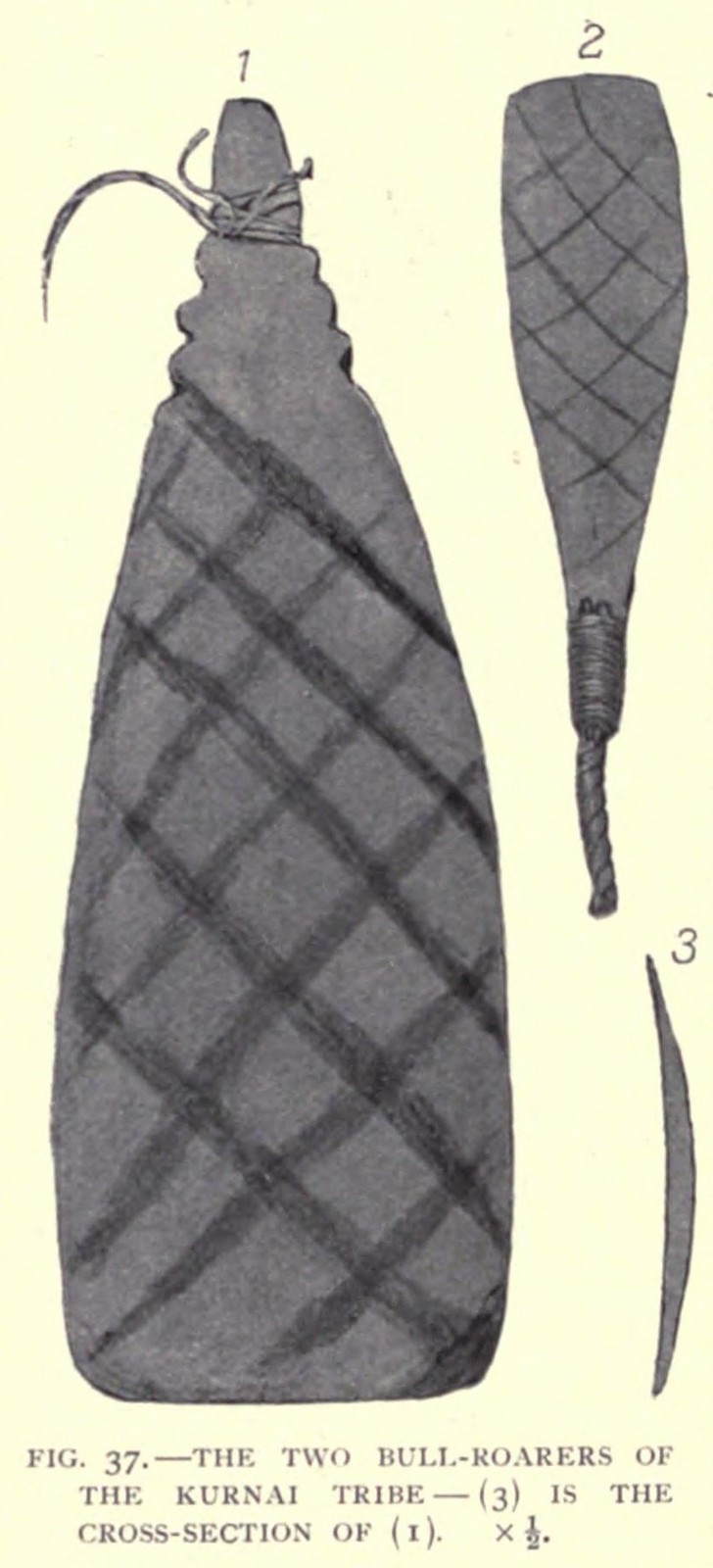
W. H. R. Rivers pursued historical layers within Melanesia. In The History of Melanesian Society (1914), secret societies and ceremonial institutions formed part of his reconstruction of regional social change. That was a more local history than Frobenius’s continent-spanning comparisons, but it made the same move: it read an institution as a historical inheritance rather than a timeless local custom. His own pages hold the complex in miniature. Among the Kilenge and Barriai of West New Britain, the roarer warns outsiders off the masked dance, and a new member pays one pig to see the roarer and a second to enter the dance.4
Felix Speiser carried the question to Australia’s doorstep. His study of South Pacific initiation brought Australian bullroarer practice in with waves of Melanesian culture; Mircea Eliade, citing him, judged that the instrument “probably” reached Australia that way. Speiser also saw a later wave in New Guinea bring the sacred flute over the older roarer. These are short, specific routes, and the ones a diffusionist would test first.5
Heinrich Schurtz and Hutton Webster drew the whole institution together. For Schurtz in 1902, the men’s societies converse with the spirits of the dead, and “masked dances and the noise of bullroarers serve this purpose”; far from their centres, he wrote, such societies survive in forms whose existence is often attested “only by the masks” or “by the bullroarers.” Webster wrote in 1908 that masks and bullroarers alike tie the members to the dead and “terrify and overawe those who are not admitted.”6 Edwin Loeb put it most plainly in 1929:
Nor does the bullroarer travel alone.
Edwin M. Loeb, Tribal Initiations and Secret Societies (1929), p. 285
With it, Loeb found, came the impersonation of ghosts and spirits, and the whole was “disseminated as a complex.” Robert Lowie, weighing the Ekoi of West Africa against the Bororo of Brazil, could find no reason two peoples would independently bar women from knowledge of the bullroarer, and did “not hesitate to accept diffusion from a common center.”7 All of them treated the sound-maker as part of a social technology: an object, a performance, a mask or a flute beside it, a guarded explanation, and the institution that grants someone the right to use it. Each mapped a different stretch of its range. Laid together, their maps outline one complex.
Women and sacred knowledge
In Africa, Migrations, Mythology (2013), Yuri Berezkin calls one widely distributed motif F38, “Women and Sacred Knowledge.” He had first assembled its instances in a comparative catalogue of world folklore. The stories recall women as former owners of ritual knowledge, sanctuaries, or sacred objects that men now control; some tell of women trying to recover what has been taken. The details change from place to place. The recurring reversal is that the present guardians inherited a power whose first custodians were women.8
Berezkin’s examples range across Australia, Melanesia, New Guinea, and South America. In some, the disputed object is a bullroarer; in others it is a sacred flute, mask, or body of ritual knowledge. That range makes F38 more than a map of one instrument. It maps a relationship: restricted sacred power, women’s remembered priority, and its transfer into male hands.8 The Marind-anim sosom shows the same institution working inside a single ritual world: a Dema-spirit voice sounded at Marind ceremonies and boys’ puberty rites. See the Marind-anim Atlas record.
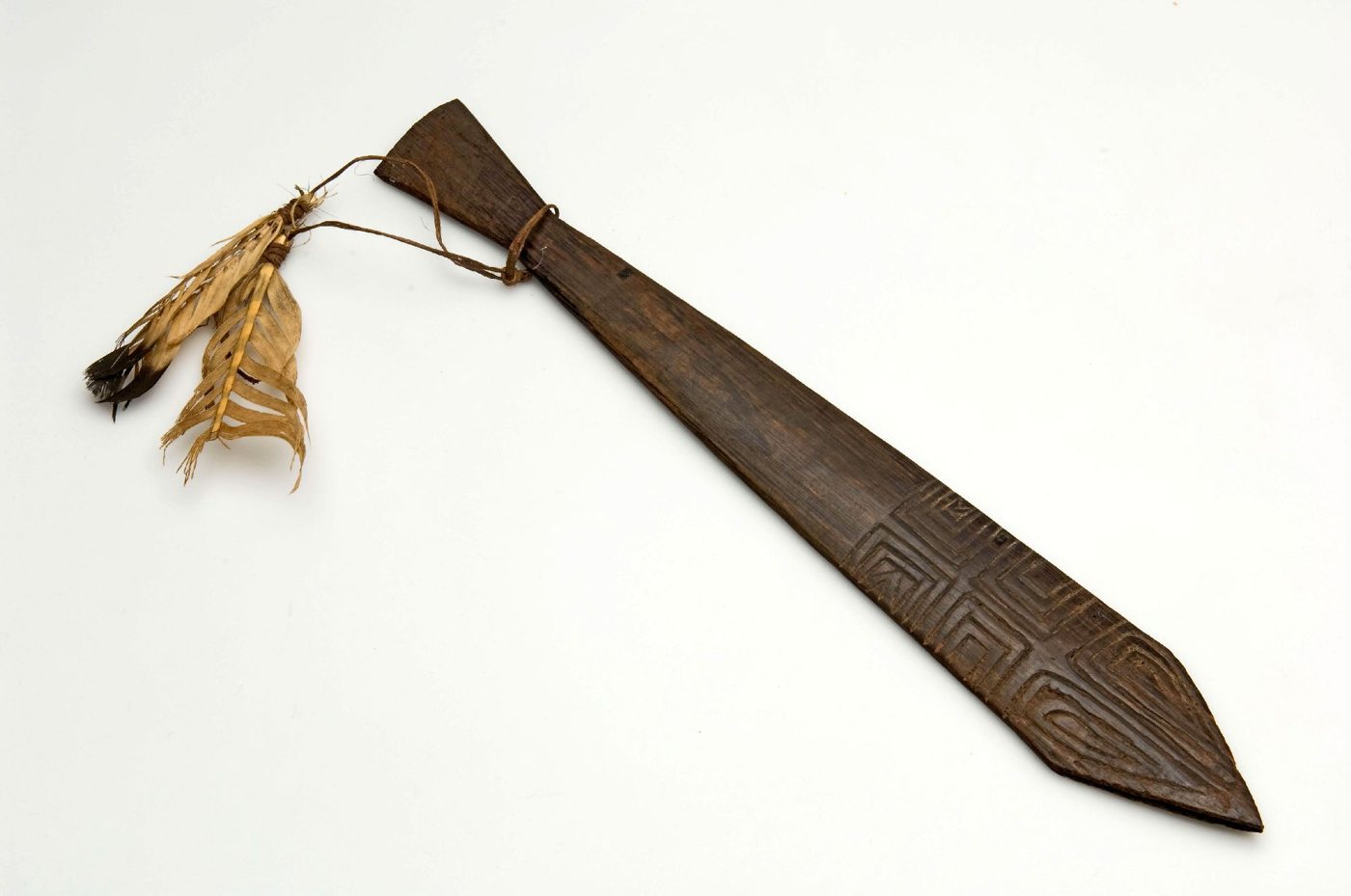
Berezkin proposes that a broader complex of male ritual and institutionalized opposition between the sexes originated in Africa. In his reconstruction, migrations carried it into Australia and New Guinea; further movement through East Asia carried it toward the Americas. He argues that the complex became more dramatic in Sahul. The cargo is a system of stories and ritual relations, and it can arrive whole at a stop where the board itself was lost along the way.8
What makes the comparison historical is the arrangement: sacred sound, secrecy, and a birthright taken from women, bound together in the same order in places no single board connects. The board is one fragment of that ritual world, the one museums keep best. The flute and the mask are two more, and later sections take them up in turn.
Myths acquire a family tree
Julien d’Huy’s 2017 study, “Matriarchy and Prehistory,” is separate, solo-authored work that uses Berezkin’s motif catalogue. With methods adapted from evolutionary biology, d’Huy reconstructs relationships among story motifs and estimates features of their ancestral combinations. F38 appears in the core reconstruction and at a Balkan node belonging to European Palaeolithic mythology.9
D’Huy roots his main tree in East Africa, guided by the Out-of-Africa dispersal rather than by the stories themselves. Yet the same paper reconstructs an ancestral Balkan node holding F38 within European Palaeolithic mythology. His own model puts the motif in Ice Age Europe even where its root was placed elsewhere.9 The Atlas essay The European Roots of the Primordial Matriarchy follows the European archaeological record.
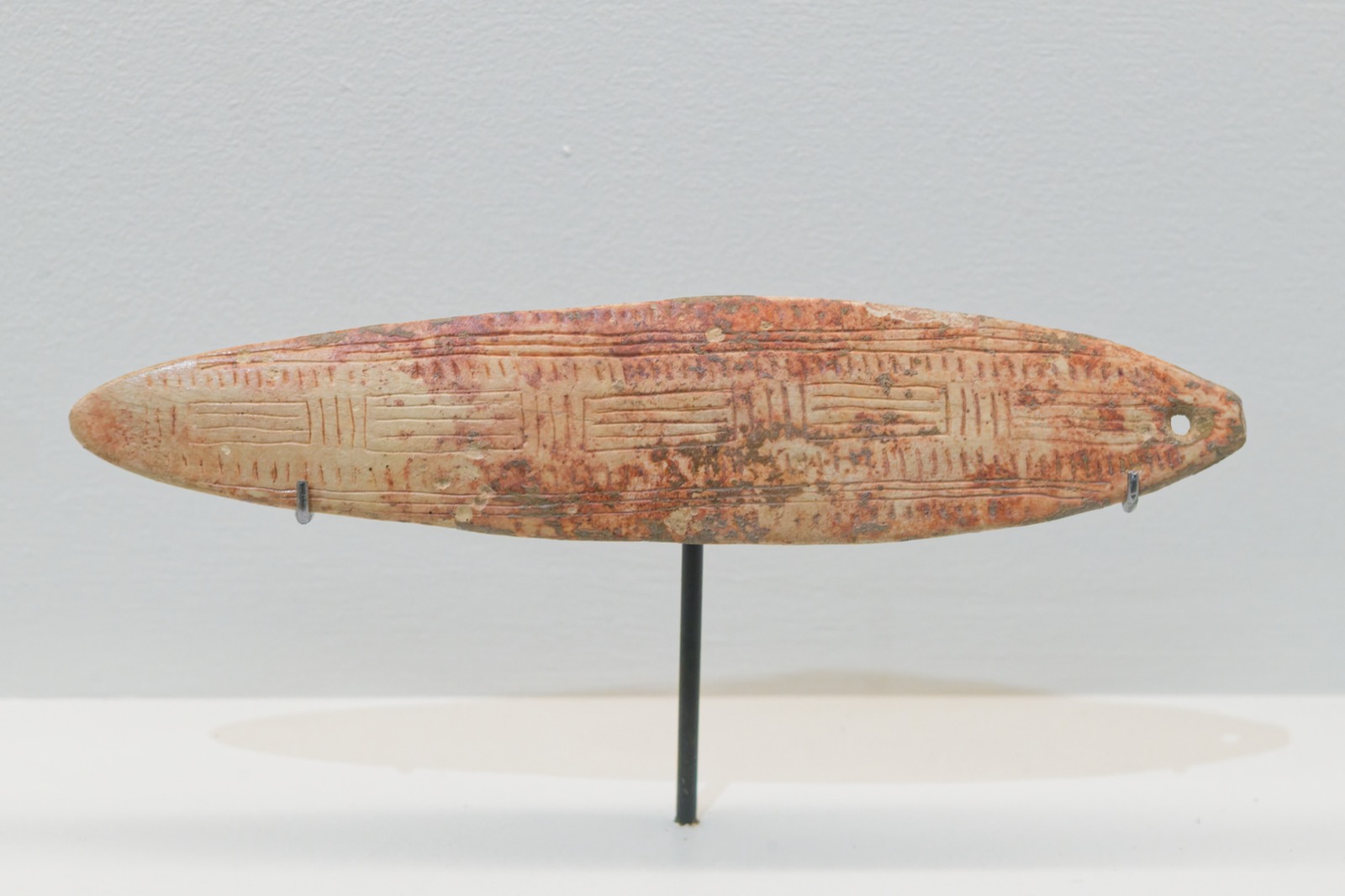
In a 2025 article d’Huy brought the method to the ground. He read the Magdalenian rhombe from the cave of La Roche at Lalinde, in the Dordogne, against the myth history his trees reconstruct, putting an Ice Age bullroarer and Ice Age stories on the same page.10
True fragments and false
Raffaele Pettazzoni’s 1912 “Mythologie australienne du rhombe,” written in French, starts from the instrument’s far-flung distribution and reads its myths for a shared origin. The distribution is the scatter of fragments; the myths show how they fit.11
In Spanish, Pablo Canalis Fernández’s 2016 essay revisits monogénesis and poligénesis: one origin spreading, or many independent inventions. The complex settles it. A whirled board could be invented twice. A whirled board sounded as a spirit’s voice at a hidden initiation, forbidden to women on pain of death, and explained by a myth of women’s first ownership was invented once.12
Galina Soldatova’s Russian-language study of Khanty and Mansi sound instruments clears out a false fragment. A rotating board used to call wind and a two-hole button buzzer both make noise through motion, but their construction and operation differ. The buzzer belongs to another family and comes out of the reconstruction.13
Shinji Okino’s Japanese-language study asks whether a bullroarer ever existed among the Ainu, or whether a historical description misread another practice. Every point on the map has to be a real bullroarer before it can be fitted into the whole.14
With the lookalikes cleared away, what remains is a set of sacred objects bound to initiation and authority, and those pieces fit together.
The woman inside the roar
Among the Ilahita Arapesh of Papua New Guinea, Donald Tuzin found nearly the whole complex kept in a single story. A woman makes the first walop, the bullroarer known as Mimi’unemb. Men force her to teach them and then kill her; the instrument’s roar becomes the voice of Lefin. Its present custodians possess a power whose origin story names a woman as its maker.15 The Atlas account of Mimi’unemb follows this local narrative in detail.
The sequence explains more than invention. A woman first makes the sound; men acquire her knowledge; the sound is then attributed to a spirit whose voice they are authorized to produce. The story preserves the transfer inside the institution built upon it. It remembers female precedence even as it authorizes male custody.
Creation, appropriation, exclusion, sacred voice: Ilahita keeps all four where most peoples keep one or two. A well-preserved fragment like this is the template against which the worn ones can be read. And Ilahita keeps more than the roarer. The same cult that shows boys the blade goes on, grade by grade, to show them the flutes.
The flutes in the men’s house
The Ilahita cult is a ladder, and the roarer is its first rung. In the Lefin grade the novices are shown the bullroarers, and Tuzin records what they are told: “The sound emitted by the bullroarers is said to be the voice of the Lefin Tambaran, a spirit personified as a little man with a large red beard and enormous teeth.” Lefin flutes follow, then the flutes of the Maolimu grade, and at the summit the giant end-blown bowan flutes of Nggwal: “When sounded in unison they become the ‘voice’ of the unitary Nggwal.” Every rung is a bigger voice for the same order of spirits, and every rung is hidden from women. Tuzin gives the rule in one line:16
The ‘voices’ of the Tambaran — flutes, trumpets, bullroarers, whistles represent the Ultimate Mystery.
Donald Tuzin, Unity in Duality (1973), p. 329
Along the Sepik and its coast, the two instruments share one cult and split its work. At Kaup and Karau the Murik roarer urubaia is the limping elder of two spirit brothers, and the sacred flute brag is the younger. Among the Chambri the roarers sound in the open as the ancestral crocodile while the flutes play inside the men’s house. On Wogeo island, off the Sepik coast, the nibek flutes and the mumumu roarers voice different spirit-monsters of one men’s cult, under one threat against women. Among the Keraki of the Trans-Fly, boys see the roarer at initiation and the sacred pipes months later.17
In the Eastern Highlands the pairing runs through a whole region. Terence Hays surveyed it in 1986: where both instruments occurred, the roarer “was usually swung in association with the playing of sacred flutes,” and “women and children were almost universally forbidden even to see the object.” The Baruya divide the powers between them, the roarer carrying death and war, the flutes the life the men took from women. The Yagwoia, at the region’s edge, keep only the first rung: there the roarer alone was ritually revealed. Hays’s verdict covers the whole field: “there are too many points of similarity between bullroarers and sacred flutes for either to be understood fully in isolation.”18
Arnhem Land in northern Australia has the same pair in a python cult. W. Lloyd Warner recorded how the Yolngu make a bullroarer while “the women and uninitiated are told that Muit, the great father, is calling out for the initiates”: “The bull roarer is Wirtit (Yurlunggur or Muit).” The Yurlunggur trumpet belongs to the same rites, the python’s second voice, blown over the novices.19
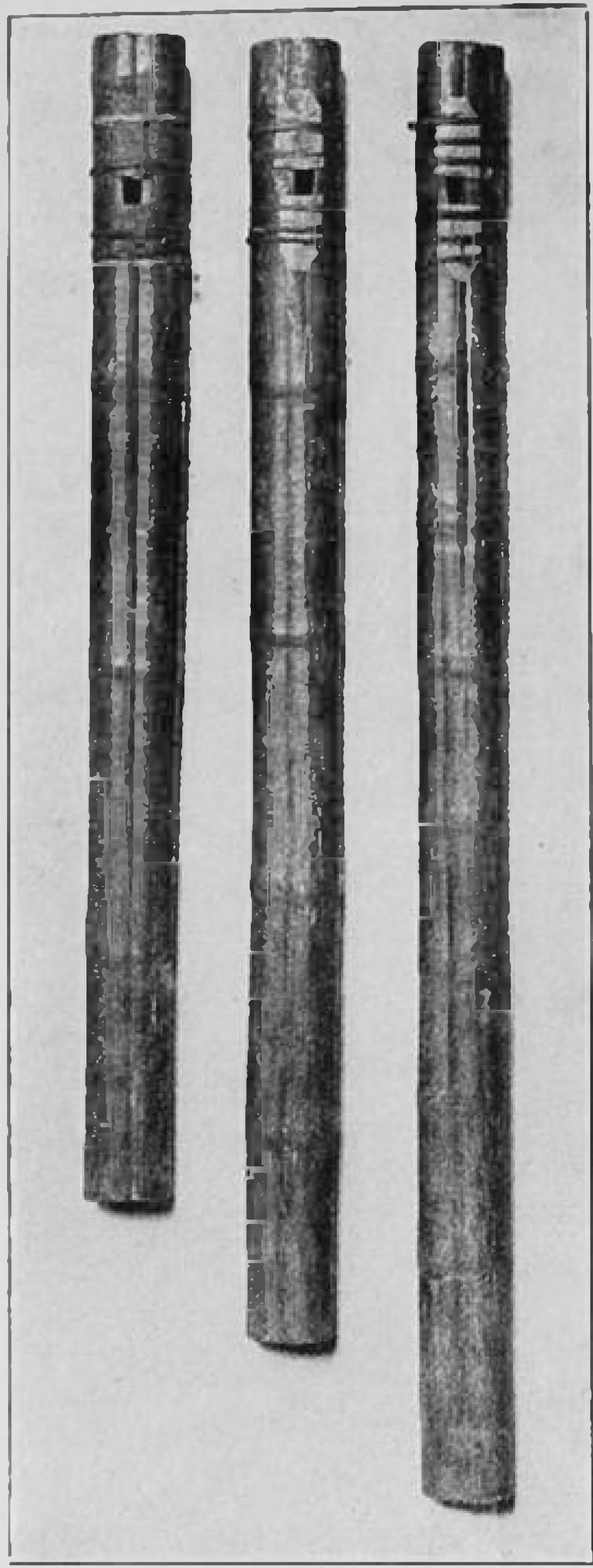
Across the Pacific, Amazonia keeps the same pair. Among the Mehinaku of the Upper Xingu in Brazil, “women are herded into the houses and the doors are shut before the men play the flutes on the plaza or whirl the bullroarers.” Theodor Koch-Grünberg described the Kóai flutes played at a whipping feast on the Aiary River, among the Baniwa and their Arawak neighbours: the celebration was the privilege of grown men, and “women may not even see the flutes, otherwise the Kóai kills them, that is, they are punished with death.” Otto Zerries followed the same spirit across the region: the voice of Juruparí “is generally reproduced by the Paxiuba-flute and perhaps elsewhere (Baniwa) by means of the bull-roarer.”20 In the Ituri forest of Central Africa, the Bali Mombela initiation divides the ordeal the same way: one elder whirls the roarer Maduali, whose voice the uninitiated take for a god, while another plays the flute of the grey ibis over the novices.21
The Chambri set the flute inside the house and the roarer outside; the Murik and the Elema make the roarer an elder brother; Ilahita makes the two instruments its first gate and its last. Each cult ranks them in its own way, and each keeps both inside one institution.
The spirit’s body
Where the flute gives the spirit a second voice, the mask gives it a body. The Dogon of Mali say so outright. Marcel Griaule recorded in 1938 that the Dogon rhombe receives the blood of the Great Mask’s consecration and with it “the power of that object, whose voice it is considered to be and whose name it bears.” At Sanga the roarer is called imina na, Great Mask, the same name as the carved serpent itself; at Tébélé it is “mother of the masked children.” Its task is “to sow terror among the women and children, to keep them away from the appearances of the masks.” The first roarer, the Dogon say, was cut in the image of the hanging tongue of tired old men, and the albarga mask carries such a tongue from its mouth. The blade is the mask’s organ of speech, carved as a separate piece.22 See the Dogon Awa society and Yougo Dogorou records.
On the Gulf of Papua the Elema of Orokolo built the same relation into kinship. F. E. Williams found that “hevehe is also the name most commonly used for bull-roarer,” the hevehe being the towering masks of their great cycle, and that “bull-roarer and hevehe are said to stand to one another in the relation of elder brother and younger brother.” The roarer is the permanent sacred thing of the village, the masks its visitors, and the roarer’s sound clears the women from the scene when the masks come out.23 In East New Britain the Baining masks of the night fire dance are the children of the salecha roarer, much as the Dogon rhombe is mother of the masks.
In Yorubaland in West Africa, the roarer announces the masked executioner. Frobenius described Oro walking the town in a white wooden mask with blood-smeared lips: “He announces his approach by a strong whirring noise, which he produces with the bullroarer. … The women are forbidden on pain of death to look out. Nor may any woman set eyes on the bullroarer.” Webster’s summary of the same cult is shorter: “No woman may see the bull-roarer and live.”24 See the Yoruba Oro record. Further west, the Bedik of Senegal count their roarer among the “audible masks” of their men’s cult, and the Dan of Côte d’Ivoire and Liberia have “naked masks” that exist only as sound, a whirled board in place of a face.25 West Africa files the roarer under masks by its own classification.
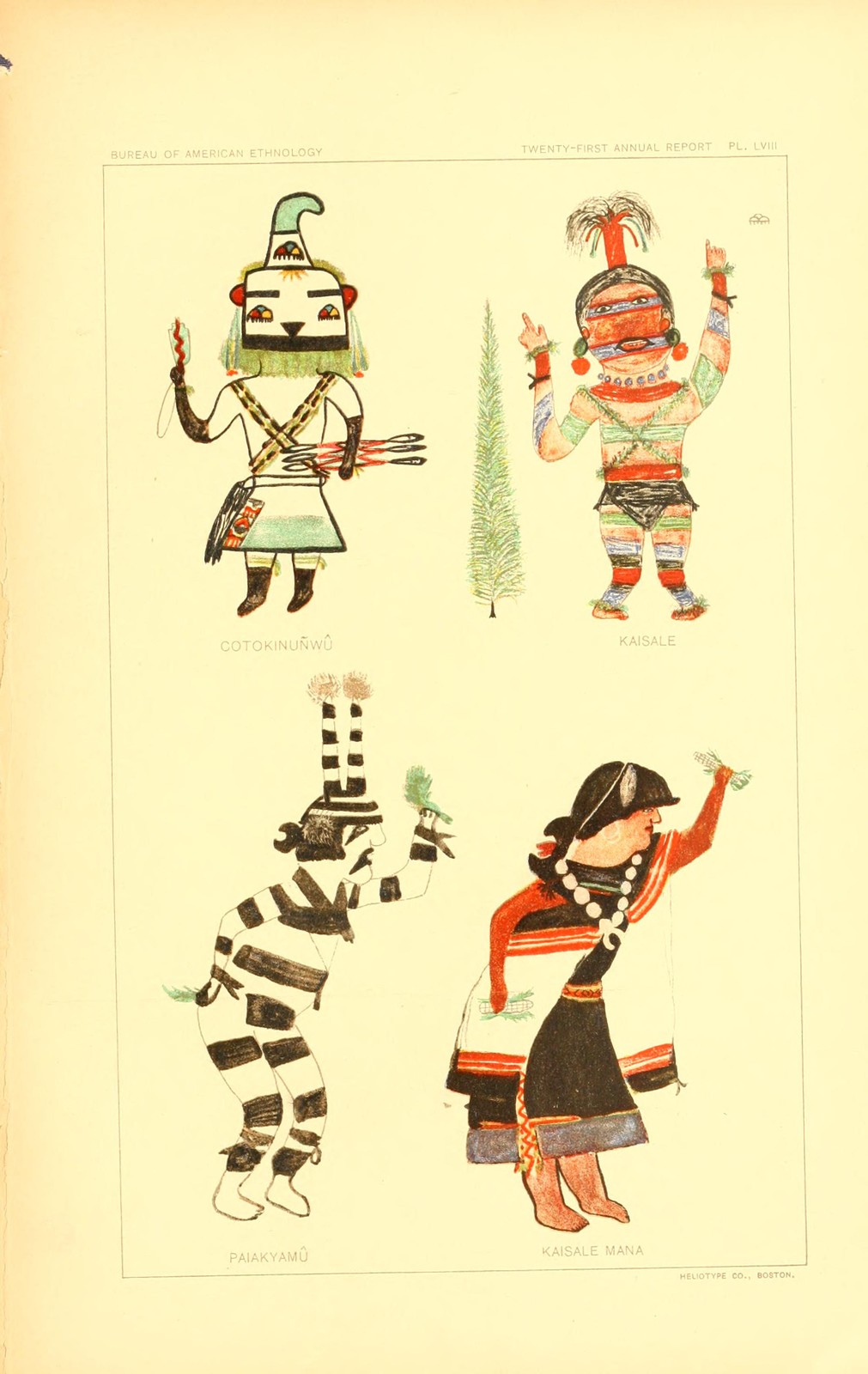
North America keeps the pairing at the far end of the range. Among the Eastern White Mountain Apache, a clown “whirled bull-roarer to announce masked gan impersonators,” then kept it sounding through the dance. The Hopi painted their masked katcinas with the whizzer in hand.26 From the Bandiagara cliffs to the Arizona mesas, the voice comes first and the body follows it into the dance ground.
Women found them first
The central myth of the complex is told of every one of its instruments. Among the Mundurucú of the Brazilian Amazon, Robert Murphy recorded it for the sacred trumpets, the karökö, kept in a closed room of the men’s house. “The sacred trumpets of the Mundurucú, called the karoko, are taboo to the sight of women, but the women once owned them. In fact it was the women who first discovered the trumpets.” Three women went out for firewood and “frequently heard music from some unknown source”; they netted three fish, which became the trumpets, and with them the women ruled. The men carried the firewood and fetched the water, until they took the trumpets back. “The women wept at their loss.”27 The Ilahita woman who made the first roarer began the same way: “One day she was chopping up an ambop tree for firewood.” The Kilenge say the first roarer was a splinter that went whirring through the air while women gathered firewood.15
Some myths tell the whole kit at once, with the roarer as the weapon that won the flutes. An Iatmul man told Eric Silverman: “Women had flutes and gave birth. … We had nothing.” The ancestral men did possess the bullroarer, and one day they twirled it: “The noise frightened the primeval women, who fled, allowing men to filch the flutes.” Among the Kamano of the Eastern Highlands, the men take the flute from the first woman, Jugumishanta, and then invent the roarer to keep it. In the Upper Xingu the Kamaiurá twins Sun and Moon drive the first flute-players, who were women, away with roarers.28
The Dogon women found the mask and the roarer together. Two women heard “the whirring of a rhombe” and came on the ancestral spirits dancing in masks; the spirits fled and left behind skirts, hoods, ornaments, “an iron rhombe and the wooden mask.” One woman put on the fibres and went home, and “all the men, all the women, all the children fled. Her frightened husband fled.” Dogon smiths still forge iron roarers to recall the metal of that first one.22 On the Gulf of Papua the Elema keep both halves as separate stories: a woman named Oie fished the first mask out of the Purari River, and “the women wore the masks until they were stolen from them by a man named Kaiva”; the old woman Uravu “made the first bull-roarer … but she also is the bull-roarer.”23
In Tierra del Fuego the Selk’nam tell it of masked spirits alone. The women once ran the Hain, the great lodge of initiation, and terrorized the men with spirits they impersonated; the men rose, killed the women, and took the lodge. From then on the men impersonated the same spirits to keep the women away.29 Thomas Gregor and Donald Tuzin, comparing Amazonia with Melanesia, summed up both regions in one sentence: “The cults’ origin myths tell of a time when the women possessed secret and powerful objects, often bullroarers, flutes, or trumpets, and used them to dominate the men.” Kenneth Gourlay counted the New Guinea roarer myths and found that twelve of fourteen give the instrument’s first appearance to women; the flute myths, he added, run parallel.30 One myth serves the whole complex. It moves from roarer to flute to mask with the institution it explains.
What travels without the blade
The complex decays unevenly, and each people keeps a different piece of it. Where the roarer drops out, another part takes up its work. Kenneth Gourlay found that in much of New Guinea “sacred flutes replace bullroarers as cult objects in initiation.” Hays traced the process on the map: the flute spread in from the north and east and stopped, leaving a belt where the two instruments stand together as if a displacement had been “frozen” in the act. Otto Zerries made substitution a chapter of the complex, titled “The substitutes of the bullroarer,” and in eastern Brazil found the ghost-flute displacing the roarer as the spirit’s voice within the complex of masked dances, initiation, and men’s societies. Murphy called the Mundurucú trumpets “functionally equivalent to the more widely distributed bull-roarer.”31
The mask carries the complex just as far. Loeb found that “no bullroarer or substitute is reported for any of the tribes of Tierra del Fuego.” Yet the Selk’nam Hain and the Yamana Kina keep every other element: spirits impersonated by men, women terrorized, a secret revealed at initiation, a myth of the women’s first rule. Among the Yamana, Loeb wrote, “the men wear masks and pretend that they are spirits, for the purpose of frightening their wives.”32
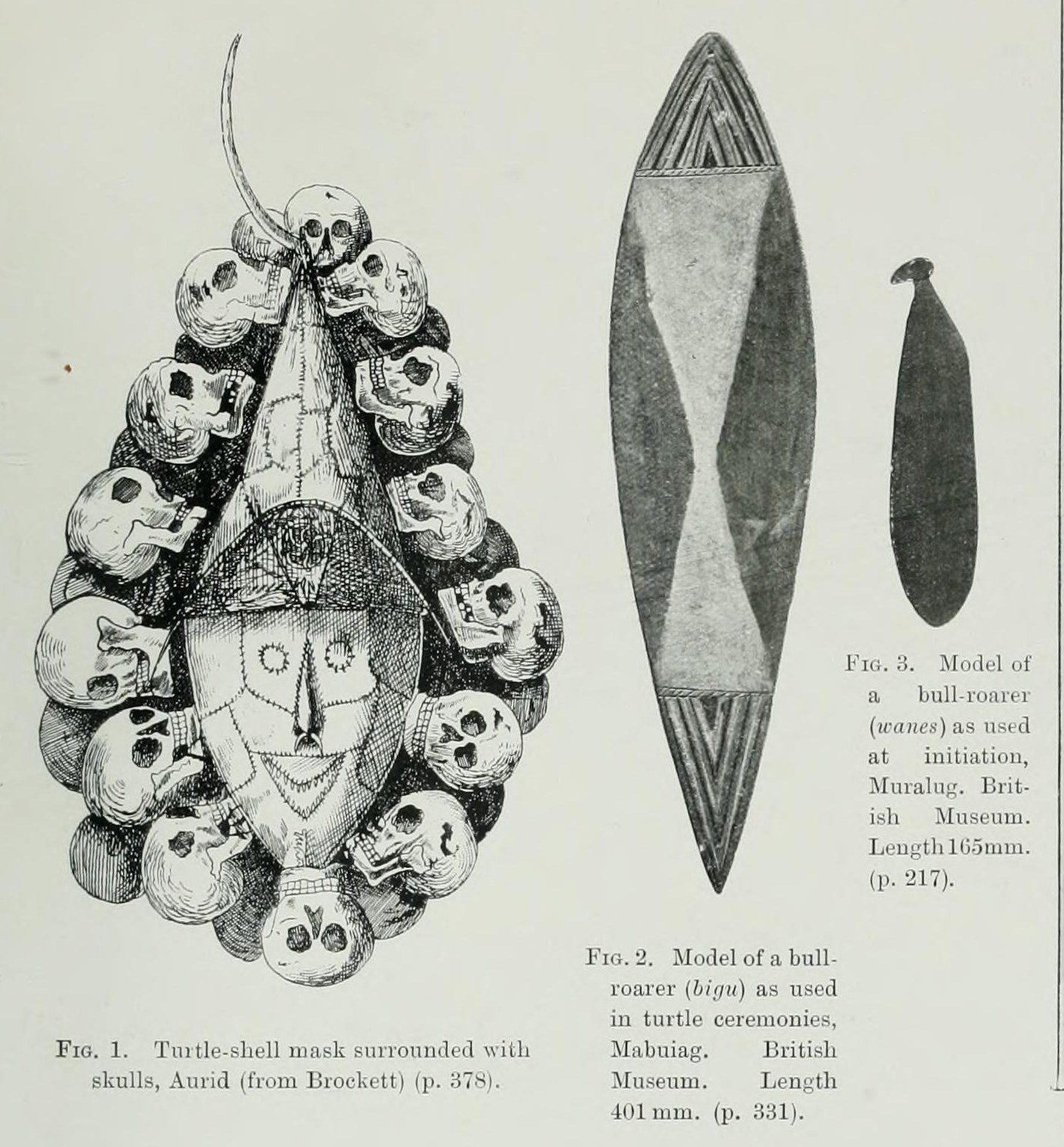
Torres Strait, between Australia and New Guinea, shows the exchange as stratigraphy. On Muralug, Haddon learned, initiation consisted mainly in showing the boys a wanes, a bullroarer. At Mawata, “no bull-roarer is employed,” and the novices are shown turtle-shell masks instead. The hero-cult of Bomai and Malu runs entirely on masks, and Haddon drew the conclusion: bullroarers “appear to belong to the oldest stratum of religion in this region.”33 On the Gazelle Peninsula of New Britain, heartland of the masked Duk-Duk and Tubuan societies, Richard Parkinson found the roarer a children’s toy; the awe belonged to the masks. On Umboi Island, Gourlay found the roarer carrying no sacred charge while the masks it partners do. The Hopi swing the roarer in the open, and the secret has moved to the katcina mask: Don Talayesva remembered the night the katcinas unmasked before him and he saw that “they were not spirits, but human beings.”34 Webster had the rule in 1908: “Like the bull-roarers, the masks have a sacred significance which often survives long after the downfall of the rites in which they were used.”6
On the Uaupés River in Amazonia, Alfred Russel Wallace watched the Juruparí music brought out at Carurú: eight great bark pipes, and not a woman in sight, because a woman who saw them was “punished with death, generally by poison.” Fathers, he was told, had executed their own daughters. The instrument there is a pipe; the men’s cult, the secret, and the sentence are the old ones.35 People are inventive, and they rework whatever they inherit. The pieces still fit.
“Where did the bullroarer begin?” is the wrong question, and a century has been spent on it. The blade is the most perishable part of the thing. It is replaced by a flute, a trumpet, a mask, a fenced clearing, and the institution goes on: a spirit voiced and embodied by men, remembered as having belonged to women, withheld on pain of death. The Arunta of Central Australia kept their churinga from women “on penalty of death or very severe punishment”; the Uaupés kept their sacred pipes the same way; Oro’s mask and roarer carried the same sentence in Yorubaland.36 That relation is what crossed the water. Frobenius, Graebner, Rivers, Speiser, Loeb, Berezkin and d’Huy were each looking at one stretch of the same road. The bullroarer falls silent in place after place, and the complex it served keeps travelling in flute and mask without it.
The world’s bullroarers are fragments of one ancient ritual complex: a spirit made present by men, with the roarer and the sacred flute for its voice and the mask for its body; boys initiated on hidden ground; women kept from the secret on pain of death; and a myth that women owned it first. Its survivals are sparse, decayed, and remixed, yet together they reconstruct the whole, and where the roarer has dropped away the flute and the mask carry the complex on without it.
Key sources
- A. C. Haddon, ed., Reports of the Cambridge Anthropological Expedition to Torres Straits, vol. V (1904), “Notes on the Initiation Ceremonies in Kiwai,” p. 218; see also the Kiwai madubu record. Dogon: see note 22.
- Leo Frobenius, Die Masken und Geheimbünde Afrikas (1898), pp. 164, 251, 259–265 (p. 164: “Zwei Attribute der Maskirten … Das eine ist das Schwirrholz”); Der Ursprung der afrikanischen Kulturen (1898).
- Fritz Graebner, “Kulturkreise und Kulturschichten in Ozeanien,” Zeitschrift für Ethnologie 37 (1905), pp. 28–53, especially p. 34 n. 4.
- W. H. R. Rivers, The History of Melanesian Society, vol. II (1914), pp. 512–515, 524–525; the Kilenge and Barriai mask dance, pp. 512–513.
- Felix Speiser, “Kulturgeschichtliche Betrachtungen über die Initiationen in der Südsee,” Bulletin der Schweizerischen Gesellschaft für Anthropologie und Ethnologie 22 (1945–46), pp. 28–61; proposal attributed through Mircea Eliade, Rites and Symbols of Initiation (1958), p. 142 n. 14. The flute wave: Speiser, “Über Initiationen in Australien und Neuguinea,” Verhandlungen der Naturforschenden Gesellschaft in Basel 40 (1928–29), pp. 187–188, as summarized in Terence E. Hays, “Sacred Flutes, Fertility, and Growth in the Papua New Guinea Highlands,” Anthropos 81 (1986), p. 436.
- Heinrich Schurtz, Altersklassen und Männerbünde (1902), pp. 380 (“dienen Maskentänze und das Geräusch von Schwirrhölzern”), 439 (“nur durch die Masken … oder durch die Schwirrhölzer”); Hutton Webster, Primitive Secret Societies (1908), p. 76.
- Edwin M. Loeb, Tribal Initiations and Secret Societies, University of California Publications in American Archaeology and Ethnology 25 (1929), pp. 284–285; Robert H. Lowie, Primitive Society (1920), p. 313.
- Yuri Berezkin, Африка, миграции, мифология (2013), pp. 141–148, especially fig. 44 and pp. 147–148; Berezkin’s analytical catalogue, entries F38 and F39.
- Julien d’Huy, “Matriarchy and Prehistory: A Statistical Method for Testing an Old Theory,” Les Cahiers de l’AARS 19 (2016–17; published 2017), pp. 159–170: East African root, p. 161; F38/F40B distribution, p. 163; Balkan F38, p. 167 n. 7. HAL archive.
- Julien d’Huy, “Le rhombe de la grotte de La Roche à Lalinde: l’apport de l’approche phylomythologique,” Bulletin de la Société historique et archéologique du Périgord 152 (2025), pp. 155–162; SHAP listing.
- Raffaele Pettazzoni, “Mythologie australienne du rhombe,” Revue de l’histoire des religions 65 (1912), pp. 149–170.
- Pablo Canalis Fernández, “La voz de los antepasados: orígenes de la bramadera,” Revista de Folklore 411 (2016).
- Galina E. Soldatova, “Факультативные фоноинструменты обских угров,” Традиционная культура 20(4) (2019), pp. 44–56, especially p. 52.
- Shinji Okino (沖野慎二), 「アイヌ民族に“うなり板”は実在したか?:N.G.マンロー「アイヌ:信仰と儀礼」のある記述をめぐって」 [“Did a bullroarer actually exist among the Ainu? On a passage in N. G. Munro’s Ainu: Faith and Ritual”], 北海道立北方民族博物館研究紀要 3 (1994), pp. 39–59; see the Hokkaido Museum bibliography.
- Donald Tuzin, Unity in Duality (PhD thesis, Australian National University, 1973), Appendix E, no. 4, p. 358; The Voice of the Tambaran (1980), “Lefin,” pp. 55–78. Kilenge firewood origin: Carl Laufer, “Rigenmucha, das höchste Wesen der Baining,” Anthropos 41–44 (1946–49), n. 39.
- Tuzin, Unity in Duality (1973), pp. 260–262 (Lefin roarers and flutes), 294 (Nggwal bowan flutes), 329, 346 (Maolimu flutes; flutes and roarers “strictly secret from the women”).
- Joseph Schmidt, “Neue Beiträge zur Ethnographie der Nor-Papua,” Anthropos 28 (1933), pp. 347, 352; Deborah B. Gewertz, “The Father Who Bore Me: The Role of Tsambunwuro during Chambri Initiation Ceremonies,” in Gilbert H. Herdt, ed., Rituals of Manhood (1982), pp. 292–293; Ian Hogbin, The Island of Menstruating Men (1970), pp. 58–59; F. E. Williams, Papuans of the Trans-Fly (1936).
- Terence E. Hays, “Sacred Flutes, Fertility, and Growth in the Papua New Guinea Highlands,” Anthropos 81 (1986), pp. 437, 439, 440 (Baruya, after Maurice Godelier), 443–444 (Yagwoia, after Mimica).
- W. Lloyd Warner, A Black Civilization: A Social Study of an Australian Tribe, rev. ed. (1958), p. 281, with the Yurlunggur trumpet in the same account of the python rites.
- Thomas Gregor and Donald Tuzin, “The Anguish of Gender,” in Gregor and Tuzin, eds., Gender in Amazonia and Melanesia (2001), p. 318, after Gregor, Anxious Pleasures (1985); Theodor Koch-Grünberg, Zwei Jahre unter den Indianern, vol. 1 (1909), pp. 188–189 (“Weiber dürfen die Flöten nicht einmal sehen, sonst tötet sie der Kóai, d. h. sie werden mit dem Tode bestraft”); Otto Zerries, “The Bull-roarer among South American Indians,” Revista do Museu Paulista, n.s., 7 (1953), p. 295.
- Bernard, “Une société secrète chez les Babali: le Mombela,” Congo 3, vol. 2 (1922), pp. 349–353, especially pp. 351–352.
- Marcel Griaule, Masques dogons (1938), pp. 59–60 (the women’s discovery: “un rhombe de fer et le masque de bois”; “Son mari effrayé s’enfuit”), 67 and n. 1 (the tongue), 253 n. 1, 254 (“la puissance de cet objet dont il est considéré comme la voix et dont il porte le nom”; “semer la terreur parmi les femmes et les enfants pour les éloigner des manifestations des masques”).
- F. E. Williams, Drama of Orokolo (1940), pp. 162, 203 n. 2, 205–206, 393 n. 1.
- Frobenius, Die Masken und Geheimbünde Afrikas (1898), p. 95 (“Sein Nahen verkündet er durch ein surrendes, starkes Geräusch, welches er durch das Schwirrholz hervorbringt … Es ist ihnen bei Todesstrafe verboten, hinauszuschauen. Auch das Schwirrholz darf kein Weib erblicken”); Webster, Primitive Secret Societies (1908), p. 119.
- Bedik: Pays Bassari, UNESCO World Heritage nomination no. 1407 (2011), p. 38; Pierre Smith in L’Homme 24 (1984), p. 5. Dan: Hugo Zemp, Musique Dan (1971).
- E. W. Gifford, Culture Element Distributions XII: Apache-Pueblo, Anthropological Records 4:1 (1940), p. 152; J. Walter Fewkes, Hopi Katcinas Drawn by Native Artists, 21st Annual Report of the Bureau of American Ethnology (1903), pls. III, XXXV, XLVIII, LVIII.
- Robert F. Murphy, Mundurucú Religion, University of California Publications in American Archaeology and Ethnology 49:1 (1958), pp. 22, 89–91.
- Eric K. Silverman, “The Waters of Mendangumeli,” Journal of American Folklore 129 (2016), p. 182; Ronald M. Berndt, Excess and Restraint (1962), pp. 51, 54.
- Anne Chapman, Drama and Power in a Hunting Society: The Selk’nam of Tierra del Fuego (1982), retelling Martin Gusinde; E. Lucas Bridges, Uttermost Part of the Earth (1948); Joan Bamberger, “The Myth of Matriarchy,” in M. Z. Rosaldo and L. Lamphere, eds., Woman, Culture, and Society (1974), pp. 263–280.
- Gregor and Tuzin, “Introduction,” in Gender in Amazonia and Melanesia (2001), p. 14; Kenneth A. Gourlay, Sound-Producing Instruments in Traditional Society, New Guinea Research Bulletin 60 (1975), pp. 79, 87–88.
- Gourlay 1975, pp. 46–47, as quoted in Hays 1986, p. 443; Hays 1986, pp. 436–437, 439, 444; Otto Zerries, Das Schwirrholz (1942), “Die Substitute des Schwirrholzes als Mittel akustischer Darstellung im Kult,” pp. 208–217, and “Der Ursprung des Schwirrholzes und seiner Substitute,” pp. 224–232; Zerries 1953, p. 294; Murphy 1958, p. 22.
- Loeb 1929, p. 280.
- Haddon, Reports, vol. V (1904), pp. 188, 217, pl. XX; vol. VI (1908), p. 296.
- Richard Parkinson, Dreißig Jahre in der Südsee (1907), p. 138; see the Gazelle Peninsula record. Gourlay 1975, p. 15. Don C. Talayesva, Sun Chief: The Autobiography of a Hopi Indian, ed. Leo W. Simmons (1942), pp. 87–88.
- Alfred Russel Wallace, A Narrative of Travels on the Amazon and Rio Negro (1853), p. 349; see also pp. 500–501.
- Baldwin Spencer and F. J. Gillen, The Native Tribes of Central Australia (1899), p. 130; Wallace 1853, p. 349; Frobenius 1898, p. 95.