No. PNG45
Umboi, the spirit’s visible tongue
Papua New Guinea · Morobe · Oceania · Sahul
Restricted
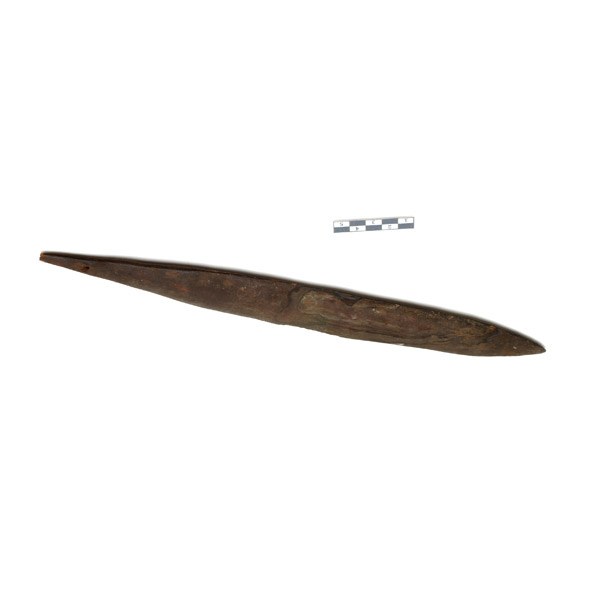
On Umboi the spirit had a tongue, and the women were expected to see it. Bamler’s Tami informants described men on Rook, today’s Umboi, building giant bodies of stuffed barkcloth topped with wooden masks. Beside them the bullroarer was presented as the spirit’s tongue and honoured as a “master.” It was no longer hidden from women: a boy’s closest female relatives were said to attend his circumcision and had to see the blade. Bamler thought the mask’s cult was older than the roarer’s.
Auf Rook hat man daneben auch das Schwirrbrett noch in Gebrauch, das dort als die „Zunge“ des Geistes ausgegeben wird.
On Rook the bullroarer also remains in use, presented there as the spirit’s “tongue.”
Bamler, “Tami,” Deutsch Neu-Guinea III (1911), p.512
Particulars
- Object
- Wooden bullroarer, presented as the tongue of a masked spirit.
- Function
- Spirit’s tongue in masked ceremonial life; reportedly shown to boys’ closest female relatives at circumcision.
Source
K. A. Gourlay, Sound-Producing Instruments in Traditional Society: A Study of Esoteric Instruments and Their Role in Male-Female Relations (New Guinea Research Bulletin 60; Canberra and Port Moresby, 1975), Table 1, entry 45 and p. 15; Georg Bamler, 'Tami,' in R. Neuhauss (ed.), Deutsch Neu-Guinea, vol. III (Berlin: Reimer, 1911), p. 512