No. PNG150
Gazelle: General
Papua New Guinea · East New Britain · Oceania · Sahul
Play / practical
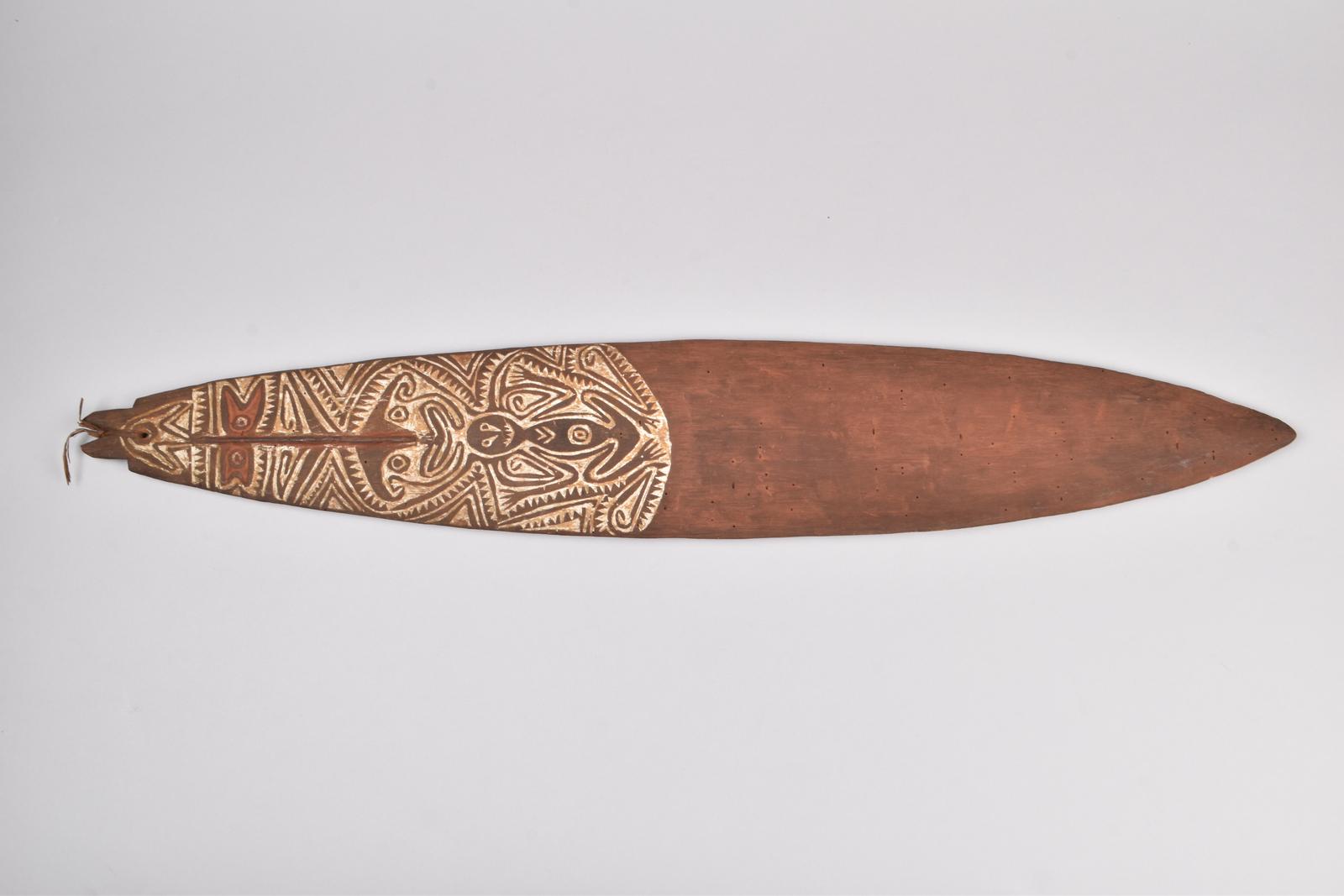
On the Gazelle Peninsula — heartland of the Duk-Duk and Tubuan, the masked men's societies whose spirits police New Britain village life — the bullroarer holds no such office. When Richard Parkinson catalogued the region's instruments around the turn of the twentieth century, he found the whirled slat here only in the hands of children: a plaything with no secret name, no forbidden ground, no death owed by a woman who saw it. The awe belonged to the masks; the roarer, for once, was left to the young.
Particulars
- Object
- Both the bullroarer and the slit-gong are in use here.
- Function
- On the Gazelle Peninsula the bullroarer was known only as a children's toy — unlike western New Britain and Buka, where Parkinson found it still a sacred instrument.
Source
K. A. Gourlay, Sound-Producing Instruments in Traditional Society: A Study of Esoteric Instruments and Their Role in Male-Female Relations (New Guinea Research Bulletin 60; Canberra and Port Moresby, 1975), Table 1, entry 150; Richard Parkinson, Dreissig Jahre in der Südsee (Stuttgart, 1907), p. 138