No. EXH2026-029
Kilenge (nausan)
Papua New Guinea · Cape Gloucester, far-west New Britain · Oceania · Bismarck Archipelago
Restricted
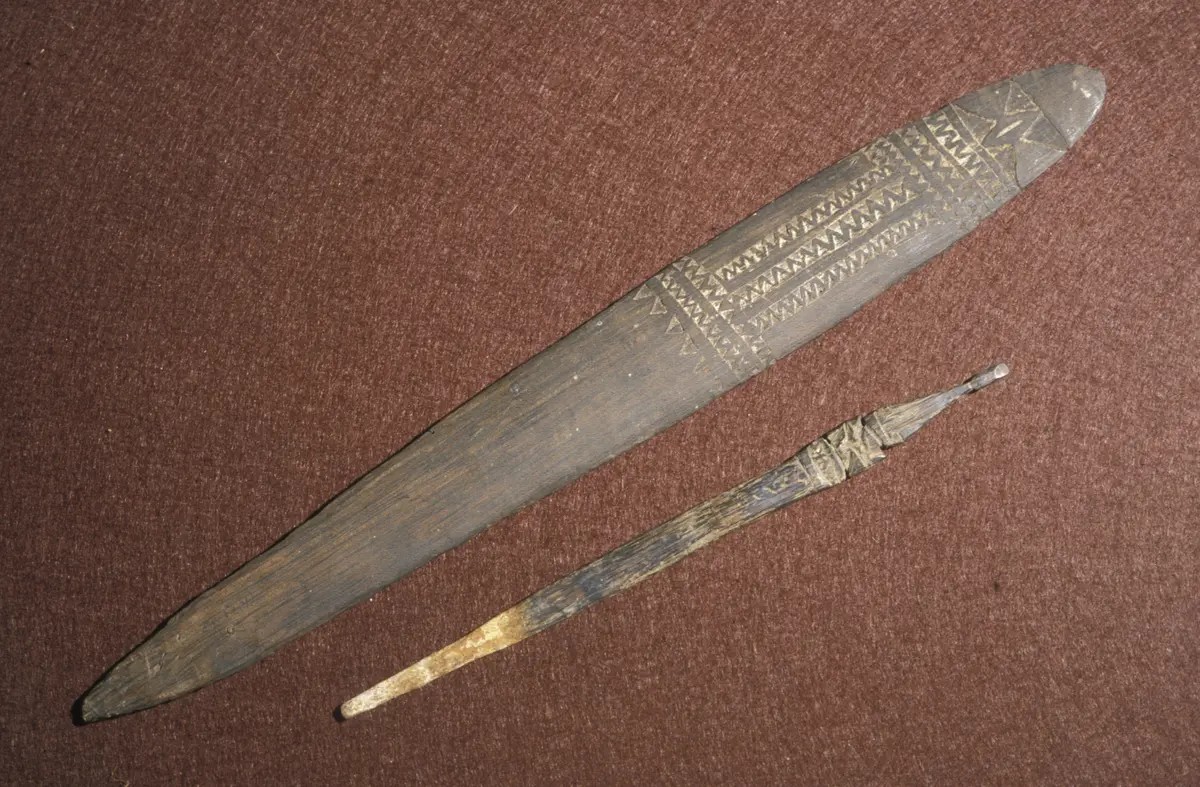
nausan
Source term: nausan-Schwirrholz
nausan: the Kilenge bullroarer, belonging to the men's nausung masked-spirit cult, kept from women and the uninitiated. Dark records the Kilenge idiom for it: the bullroarer is 'the tongue of nausung' — the mask-spirit's own organ of speech.
Etymology. Laufer records nausan as the Kilenge name of the bullroarer without glossing it; the form corresponds to nausung (nausang), the masked spirits of the Kilenge men's initiation cult, whose ceremonies used the bullroarer to keep women and children away. If that identification is right, the instrument bears the mask-spirits' name.
The Kilenge of Cape Gloucester, on the far-western tip of New Britain, traced the bullroarer back to women. The missionary-ethnographer Carl Laufer recorded their account: women of the nearby Siassi Islands, with whom the Kilenge traded, invented the first one out gathering firewood, when a splinter went whirring through the air. The men then killed the inventors and made the instrument their own. The same firewood-origin story runs along the Huon Gulf and the Bismarck coast. The Tami tell of a woman who finds a swinging chip of wood with a string attached and brings it home; the men agree to put a spell on her so that she dies, and the instrument becomes their secret. The Busama tell it more bluntly still: a husband spears his wife to death so the bullroarer will stay a male monopoly, and the women are told she was eaten by an ogre. Laufer worked among the Baining at the other end of the island, who blew bamboo trumpets alongside the bullroarer in their masked dances, in his words, to scare the women.
so erfanden die Frauen das erste Schwirrholz... Sie wurden später von den Männern getötet, die das Schwirrholz für sich übernahmen.
so the women invented the first bullroarer... They were later killed by the men, who took the bullroarer for themselves.
Laufer, "Rigenmucha, das höchste Wesen der Baining," Anthropos 41–44 (1946/49), fn. 39
Particulars
- Object
- Bullroarer (nausan).
- Function
- Sounded at the aulu or bokumu cylindrical-mask dance of the Barriai and Kilenge to warn off the uninitiated; a new member paid one pig to see the bullroarer and a second for admission to the dance.
Source
Carl Laufer, 'Rigenmucha, das höchste Wesen der Baining (Neubritannien),' Anthropos 41-44 (1946/49), pp. 497-560, fn. 39 (informant Lavatu); W. H. R. Rivers, The History of Melanesian Society, vol. II (1914), pp. 512-513, citing G. Friederici, Beiträge zur Völker- und Sprachenkunde von Deutsch-Neuguinea (1912), p. 102; Philip Dark, Kilenge chapter, in Exploring the Visual Art of Oceania