Is This a Bullroarer? · Research study ·
Stone Spatulas
Broad pierced blades and the wear of a taut cord
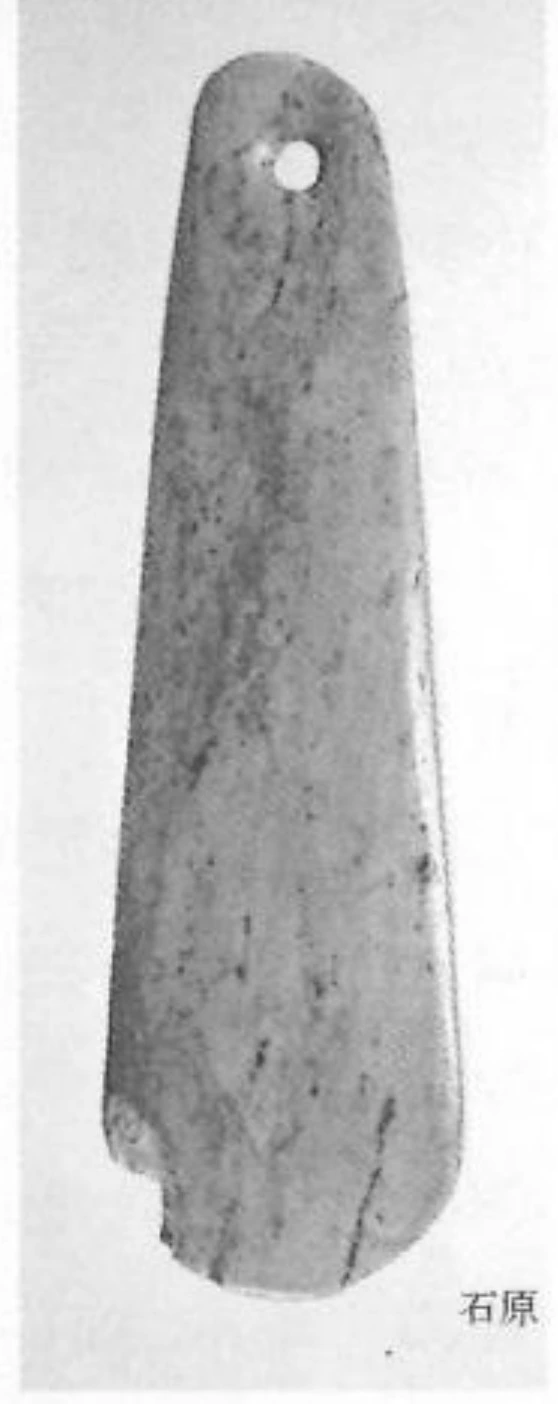
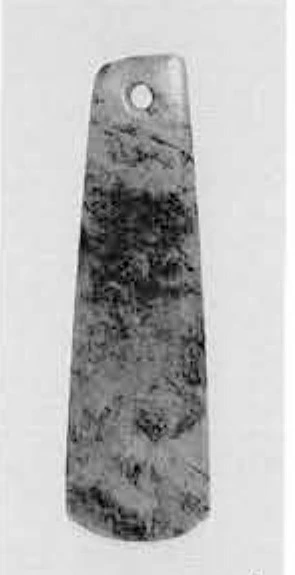
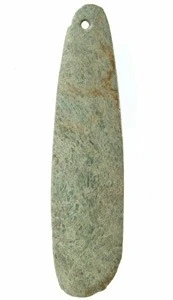
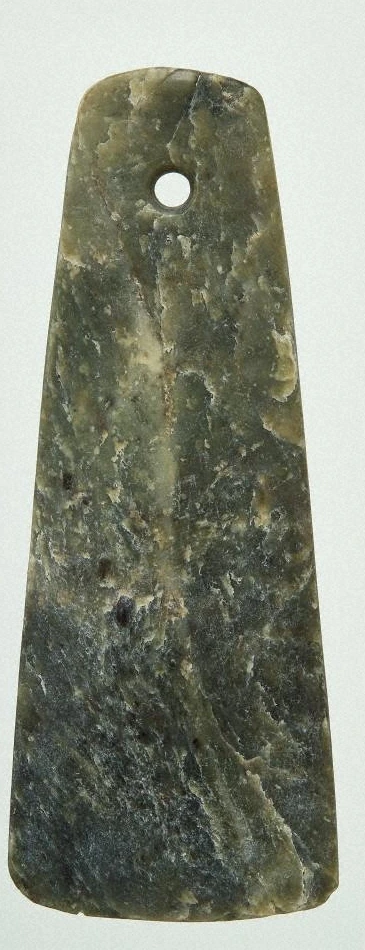
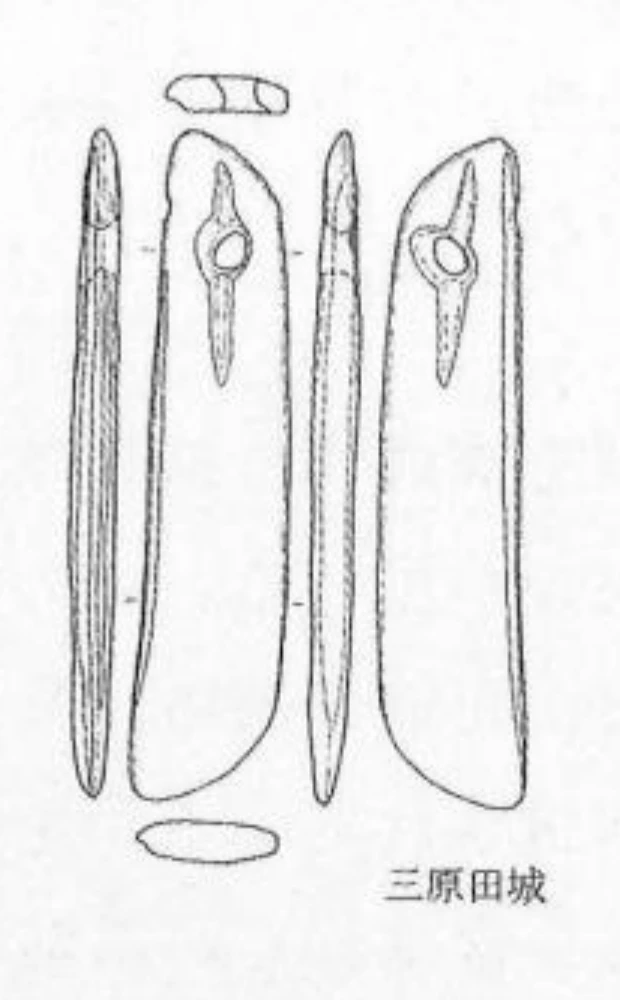
At Ishihara in Japan, a small hole interrupts the rounded top of a broad stone blade. The surface around it has a history: a soft attachment repeatedly pulled across the stone. Four related objects carry a similar pattern. They keep a record of how they moved, and it is not the record of an ornament hanging still.
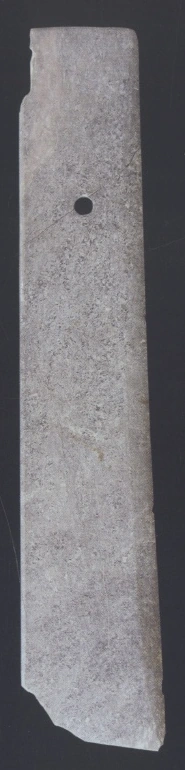
Five large Jōmon serpentinite spatulas carry the most telling wear in the jade complex: rubbing at about 45° on both faces of the hole, and none at its top, where a hanging pendant wears. Their observer, Igarashi Mutsumi, proposed waist ornaments on a taut cord. A whirled blade also pulls its cord taut, and spun replicas wear at the sides of the hole. The broad Chinese blades called spatulas are a separate case.
In brief
- Is it a bullroarer? Possibly, and theirs is the strongest case in the jade complex. Their holes are worn at the sides, as a whirled cord wears them, and not at the top, where a freely hanging pendant wears.
- Five serpentinite objects from Kanagawa and Gunma, Japan, of the late Early to initial Middle Jōmon, have near-45° wear on both faces of their holes and none at the top. Igarashi proposes waist ornaments or insignia on a cord held taut.
- Bone replicas whirled for fifteen hours wore mainly at the sides of the hole and only lightly at the top (Kumbani et al. 2019). The spatulas are worn where whirling wears.
- On Hokkaido the Ainu swung a spatula-shaped board, the rera-suyep, to raise the wind. Weather bullroarers run across northern Eurasia and North America, a practice likely far older than the spatulas.
- The Mitsugosawa-naka specimen measures 126 × 38 × 7.5 mm and weighs 62 g; Miharadajō 432 is 100 mm long with an approximately 5 mm bore.
- Chinese comparison pieces include a 4 mm-thick Dawenkou blade and two 5 mm-thick Zongri knives; their edges and attachment arrangements require individual explanations.
Where these objects were found

A broad end below a narrow attachment
These objects broaden away from a pierced end without the separate head of the headed blades or the pronounced tang of the tanged blades. Sixteen specimens or documented units enter this broad-form comparison. The Japanese stones range from serpentinite to tuff; “jade complex” does not identify every specimen’s mineral.
The Japanese term hera means spatula. It describes an outline; it does not make the object a kitchen tool. Endō Hiroya is a useful boundary case: its long body widens only gently, approaching the plain slats. Lingyanghe lies toward the opposite boundary, with a broad, nearly rectangular body. These boundaries matter when comparing possible uses.
Published interpretations
Igarashi Mutsumi interprets five large serpentinite examples from Kanagawa and Gunma as waist ornaments, possibly personal insignia · archived. He personally observed near-45° wear around the holes on both faces. Ordinary hanging would pull the cord toward the top; these oblique traces led him to propose a somewhat taut cord and contact against something. Bone replicas whirled mechanically for fifteen hours wore mainly at the sides of the hole and only lightly at its top (Kumbani et al. 2019); Igarashi’s spatulas were not simply hung.
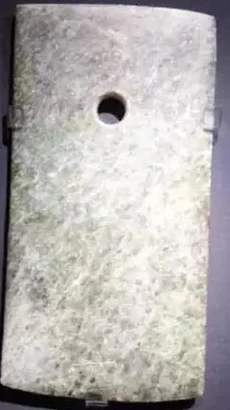
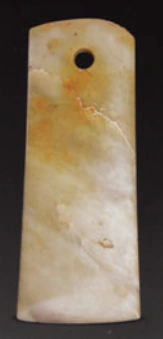
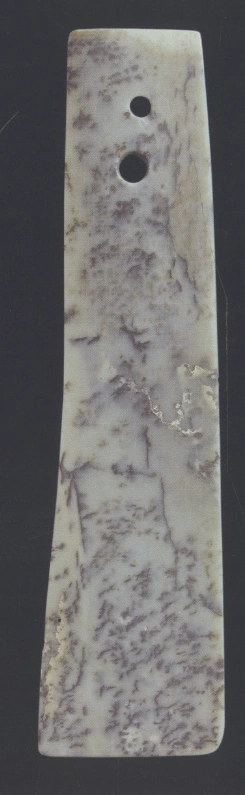
The Chinese objects have different published readings. The Shandong register interprets the yellow Dawenkou spade as an ornament derived from a tool · archived, citing its edged outline but no obvious edge-use traces. For the green Lingyanghe spade, the Juxian gazetteer offers a production tool or an axe symbolizing authority · archived. Zongri’s specimens are catalogued as jade knives, with no use traces reported. These are separate objects and observations, not competing votes on one universal function.
None of these accounts reports an acoustic trial or an experimental match between ancient wear and whirling. Testing selected specimens as bullroarers is the proposal made here; the published evidence currently concerns attachment, edges and possible ornament or tool use.
Japanese spatulas · published drawings
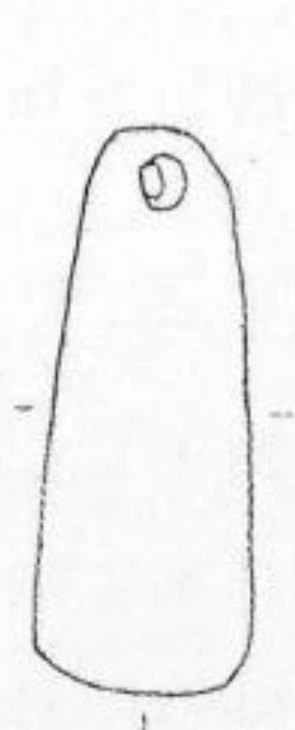
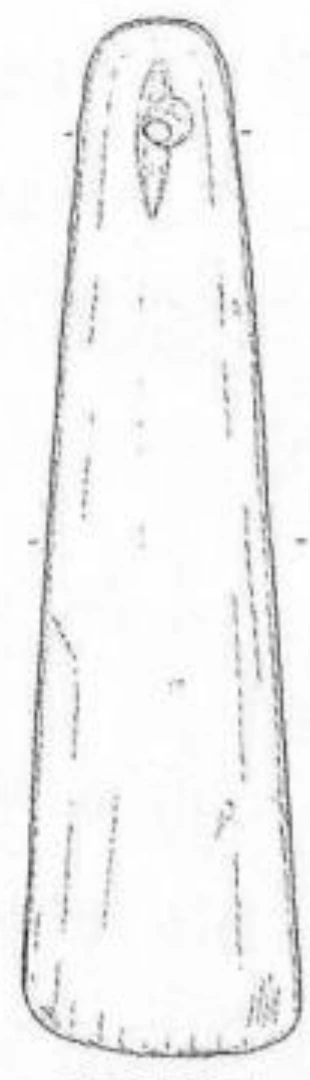
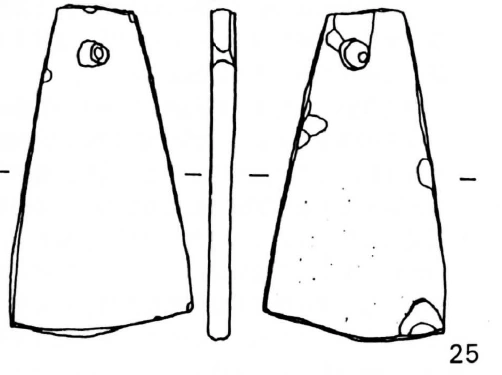
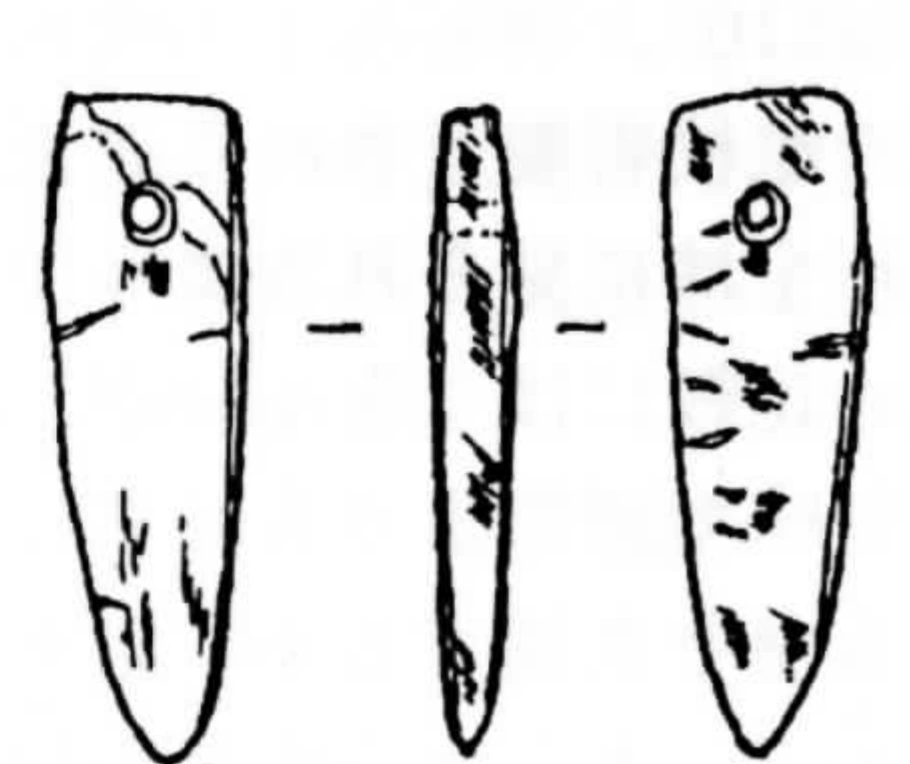
Twelve objects, different proportions
Each measurement belongs to its named specimen; an unreported thickness does not establish thinness. Dates in the Japanese group are cultural attributions: Igarashi places the five serpentinite examples in the late Early to initial Middle Jōmon, following Tsubota Hiroko. The Chinese pieces below span distinct archaeological cultures.
Scroll sideways to compare all columns.
| Object | Country | Dimensions (mm) | Published observation | Source locator |
|---|---|---|---|---|
| Ishihara | Japan | Not individually measured here | Serpentinite; angled wear at bore | Igarashi, p.4 |
| Yamaguchidai | Japan | Not individually measured here | Serpentinite; earth pit; angled wear | Igarashi, p.4 |
| Endō Hiroya | Japan | Not individually measured here | Slender boundary form; pit; angled wear | Igarashi, pp.4,9 |
| Mitsugosawa-naka 75土-1 | Japan | 126 × 38 × 7.5; 62 g | Complete serpentinite object; pit 75 | Report, Fig.194/table |
| Miharadajō 432 | Japan | 100 long; bore ≈5 | Serpentinite; pit 86; depressions across bore | Report, pp.146–147 |
| Nakano B 239 | Japan | 82 × 25 × 8; 15.9 g | Tuff; axe-like tapering plate | Aomori Bulletin 30, Fig.7/Table8 |
| Yoshimine | Japan | 120 × 30; thickness unreported | Early Jōmon; classified as a pendant | Toyama virtual museum |
| Sannai-Maruyama 9530 | Japan | 78 long; thickness unreported | Early Jōmon; flat tapering pendant | Sanmaru database 9530 |
| Dawenkou yellow spade · archived | China | 178 × ≈72 × 4 | Terminal tubular bore; three edged sides | Shandong provincial register |
| Lingyanghe green spade · archived | China | 196 × 100; thickness unreported | 16 mm bore; flat, nearly rectangular body | Juxian gazetteer |
| Zongri 152 · archived | China | 234 × 44–60 × 5 | Two bores; curved beveled edge | Gu Fang ed., vol.15, no.152 |
| Zongri 153 · archived | China | 285 × 46–55 × 5 | One bore; losses at ends/edge | Gu Fang ed., vol.15, no.153 |
The Yoshimine museum entry · archived gives its own 120 × 30 mm dimensions. The Sannai-Maruyama archive · archived identifies object 9530 and its 78 mm length. Neither entry supplies a motion-specific wear diagnosis.
Five holes with the same oblique wear
Igarashi’s five observations concern Ishihara, Yamaguchidai, Endō Hiroya, Mitsugosawa-naka and Miharadajō. Their shared wear supports treating this particular subgroup together; it cannot supply a wear diagnosis for Yoshimine, Nakano B 239 or every object called hera. His account supplies no matched experimental wear controls.
Four of the five came from earth pits; Ishihara is the exception in his account. “Pit” does not establish a grave or a position on a body. The Mitsugosawa-naka excavation table · archived independently records a complete serpentinite object, 126 × 38 × 7.5 mm and 62 g. The Miharadajō report, p.147 · archived, describes groove-like depressions crossing the hole on both faces. It also distinguishes marks from manufacture along an edge. Those observations should remain separate from Igarashi’s later use-wear interpretation.
The Ainu swung a spatula for wind
On Hokkaido, Japan’s northern island, the Ainu swung a board to raise the wind. At Shiraoi in 1916 Neil Gordon Munro saw a booming device shaped like the Ainu weaving spatula, used to bring a favourable wind for the deer hunt. In the north of the island the same object was called rera-suyep, the wind-raiser. An old woman, Tekatte Fuchi, answered the name by miming the swing of the arm and the roar, and remembered that as a girl she and the other children were forbidden to swing a spatula “lest by so doing they raised a storm” (N. G. Munro, Ainu Creed and Cult, 1962, p. 117). The Ainu boards were wooden and much larger than these stones; the action was the same: a flat blade on a cord, swung to move the weather.
The Ainu were not alone. Whirling a blade for wind, rain, thunder or thaw runs across the whole north. In Europe it was the Scottish thunder-spell and the bullroarers of Norwegian fishermen. In Siberia the Khanty and Mansi of the Ob asked for wind with one, the Nganasan and Enets of the Taimyr Peninsula called it with another, and the Chukchi storm howler, the Vadul weather blade of the Kolyma and the Amur Evenki wind-summoner carry the practice to the Pacific. Across the Bering Strait it continues among the Gwich’in of Alaska, the Dakelh of British Columbia, the James Bay Cree, and the Shoshone and Paiute of the Great Basin in the western United States, who swung it for wind and to bring a thaw. The atlas records nearly seventy weather bullroarers across northern Eurasia and North America.
A practice spread that widely, on both sides of the Bering Strait, is not a recent invention. It is likely far older than the Jōmon spatulas, which makes the Ainu wind-raiser a fair model for them: a spatula-shaped blade, swung on a cord, to call the wind.
Broad Chinese blades retain their edges
The yellow Dawenkou blade from Shandong, China, has three edged sides and a body only 4 mm thick. Zhong Yaxun illustrates this exact object at right in her 2024 study, p.47, fig.22 · archived. Lingyanghe’s larger green spade has a 16 mm eye, but its own thickness is unreported. An edge, a hole and a similar outline do not establish the same attachment or use.
The two Zongri objects from Qinghai, China, have a different attachment contrast: catalogue 152 has two neighboring holes, while 153 has one. Both preserve a curved beveled edge. Gu Fang’s catalogue, volume 15, nos.152–153 · archived, reports no use traces on either. That is a limited published inspection, not a microscopic demonstration that bindings never touched them. Their Qijia attribution does not supply a date for an individual grave.
The useful test is how the cord moved
A hole, a broad face and a thin body make selected specimens worth testing as rotating blades. A successful replica would demonstrate that the chosen stone, dimensions and rigging can produce sound. Historical identification requires another match: where the ancient attachment touched the hole, which direction it moved, and whether the faces contacted skin, clothing or a haft.
For the five Japanese specimens, a comparison of experimentally worn pendants, waist fittings and rotating replicas could test Igarashi’s explanation against whirling under matched conditions. The different sizes, sections and contexts collected under hera give no reason to assign every Japanese spatula one function. Until that test is run, the wear points to a cord pulled taut and moving, which a whirled blade explains at least as well as an ornament; the Chinese edged blades preserve a wider set of possibilities.
Chinese comparisons · one hole or two
The comparative catalogue
Measurements are length × width × thickness in millimetres. A dash means unreported; ≈ marks an estimate. Groups and possible duplicate objects remain labelled. Download the specimen table.
View all 16 evidence entries
Scroll sideways to compare all columns.
| Object | L × W × T, mm | Material | Context | Reported traces |
|---|---|---|---|---|
| Ishihara · Ishihara site large hera-shaped pendantJapan · object; minimum 1 | — × — × —Source gives >100 mm class; do not treat this as exact specimen measurement. | serpentinite | unknown | Bilateral oblique wear near 45 degrees at perforation, reported for each of the five by Igarashi. |
| Yamaguchidai · Yamaguchidai site large hera-shaped pendantJapan · object; minimum 1 | — × — × —No individual body dimensions reported in the cited lecture; its over-100 mm description concerns the group. | serpentinite | Earth pit; burial use is not established. | Bilateral oblique wear near 45 degrees at perforation, reported for each of the five by Igarashi. |
| Endo Hiroya · Endō Hiroya site large hera-shaped pendantJapan · object; minimum 1 | — × — × —No individual body dimensions reported in the cited lecture; its over-100 mm description concerns the group. | serpentinite | Earth pit; burial use is not established. | Bilateral oblique wear near 45 degrees at perforation, reported for each of the five by Igarashi. |
| Mitsugosawa Naka · 75土-1Japan · object; minimum 1 | 126 × 38 × 7.5Reported 126 × 38 × 7.5 mm, 62 g; complete specimen 75土-1. | serpentinite | Pit 75; burial use is not established. | Bilateral oblique wear near 45 degrees at perforation, reported for each of the five by Igarashi. |
| Miharadajo · 432Japan · object; minimum 1 | 100 × — × —Reported length 100 mm; bore approximately 5 mm. Width and thickness unreported. The lecture’s over-100 mm group description does not replace this individual measurement. | serpentinite | Pit 86; burial use is not established. | Bilateral oblique wear near 45 degrees at perforation, reported for each of the five by Igarashi. |
| Nakano B · 239Japan · object; minimum 1 | 82 × 25 × 8 | tuff | unknown | not reported |
| Nokubi Hera · Nokubi trapezoid pendant of imported sandstoneJapan · object; minimum 1 | 80 × — × — ≈Length (and Wanigawa full dimensions) estimated from published scale; approximate, not published specimen measurements. | fine-grained hard sandstone | mixed | not reported |
| Yoshimine · Yoshimine hera-shaped pendantJapan · object; minimum 1 | 120 × 30 × — | polished stone | unknown | not reported |
| Sannai Maruyama · 9530Japan · object; minimum 1 | 78 × — × — | green stone | unknown | not reported |
| Uril Sapunov · Fig1.6.5:17 · archivedRussia · object; minimum 1 | — × — × — | stone; exact material unpublished | unknown | not reported |
| Wanigawa · Wanigawa shell-mound wedge pendant — Goto Islands, Late–Final Jomon · archivedJapan · object; minimum 1 | 43 × 13 × 9 ≈Length (and Wanigawa full dimensions) estimated from published scale; approximate, not published specimen measurements. | soft serpentinite/near-steatite; chalcedony also suggested | midden | not reported |
| Lingyanghe · gazetteer green spade · archivedChina · object; minimum 1 | 196 × 100 × — | jade (mineral not established) | unknown | not reported |
| Maquan Unnamed Site · Wang photo12 · archivedChina · object; minimum 1 | 190 × 28–42 × 2–8photo11 width40–57mm, thickness2–7mm; photo12 width28–42mm, thickness2–8mm. | jade (mineral not established) | unknown | not reported |
| Dawenkou · 1959 yellow spade · archivedChina · object; minimum 1 | 178 × 72 × 4 | jade (mineral not established) | unknown | Register reports no obvious edge use traces; scope limited |
| Zongri · catalogue152 · archivedChina · object; minimum 1 | 234 × 44–60 × 5Reported individual width range 44–60 mm, thickness 5 mm. Two near-narrow-end bores. Measurements and wear observations belong to this catalogue specimen. | jade (mineral not established) | unknown | Catalogue152 explicitly states 无使用痕迹 (no use traces); limited catalogue observation, not proof of absent hafting. |
| Zongri · catalogue153 · archivedChina · object; minimum 1 | 285 × 46–55 × 5Reported individual width range 46–55 mm, thickness 5 mm. One near-narrow-end bore. Measurements and wear observations belong to this catalogue specimen. | jade (mineral not established) | unknown | Catalogue153 explicitly states 无使用痕迹 (no use traces); limited catalogue observation, not microscopy or proof of no hafting. |
Key sources
- Igarashi Mutsumi (五十嵐睦), “Accessories as a view of the Jōmon period: stone ornaments” (アクセサリーから見た縄文時代~石製装身具の様相~), Kanagawa Prefecture lecture PDF, pp.4,9. · archived Firsthand wear observations and waist-ornament/insignia proposal. P.9, fig.4 embeds the five-object fig.2. Chronology follows Tsubota 2017; wear interpretation is Igarashi’s.
- Mitsugosawa-naka excavation report, fig.194, pl.89 and pit 75 measurement table, 75土-1. · archived Complete serpentinite object; 12.6 × 3.8 × 0.75 cm, 62 g. 玉斧 (“jade axe”) is the report classification.
- Miharadajō excavation report, pp.146–147, no.432, pit 86. · archived 100 mm length, approximately 5 mm biconical bore, transverse depressions on both faces and separate manufacture marks.
- Aomori Prefectural Buried Cultural Property Center, Research Bulletin 30, fig.7 and table8; Nakano B 239. · archived Individual crosswalk: Nakano B 239 = fig.7:2. Measurements refer only to this tuff specimen.
- Toyama Prefecture virtual museum, Yoshimine site pendant. · archived Official object page: Early Jōmon; 12.0 cm long, maximum width 3.0 cm.
- Sannai-Maruyama Jōmon Culture Center, Sanmaru Search, stone pendant 9530. · archived Early Jōmon, 7.8 cm; report 35, fig.241-6. The page’s generic slit-earring caption is inconsistent with its object title/image and is not adopted.
- Shandong provincial gazetteer, Cultural Relics volume, “Pre-Qin jades,” perforated yellow jade spade. · archived Archived mirror of provincial register. Exact dimensions, 1959 Dawenkou find, edges and limited negative edge-use observation.
- Zhong Yaxun, “Before becoming kings: the formation of prehistoric Chinese jade and stone axes,” Palace Museum Monthly of Chinese Art 491 (2024), pp.36–49, especially pp.47–48, fig.22 right. · archived Exact yellow Dawenkou blade illustrated at right; the neighboring inlaid white object is different.
- Juxian gazetteer, “Stone, pottery and porcelain,” green jade spade entry. · archived Archived mirror of original gazetteer: Lingyanghe, 1979, 19.6 cm long, 10 cm wide, 1.6 cm bore; no own thickness.
- Gu Fang, ed., Complete Collection of Jades Unearthed in China, vol.15 (2005), catalogue nos.152–153; text by Cui Zhaonian, photographs by Ye Maolin. · archived Original object pages visually checked; two different Zongri knives, own dimensions and limited no-use-traces observations. Public scan route.