No. EA-SANNAI-MARUYAMA-9530
Sannai-Maruyama tapering greenstone pendant
Aomori, Japan; Sannai-Maruyama official object 9530 · East Asia
Function not recorded Candidate only
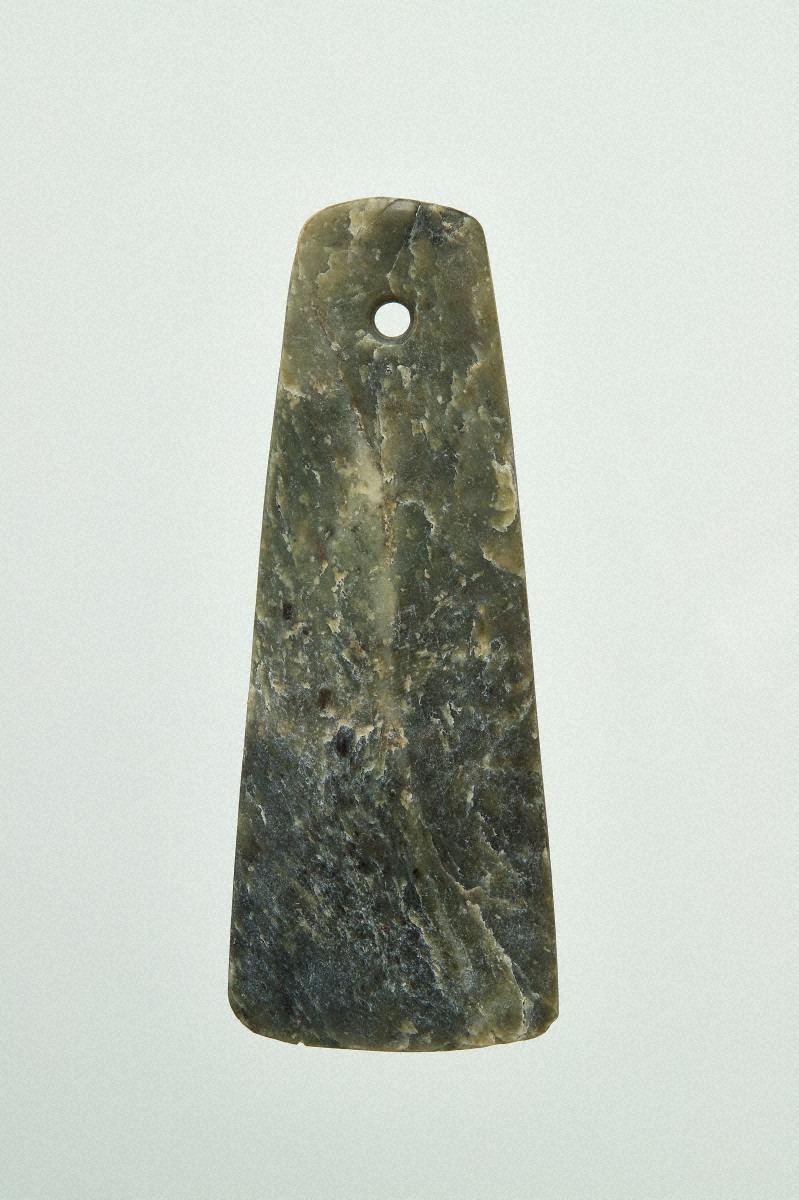
石製垂飾品
Source term: 石製垂飾品; 有孔石製品; stone pendant; official Sanmaru Search object
石製垂飾品 (sekisei suishokuhin): 'stone pendant'
Flat, green and ground smooth, this Early Jōmon pendant is 7.8 centimetres long and pierced once near its rounded top. It comes from Japan's most celebrated Jōmon settlement — the great Aomori village of monumental posts and a millennium of continuous occupation — and it is catalogued exactly as what it appears to be: a stone pendant. In profile it is a thin, elongated, end-hung blade — the silhouette that reads as a bullroarer wherever an ethnographer rather than an ornament specialist happens to describe it. It survives exactly as it must once have hung: labelled a pendant, photographed, and never asked to make a sound.
Particulars
- Object
- A flat, tapering slab of green stone, ground smooth, 7.8 cm long, with one round hole near its narrow top.
- Function
- Catalogued as an Early Jōmon stone pendant (石製垂飾品) in the official Sannai-Maruyama database; no wear or function study is published.
Source
Aomori Prefecture, Sannai-Maruyama site, Sanmaru online database, object 9530 (石製垂飾品); Sannai-Maruyama report 35, fig. 241-6