No. EA-YOSHIMINE-001
Yoshimine hera-shaped pendant
Tateyama, Toyama Prefecture, Japan; Yoshimine site, Early Jomon · East Asia
Function not recorded Candidate only
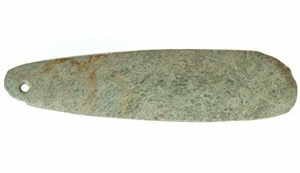
箆状垂飾
Source term: 箆状垂飾; hera-shaped pendant; spatula-shaped pendant
箆状垂飾 (hera-jō suishoku): 'spatula-shaped pendant'
The Yoshimine terrace above the Jōganji River was being cut away for soil when Toyama archaeologists pushed through a rescue excavation in 1973–74; among the Early Jōmon houses and pits they salvaged was what the prefecture's own newsletter calls a 'rare hera-shaped pendant' — a spatula of polished stone twelve centimetres long and three wide, pierced once through the end. The official object page says almost nothing else: no material, no thickness, no wear notes, just the classification 'pendant.' The hera class it belongs to is scattered thinly across Early Jōmon Japan and has attracted a century of guesses — hairpin, waist ornament, insignia — none of which sits comfortably on a hand-length polished blade. At twelve centimetres Yoshimine's is among the largest, well into the size range of working bullroarers.
出土品の中には、珍しい箆状垂飾もあります。
Among the excavated finds is also a rare hera-shaped pendant.
Maibun Toyama, vol. 158 (2022), on the Yoshimine site
Particulars
- Object
- A spatula-shaped (hera) pendant of polished stone, 12.0 cm long and 3.0 cm at its widest, pierced once at the end.
- Function
- Published as a rare hera-shaped (spatula) pendant from the 1973–74 rescue excavation; the pendant label is classificatory rather than argued, and the large end-holed form is that of a whirled blade.
Source
Toyama Prefectural Center for Archaeological Operations, Maibun Toyama 158 (2022); Toyama Prefecture virtual museum, 吉峰遺跡 垂飾