Is This a Bullroarer? · Research study ·
The Plate in the Writing Kit
Roman bone plates • Britain, continental Europe and Syria • chiefly the first four centuries CE
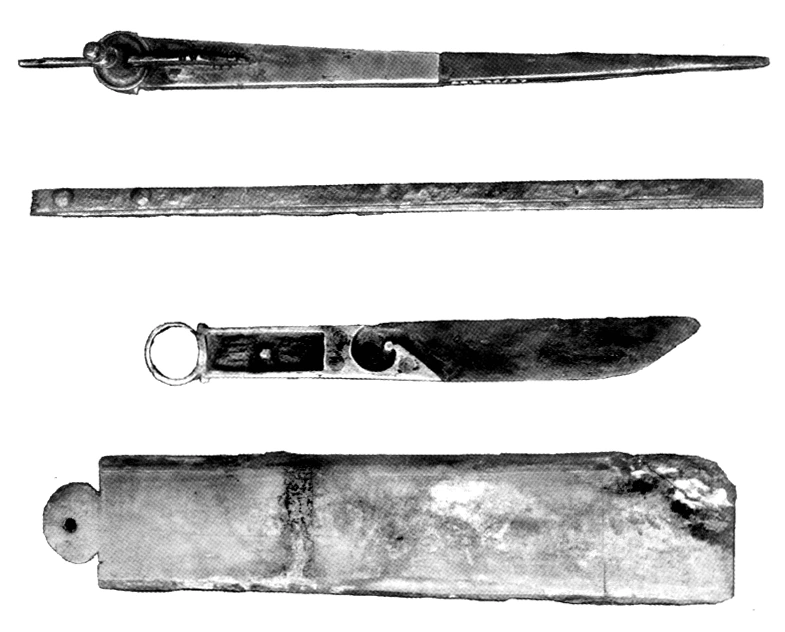
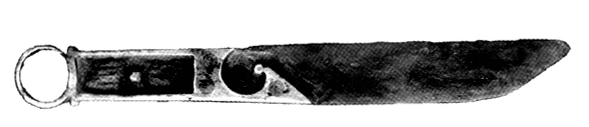
In a Roman grave at Nijmegen, in the Netherlands, a thin bone plate survived stuck to an iron wax spatula. Two other graves in the same cemetery held similar combinations. Around them lay styli, small knives and inkwells: equipment for making, correcting and keeping written words. The plates have the long blade and terminal tab that can invite comparison with a bullroarer. Their companions place them much closer to a writing desk.
These plates belong to the writing kit. Graves set them beside styli, inkwells and wax spatulas, and their faces are worn by rubbing, as a ruler or a wax smoother would be. Their shape recalls a bullroarer; nothing else about them does.
In brief
- Is it a bullroarer? No. They are most likely writing tools, used as rulers or wax smoothers. The case is quite strong.
- Sixty-six of these thin bone plates are catalogued from Roman Britain, continental Europe and Syria, chiefly of the first four centuries CE. Some end in a pierced round tab; some are not pierced at all.
- Where a grave records what lay with them, it is most often writing equipment. At Nijmegen one plate is corroded onto an iron wax spatula.
- On the London plates, long marks run along the blades and shorter ones cross them, strongest on the curved face: the wear of rubbing or drawing, not of a cord.
- Which writing task they served, ruling or smoothing wax, is still open.

A blade made for the hand
A typical plate is palm-length, with a broad, thin blade and a small terminal head. Many have a hole through the head; others have a wider, unpierced head above sloping shoulders. Johnson separates rectangular blades, blades that widen toward the foot, and tapering blades. The principal rectangular group measures roughly 100–140 millimetres long and 20–30 millimetres wide. Several objects are curved in section rather than flat on both faces. These are carefully shaped objects, not simply scraps cut from bone. Johnson, catalogue pp. 1–18.
The title “bone ruler” is a useful scholarly label, but it already contains an interpretation. A straight edge could guide a line. A polished face could work against another surface. A hole could attach the tool to a thong or case. None of those features by itself identifies the action. Even the material is not uniform: the Brindisi specimen is reported as apatite rather than bone. Johnson, catalogue p. 8.
Published outlines · independently enlarged · not to a common scale

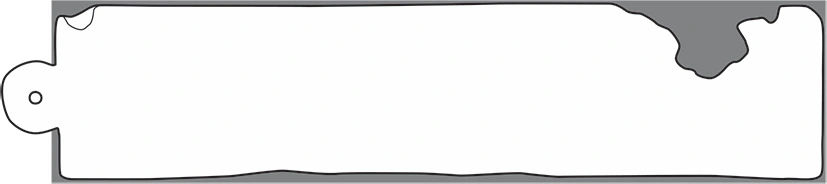
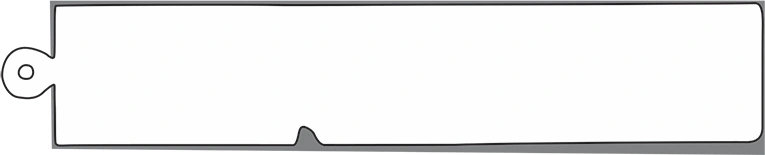
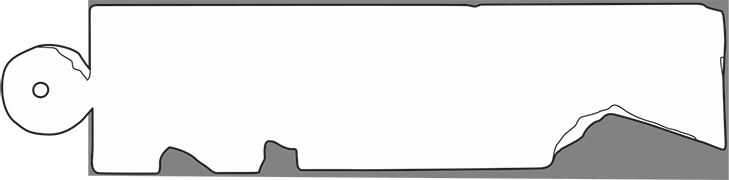


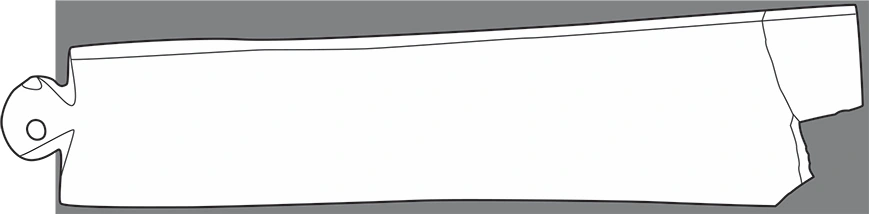
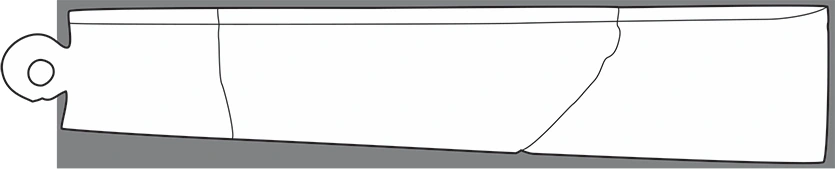



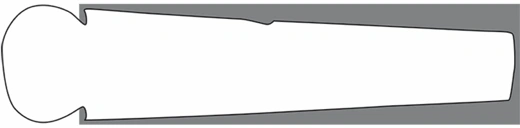
Sixty-six specimens, an expanded catalogue
The firm starting point is William A. Johnson’s catalogue of 66 numbered specimens, assembled from excavation publications, museum information and earlier studies. It is a reference collection, not a random sample of Roman possessions. Many descriptions are brief, several objects are fragmentary, and some drawings reproduce old photographs. The catalogue distinguishes its numbered corpus from other possible or claimed examples. The numbered corpus itself includes an unfinished Southwark blank, I.A.13. Johnson, catalogue pp. 4, 18–19.
An expanded inventory contains 81 entries: the original 66, three additional specimens, two possible fragments, seven workshop blanks and three unverified leads. Those categories must stay visible. Seven blanks from one workshop are seven artifacts, but only one production deposit; two unresolved mentions are not two demonstrated rulers. The extended total therefore measures the range of material considered, rather than 81 confirmed examples of one tool.
Within the original 66, fourteen entries are attributed to explicit graves. Nine report an inkwell or stylus without the additional identification or assemblage qualifications retained here; five carry such qualifications. All fourteen have a reported writing association of some kind. Two further entries, from Zadar in Croatia and Aquileia in Italy, have uncertain funerary provenance. The remaining fifty have settlement or site-level provenances of varying precision. An inkwell omitted from a short description cannot be counted as an inkwell absent from an excavated assemblage. Johnson, catalogue pp. 3–18.
The objects beside the plates
Nijmegen supplies the closest connections. Johnson reports that the plate in grave 8 adhered to a wax spatula; the plate in grave 9 adhered to a stylus and spatula; and the very fragmentary plate in grave 11 adhered to a spatula. Fünfschilling independently discusses the three plates beneath the spatulas. A stylus is the pointed implement for writing in wax; a wax spatula is a broader tool for working the wax surface. They are distinct tools, and the bone plate accompanied them. Johnson, catalogue p. 5; Fünfschilling 2012, pp. 170–171, 196 · archived.
Scroll sideways to compare all columns.
| Assemblage | Date of context | Plate and companions | Association |
|---|---|---|---|
| Nijmegen grave 8, Netherlands | 80–100 CE | Plate; wax spatula; two styli; knife; inkwell | Plate fused to spatula |
| Nijmegen grave 9, Netherlands | 100–115 CE | Plate; wax spatula; three styli; knife; inkwell; pouch remains | Plate fused to stylus and spatula; tablet wood only possible |
| Nijmegen grave 11, Netherlands | 95–110 CE | Plate fragments; spatula; three styli; knife; inkwell | Plate fused to spatula |
| Berlingen grave 26, Belgium | Early Flavian, approximately 70–80 CE, in excavation report | Plate; possible inkwell; points later identified as styli; knife; later wax-spatula identification; divider; folding measure | Same grave; several tool names are later interpretations |
| Augst, Switzerland, find complex B01701 | 30–75 CE, pottery dating | Plate 1978.3610; ceramic inkwell rim/ink collector 1978.19285 | Explicit published cofind; a closed personal kit is unestablished |
| Huissen, Netherlands | Approximately 80–100 CE, from inkwell | Spatulate bone strip; bronze inkwell; small bone-handled knife | Reported together in a wooden box; additional to the 66 |
Sources: Johnson, catalogue pp. 5, 10, 12; Roosens and Lux 1973, pp. 20–31, 48–50 · archived; Fünfschilling 2012, p. 200 table 4, catalogues 181 and 281 · archived; de Bruin 2024, p. 341. Dates belong to the associated deposits or objects, not direct measurements of the plates’ age.
Berlingen makes a particularly useful comparison because its grave also contained a genuine folding measure, marked with units. The thin bone plate and the measuring rule were separate objects. Their coexistence suits a varied writing-and-measuring kit, while leaving the plate’s particular job to be explained. Roosens and Lux 1973, pp. 30–31, fig. 20 · archived.
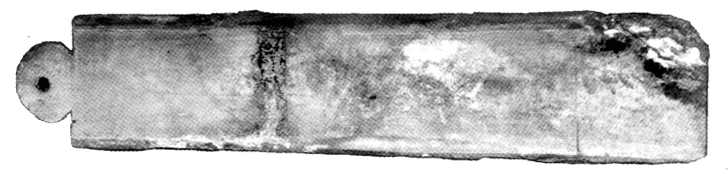



Literacy carried into burial
Writing equipment could express education, occupation or social standing when it was selected for burial. At Nijmegen, four of eleven burials inside walled enclosures contained writing equipment; a fifth equipped burial lay outside. De Bruin interprets these enclosed graves as probably belonging to the municipal elite and their tools as a display of status. This is a count for that particular group, not the frequency of writing tools in all Roman graves. De Bruin 2024, p. 345, §9.5.3.
The plate-bearing graves include different ages and burial practices. Nijmegen graves 9 and 11 held women, while Brescia’s example came from a child’s small sarcophagus. Berlingen’s plate accompanied a cremation in a rich chamber burial. A grave location can therefore explain why a useful possession was preserved without turning the possession into a musical or initiatory instrument. Johnson, catalogue pp. 5, 10, 14; Roosens and Lux 1973, pp. 20–31, 58 · archived.
Ruling, smoothing and sounding
London brings the question from companions to contact surfaces. Glynn Davis examined the plates under magnification and variable light. He described long marks running along the blades and shorter, parallel marks crossing them, often more strongly on the curved face. Some specimens show little edge wear. He also identified a Southwark blank with manufacturing saw marks and no discernible use wear: making a tool leaves its own traces. Davis 2016, pp. 8–11 · archived.
Davis considered rulers plausible in size, but questioned ruling as their primary task. Some blades twist along their length; the face scratches suggest rubbing or drawing contact. He proposed finishing or smoothing tablet wax, while observing that the expected regular contact with a tablet frame was not clearly expressed in the marks. That is a functional proposal grounded in wear, rather than an established reconstruction of a Roman movement. Davis 2016, p. 11 · archived.
Against that evidence, the bullroarer comparison currently rests on general shape and, for pierced examples, the possibility of attaching a cord. The inspected descriptions supply no specimen-specific acoustic trial or diagnostic comparison between rotating-cord wear and the ancient marks. The unpierced forms also need their own explanation. A replica that roars would establish a capability; identifying ancient use would require that capability to agree with the object’s wear and context.
The best present identification is therefore a writing accessory, with ruling and wax-working among the plausible operations. The question has become quite specific: what repeatedly touched the curved faces, and why? Experimental wear matched to the surviving plates could distinguish those actions. For now, the inkwells, styli and spatulas give these modest blades their clearest place in Roman life.
Download the full 81-entry comparative table · The original 66-specimen catalogue and later additions are labelled separately.
Key sources
- William A. Johnson, Catalogue of known specimens of bone rules (2022; accompanying 2023 publications), pp. 1–19. Numbered reference corpus of 66. Nijmegen p.5; Berlingen p.10; Brindisi p.8; Augst p.12. Catalogue header errors for Nijmegen and Ljubljana are not reproduced.
- William A. Johnson, “Typological Catalogue of the ancient Roman Scribal Tool Known as a Bone Rule,” Journal of Open Archaeology Data 11 (2023), pp. 1–7, especially p.2. Dataset method, three broad forms, publication-based scope and explicit uncertainty over exact function.
- H. Roosens and G. V. Lux, Grafveld met gallo-romeinse tumulus te Berlingen, Archaeologia Belgica 147 (1973), pp.20–31,48–50,58. · archived Original grave26 account; plate38d13cm, separate folding bronze measure38c. Original tool identifications differ from later writing-tool interpretations.
- Sylvia Fünfschilling, “Schreibgeräte und Schreibzubehör aus Augusta Raurica,” Jahresberichte aus Augst und Kaiseraugst 33 (2012), pp.170–172,196,200,222,227–228. · archived Nijmegen associations; Berlingen and Budapest assemblage drawings; Augst181/281 explicit cofind references.
- Glynn J. C. Davis, “Bone Spatulate Strips from Roman London,” Lucerna 51 (2016), pp.6–12, especially8–11. · archived Actual surface observations and wax-smoothing proposal. Not a performed experiment.
- Jasper de Bruin, “Writing Equipment and Latin Literacy in the Netherlands: An Archaeological Perspective,” in Latinization, Local Languages, and Literacies in the Roman West (2024), pp.321–354; Huissen p.341; Nijmegen p.345,§9.5.3. Bounded elite burial denominator and published Huissen box assemblage; publisher-indexed full chapter text checked.
- Dragan Božič and Michel Feugère, “Les instruments de l’écriture,” Gallia 61 (2004), pp.38–40,figs33–35. Berlingen equipment photograph and interpretation of writing sets in Atimetus shop relief.
- Patrick Prévot, “Un atelier de fabrication de règles en os dans une villa gallo-romaine de Cuperly (Marne)?,” Revue archéologique de l’Est 59 (2010),pp.539–565,figs5–6,§§129–130. · archived Seven workshop blanks kept outside numbered66; manufacturing observations do not establish use.