No. EA-ENDOHIROYA-HERA-001
Endō Hiroya site large hera-shaped pendant
Fujisawa, Kanagawa, Japan; Endo Hiroya site · East Asia
Function not recorded Candidate only
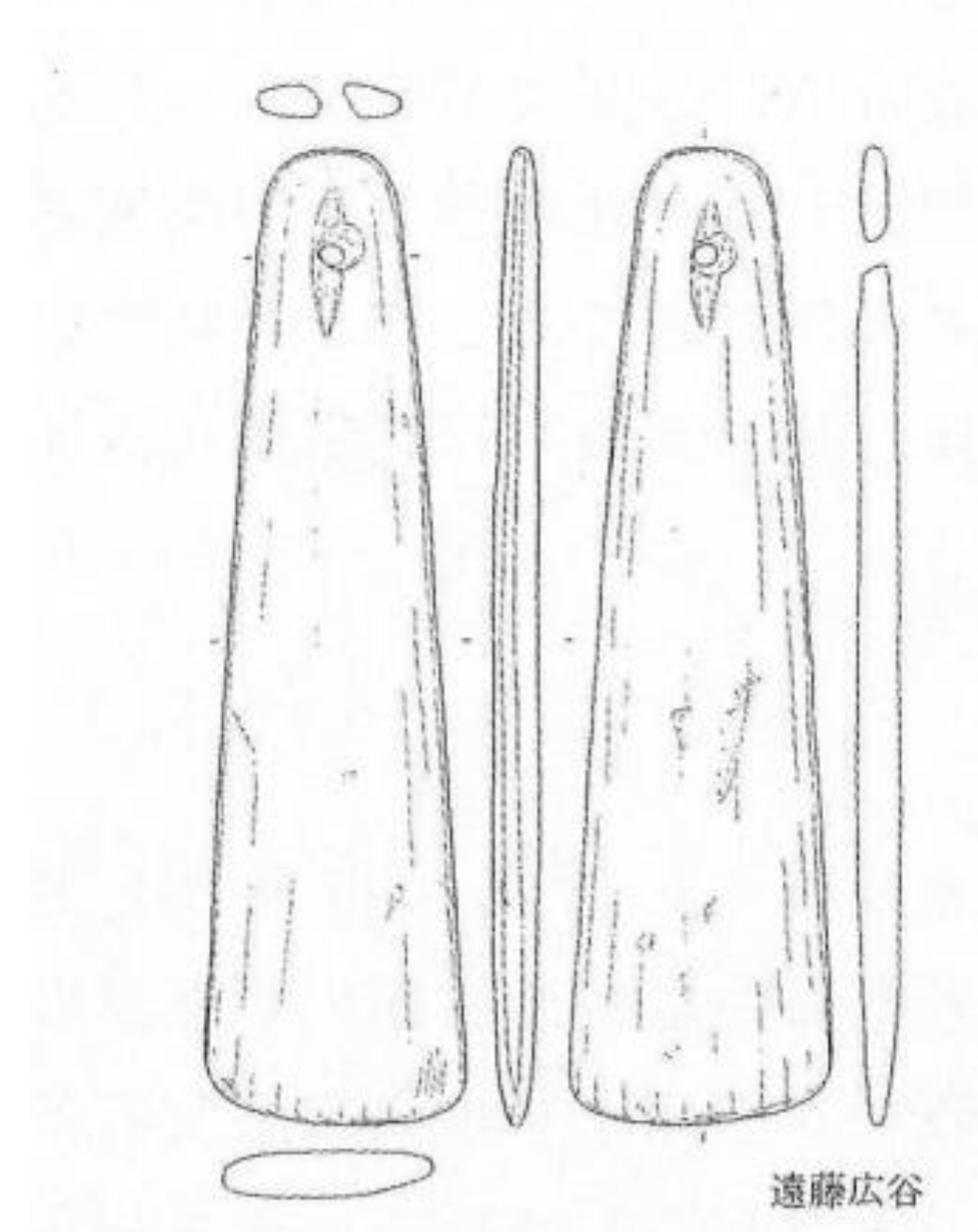
ヘラ状垂飾
Source term: ヘラ状垂飾; hera-shaped pendant; spatula-shaped pendant
ヘラ状垂飾 (hera-jō suishoku): 'spatula-shaped pendant'
A palm-length blade of green serpentinite, pierced once at the top — and worn, on both faces, in a matching slant nearly 45 degrees off the hole. That doubled oblique groove is the whole puzzle: a cord that dragged hard and at an angle, as if the thing hung heavy or turned. Five such large blades cluster in Early Jōmon Kanagawa and Gunma; this one lay in a pit at the Endō Hiroya settlement some 6,000 years ago. Catalogued as a body ornament, it carries the slant a cord cuts when a blade is whirled.
Particulars
- Object
- A large serpentinite blade, over 10 cm long, pierced once near the top; around the hole, both faces are worn in a slant of nearly 45 degrees. From a pit at a settlement of pit dwellings and fire pits of the late Early Jōmon Moroiso a–b phase.
- Function
- Published as a hera-shaped pendant of the later Early Jōmon, excavated from a pit; one of five in the Kantō/Gunma cluster that share the same anomalous two-faced oblique wear, the wear a blade whirled on a cord would leave.
Source
Kanagawa Prefecture archaeology lecture (2025), Fig. 2, after Tsubota 2017; Nara National Research Institute for Cultural Properties, HeritageMap, Endō Hiroya site