No. EA-NOKUBI-HERA-001
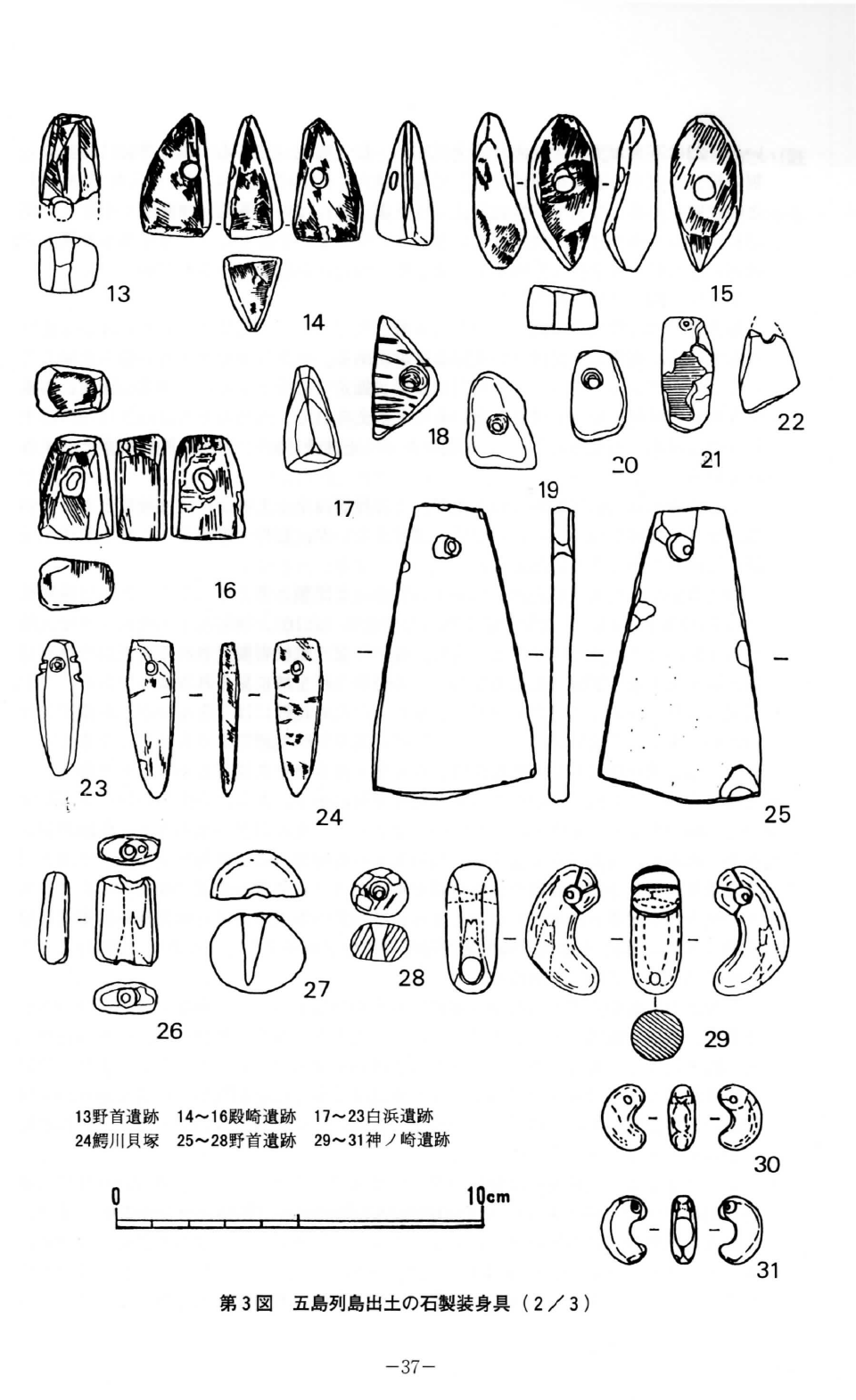
Nokubi trapezoid pendant of imported sandstone
Goto Islands, Nagasaki, Japan; Nokubi site · East Asia
Function not recorded Candidate only
垂飾品
Source term: 垂飾品; 箆状垂飾 comparison
On the Gotō Islands off Kyūshū, the Nokubi site yielded a thin, vertically long trapezoid of hard sandstone — a stone that does not occur on the islands and had to arrive by boat. The archaeologist who published it compared it, cautiously and explicitly without committing, to the hera-shaped pendant class, whose origin is traced to the Chinese mainland. It is an island outlier, an imported slab at the far southwestern edge of the distribution — and though its layer is disturbed, the same site has yielded some ten sherds of Korean Neolithic pottery, proof that boats were crossing from the continent in the Early Jōmon.
Particulars
- Object
- A thin, vertically long trapezoid of very fine-grained hard sandstone, about 8 cm long, pierced near the narrow top. The stone is foreign to the Gotō Islands and was brought in from elsewhere. From a disturbed layer at the Nokubi site.
- Function
- Published as a pendant (垂飾品).
Source
Tsukahara 2001, 「五島列島出土の石製装身具と異形の磨製石製品」, Fig. 3 item 25