Is This a Bullroarer? · Research study ·
Grooved Jade Blades
Sculpted stone from northern China, Japan and the Russian Far East
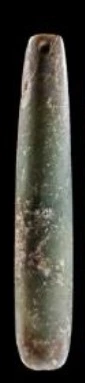
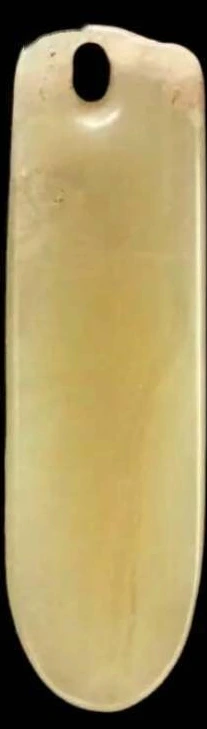
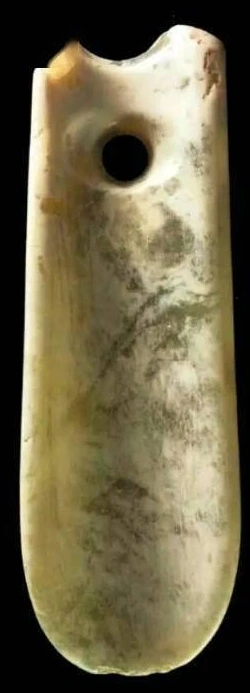
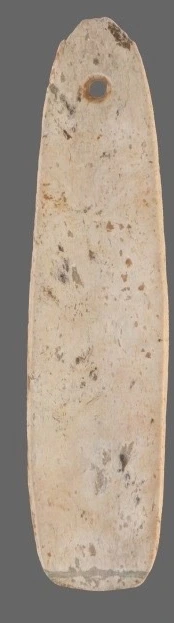
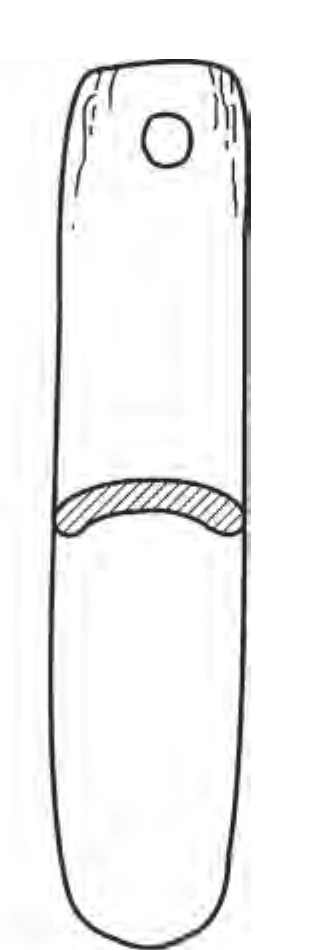
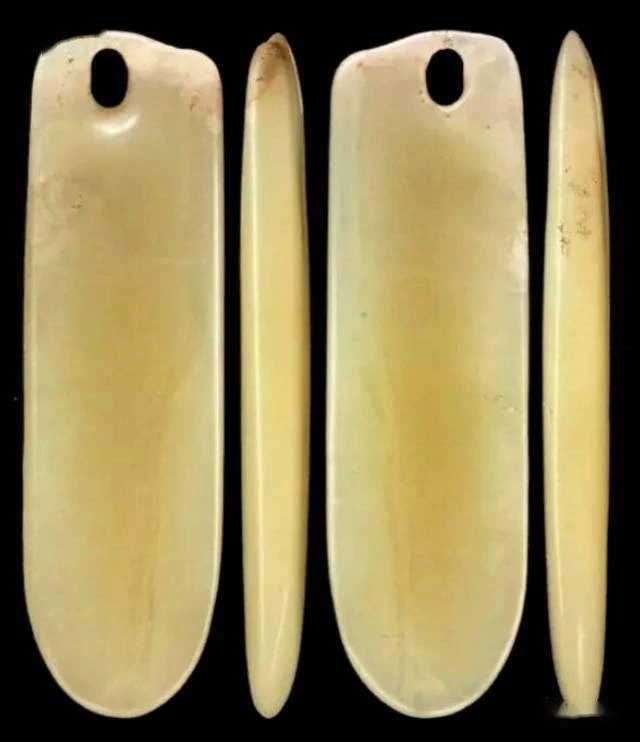
A Neolithic jade blade from Kuwano, on Japan’s Sea of Japan coast, curves inward like a shoehorn. A small hole pierces its narrow end; the broad end rounds into a smooth lip. Across the sea, a longer blade from Xibenbaoleng in northern China repeats the hollowed face and carefully finished tip. These are objects made to a demanding shape. What that shape accomplished is the mystery: it could carry stone against the body, move it through water, or perhaps set it turning in air.
These hollowed blades were cut to the same plan from Japan to the Amur. One of them is the only jade blade ever tied to a cord and set moving: it turned in water like a spinner lure, and a blade that turns on a cord is also what roars in air. Its excavators called it a fishing lure, though no hook fitting is recorded and no one tried it in air. Worn bevels at the broad end show that some of these blades also rubbed against something in use.
In brief
- Is it a bullroarer? Possibly. On a cord the Kondon plate turned in water, and a turning blade is what sounds in air; wear at the broad end of other blades points to a second use.
- Okladnikov and Derevyanko tied a grooved nephrite plate from Kondon, on the Lower Amur, to a cord, and it turned in water “exactly as modern spinner lures do.” They called it a lure. A blade turning on a cord is also what makes a bullroarer sound; no hook fitting is recorded, and the plate was never tried in air.
- At least seventeen grooved blades are known from seven sites in China, Russia and Japan, their concave sections cut on purpose.
- Two blades from Chertovy Vorota carry cord traces; Kuwano and Xibenbaoleng have friction on small bevels at the broad end.
Where these objects were found

Published interpretations
“Grooved jade blades” is this page’s visual grouping, not a single ancient tool type. At Kuwano, the Awara museum guide calls the objects spatula-shaped pendants and infers hanging from the narrow-end hole, while explicitly leaving their use unknown. Ornament terminology therefore records an interpretation of attachment, not a demonstrated activity. Awara 2016, p. 4. · archived
Tang Chung calls the Kuwano and Xibenbaoleng objects spoon-shaped. He compares their hollow faces, manufacturing marks and friction on small bevels at the broad ends, inferring a similar manner of use without naming the operation. His comparison does not identify either eating or sounding. Tang 2019, PDF pp. 13–14, plate VII. · archived
Okladnikov and Derevyanko instead identify the Russian Far East pieces as fishing lures. Their Kondon water trial produced rotation on a cord, which they compared to a living fish; they interpreted the bright, white nephrite as an attraction for predatory fish. The account supplies no hook arrangement or catch result, and does not say whether an original or replica was tested. They extend the lure interpretation to Novopokrovka, without reporting another trial there. Okladnikov and Derevyanko 1973, pp. 124, 135. · archived
The bullroarer comparison is this page’s proposal. None of these accounts identifies the blades as bullroarers or reports a sounding trial in air.
A hollow face · published sections
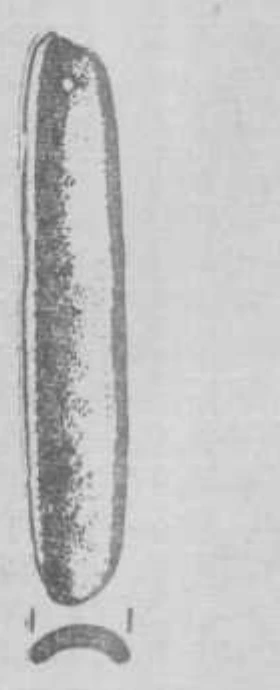
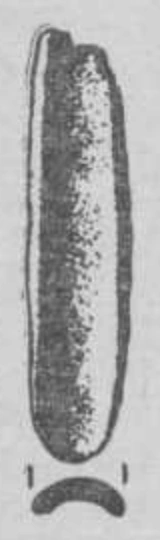
A hollow made by hand
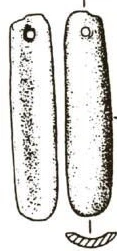
At Kuwano, five spatula-shaped pendants share the hollowed cross-section. The measured example, kw49, is 132.3 mm long, 32.6 mm wide and 8.2 mm thick. Tang Chung’s comparison blade from Xibenbaoleng is longer and narrower: 149 × 27 × 9 mm. Their likeness extends beyond silhouette. Tang observed pits left by pecking in the hollowed faces and inferred further grinding along the length. The groove is part of their manufacture, rather than a channel rubbed into the stone by a cord. Tang 2019, PDF pp. 13–14, plate VII. · archived
Plate VII places the use-friction traces on the broad terminal lips, away from the attachment holes. Those contact surfaces are a different clue from the hollow itself and from traces left by a cord in a bore.
The resemblance invites comparison across the sea; it does not establish an identical life for every blade. The much smaller examples from the Russian Far East change the scale of the problem.
The blades beside one another
Dimensions below are reported measurements in millimetres, in the order length × width × thickness. A dash means that the cited passage supplies no measurement. Multiple faces and profiles in a plate are views of one object.
Scroll sideways to compare all columns.
| Object | Measurements | Section and attachment | Reported trace or limitation |
|---|---|---|---|
| Kuwano kw49, Japan | 132.3 × 32.6 × 8.2 | Hollow face; narrow-end hole | Manufacture pits; use friction on terminal bevel |
| Xibenbaoleng comparison blade, China | 149 × 27 × 9 | Hollow face; end hole | Manufacture pits; use friction on terminal bevel |
| Chertovy Vorota fig. 1:8, Russia | 70 × 17 × 5 | Pronounced U-section; drilled from both faces | Use-wear not reported |
| Chertovy Vorota fig. 1:9 | 60 × 17 × 5 | Shallower U-section; drilled from both faces | Cord-attachment traces reported |
| Chertovy Vorota fig. 1:10 | 38 × 17 × 5 | Shallow U-section; drilled from both faces | Hanging-cord traces relayed from original report |
| Novopokrovka first blade, Russia | 90 × 12 × — | Concave/convex; biconical end hole | Attachment end damaged |
| Novopokrovka second blade | 70 × 10 × — | Similar form; biconical end hole | Break crosses the hole |
| Novopokrovka third fragment | 50 preserved × 20 × — | Heavier lower-end fragment | Grouped with the blades; hollow section less securely established |
| Kondon plate, Russia | — | Grooved; one rounded end, other end pierced | Water rotation reported; exact specimen image unresolved |
Tang 2019, PDF pp. 13–14 · archived; Tang and Deng 2017, fig. 1:8–10 · archived; Okladnikov and Derevyanko 1973, pp. 124, 135 · archived.
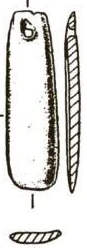
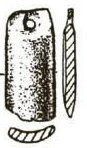
At Chertovy Vorota, a cave in Russia’s coastal Primorye region, the smallest blade is only 38 mm long. The 5 mm measurement does not mean a uniform slab: blade 8 thins towards both ends. The same published group also includes a flat, ungrooved blade, fig. 1:7. The excavated assemblage therefore contains related outlines with different sections, rather than one uniform design.
Bodies, strings and water
Find position anchors some possibilities. Two blades were reported at the waist in a single burial at Xibenbaoleng, with a slit jade ring near the head. At Kuwano, kw49 overlapped slit rings in pit 18; two other spatula pendants accompanied ring pairs and a tube bead in pit 20. These are one burial and two pits, not a separate context for every ornament. Kuwano’s museum guide calls the use unknown while inferring suspension from the narrow-end hole. Xibenbaoleng context; Awara 2016, p. 4. · archived
At Beifudi in northern China, the hollow-section blade J:87 belongs to a group of jades from a sacrificial ground. That tells us how it entered the ground, rather than which action it performed beforehand. Chertovy Vorota’s blades 9 and 10 supply a different kind of evidence: reported cord traces at the perforations. Their published description interprets hanging, but gives no microscopic trace pattern that distinguishes a worn pendant from an object repeatedly swung. Zhao, Sun and Du, pp. 71, 74, fig. 4:6 · archived; Tang and Deng 2017, fig. 1:9–10. · archived
The Kondon trial, on Russia’s Lower Amur, adds observed movement to this record. It establishes that the tested plate rotated in water; the published narrative offers neither a measured protocol nor a comparison between experimental and archaeological wear. Novopokrovka’s three pieces came from a ploughed settlement collected as surface finds, so their placement among fishing gear in the book is an interpretation, not a documented fishing rig. Okladnikov and Derevyanko 1973, pp. 121, 124, 135. · archived
The possibility of a voice
A terminal hole allows attachment, and a hollowed body gives a replica a geometry worth testing. Neither feature identifies a bullroarer. Kondon’s plate was never tried in air, but turning on a tethered cord, the motion it showed in water, is also the motion of a bullroarer, and the lure reading adds a hook that no one has found. The smaller Russian blades also need individual tests rather than an inference from the larger Kuwano example.
The useful experiment begins with individual blades: measured section, mass, cord attachment and intact outline. It asks whether each can sustain rotation in air and produce sound, then compares the resulting traces with archaeological wear at both the hole and terminal bevel. Body suspension and water movement belong in that comparison. A roaring replica would establish an ability; matching the ancient wear would bring us closer to the action that once gave these polished stones their purpose.
The comparative catalogue
Measurements are length × width × thickness in millimetres. A dash means unreported; ≈ marks an estimate. Groups and possible duplicate objects remain labelled. Download the specimen table.
View all 13 evidence entries
Scroll sideways to compare all columns.
| Object | L × W × T, mm | Material | Context | Reported traces |
|---|---|---|---|---|
| Chertovy Vorota · Fig.1:8Russia · object; minimum 1 | 70 × 17 × 5Reported 70 × 17 × 5 mm; ends are described as thinner, without numeric end thickness. | nephrite | Cave dwelling assemblage with human remains; no individual body position established for this blade. | not reported |
| Chertovy Vorota · Fig.1:9Russia · object; minimum 1 | 60 × 17 × 5Reported dimensions; not measured from the image. Thickness describes the specimen, not a demonstrated uniform slab. | nephrite | Cave dwelling assemblage with human remains; no individual body position established for this blade. | Clear cord suspension traces in bore reported for Fig.1:9 |
| Chertovy Vorota · Fig.1:10Russia · object; minimum 1 | 38 × 17 × 5Reported dimensions; not measured from the image. Thickness describes the specimen, not a demonstrated uniform slab. | nephrite | Cave dwelling assemblage with human remains; no individual body position established for this blade. | Clear cord suspension traces in bore reported for Fig.1:10 |
| Xibenbaoleng · Xibenbaoleng jade blades at the waistChina · group; minimum 2 | — × — × —149 × 27 × 9 mm is reported for one comparison blade. Its mapping within the two-blade group remains unresolved; group dimensions remain unassigned. | nephrite | One reported tomb, two blades at the waist and a ring near the head; original grave report not directly checked. | Tang reports use friction on small terminal bevels of the measured comparison blade; this does not establish wear on both blades. |
| Xinglongwa · House 201 captioned bladeChina · object; minimum 1 | — × — × —No verified individual numeric dimensions; captioned photographs have not been crosswalked to the original excavation catalogue. | jade/nephrite | Captioned as Xinglongwa H201; house attribution does not establish dwelling floor versus intramural grave deposition. | not reported; pecking, polishing and H125 redrilling are manufacturing/repair observations. |
| Xinglongwa · House 125 captioned bladeChina · object; minimum 1 | — × — × —No verified individual numeric dimensions; captioned photographs have not been crosswalked to the original excavation catalogue. | jade/nephrite | Captioned as Xinglongwa H125; house attribution does not establish dwelling floor versus intramural grave deposition. | not reported; pecking, polishing and H125 redrilling are manufacturing/repair observations. |
| Beifudi · J:87China · object; minimum 1 | — × — × — | jade | ritual deposit | not reported |
| Kuwano · kw49Japan · object; minimum 1 | 132.3 × 32.6 × 8.2Reported 132.3 × 32.6 × 8.2 mm for kw49 alone. | tremolite rock / nephrite | Pit 18, overlapping slit rings; no body position or sex established. | Tang reports use friction on small bevels at the broad end, separate from the bore; pecking and longitudinal grinding formed the hollow face. |
| Kuwano · Kuwano other four hera pendantsJapan · group; minimum 4 | — × — × —Individual dimensions unreported; kw49’s measurements and terminal-wear observation are not transferred to these four. | tremolite rock | Two of these four pendants are reported in pit 20 with ring pairs and a tube bead; the other individual contexts remain unresolved. | not reported |
| Kondon · Kondon nephrite blesny / Lower Amur slat-lureRussia · group; minimum 1 | — × — × — | white nephrite | unknown | not reported |
| Novopokrovka · 1973 p124 first-90mmRussia · object; minimum 1 | 90 × 12 × —Preserved length; first also broken terminal; third lower-end fragment. | whitish-green nephrite | surface | not reported |
| Novopokrovka · 1973 p124 second-70mmRussia · fragment; minimum 1 | 70 × 10 × —Preserved length; first also broken terminal; third lower-end fragment. | whitish-green nephrite | surface | not reported |
| Novopokrovka · 1973 p124 third-fragmentRussia · fragment; minimum 1 | 50 × 20 × —Preserved length; first also broken terminal; third lower-end fragment. | whitish-green nephrite | surface | not reported |
Key sources
- Tang Chung (鄧聰), “The spread of the early Northeast Asian nephrite cultural information revolution: on the origins of Kuwano jades,” in 桑野遺跡から見た縄文世界 (2019), PDF pp. 13–14, plate VII; site-summary contribution, PDF p. 29. · archived Direct author inspection: kw49 and Xibenbaoleng dimensions, pecking and longitudinal grinding, broad-terminal-bevel friction. Tang infers shared use but names no operation; “spoon-shaped” is not an eating-use diagnosis. PDF p. 29 supplies five hollow-section tremolite pendants.
- Awara City Local History Museum, Kuwano stone ornaments spring-exhibition sheet (2016), p. 4. · archived The guide groups these objects as spatula-shaped pendants, infers suspension from the hole and explicitly calls kw49’s use unknown. It also gives pit 18 and pit 20 associations.
- Tang Chung and Deng Xuesi (鄧聰、鄧學思), “The spread of Neolithic Northeast Asian jade slit rings: the Chertovy Vorota case,” 北方文物 2017(3):17–23, fig. 1:7–10. · archived Author-supplied article repost: measured sections and attachment traces. Blade 10’s trace observation is explicitly relayed from the original report. No exact in-journal leaf number has been inferred from the unpaginated repost.
- A. P. Okladnikov and A. P. Derevyanko, Далекое прошлое Приморья и Приамурья [The distant past of Primorye and the Amur region] (1973), pp. 121, 124–125, 135. · archived The archaeologists identify the blades as lures. Their Kondon narrative reports cord-tethered rotation in water, without hook arrangement, catch result or an original/replica distinction; Novopokrovka supplies descriptions and dimensions, not a second trial. Its finds were collected from a ploughed site.
- Zhao Binfu, Sun Mingming and Du Zhanwei, 饶河小南山墓葬出土玉器的年代和性质 [Date and character of the jades from the Raohe Xiaonanshan burial], 边疆考古研究 14:69–78, pp. 71, 74, fig. 4:6. · archived Comparative publication identifies Beifudi J:87 and places the Phase I jade group in the sacrificial ground. Ritual deposition is distinct from an acoustic use identification.
- Inner Mongolia Local Gazetteers, “Neolithic tombs” (2016), section on Xibenbaoleng; reporting the 1982 find. Accessible context account: one tomb, slit ring at head, bi-shaped blades at waist. The original report is Chaogebatu, 考古 1996(2); that original excavation publication was not directly read for this essay.