Is This a Bullroarer? · Research study ·
Heads, Necks, and Jade Blades
Six carved forms from China and Japan
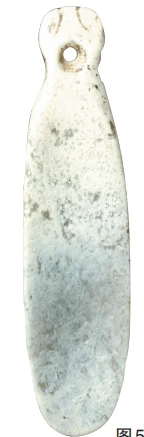
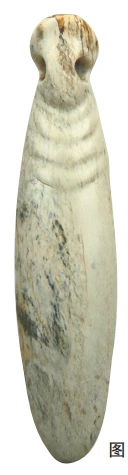
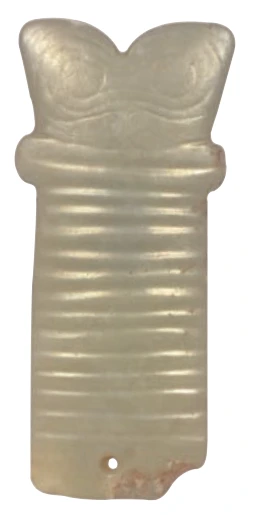
Two curved lines give the small jade a face. Below them, a neck narrows around a cord hole before the body opens into a long leaf. This is the De Fu Museum piece from Chaoyang in northeastern China: a blade-like object whose carved head makes it more than a plain strip.
These six objects share differentiated heads, not a demonstrated use. The insect-headed jades have a published ornament interpretation; none has an established sounding function.
In brief
- Is it a bullroarer? Possibly. The leaf-shaped body and end hole fit; no wear or trial yet shows how they were used.
- Three northeastern Chinese jades have small heads, narrow necks, and leaf-shaped bodies.
- Fuxingdi’s animal face lies opposite its hole; the insect-headed pieces are pierced at the neck.
- The Japanese gourd-shaped stone and Shandong gui extend the shape comparison without establishing a shared tradition.
Where these objects were found

Published interpretations
“Headed” groups visible outlines for this comparison. The publications use different names and do not establish one functional class. Zhang Pengfei (2024, p. 6) · archived proposes insect-head bi-shaped object for the northeastern Chinese carvings. He compares heads, necks, body segments, drilling and carving technique with excavated Hamin Mangha examples. The De Fu arcs suggest eyes; Chaoyang’s raised bands suggest an insect’s segmented body. He reads the neck hole as suitable for tying and wearing. This is a visual and typological argument, without a species identification or a reported trial of wearing or sounding.
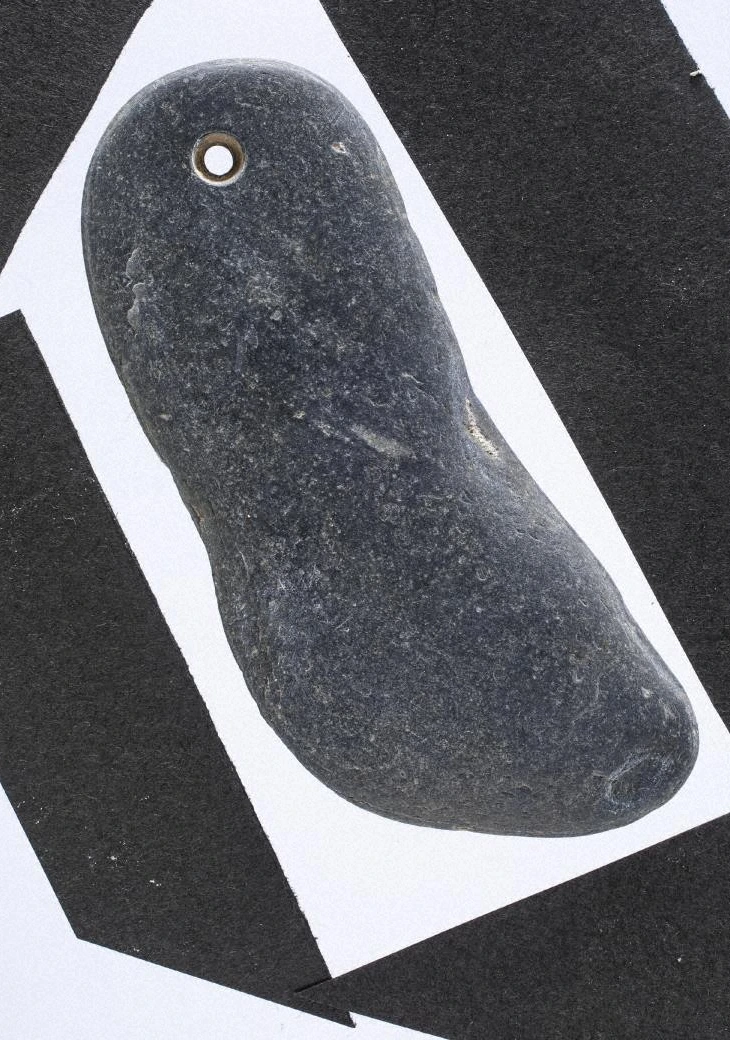
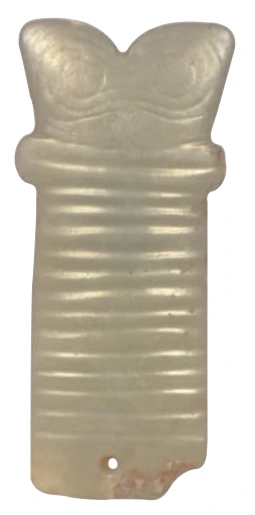
The Sannai-Maruyama database · archived instead uses the broad categories ornament and perforated stone product; the gourd-like outline describes its shape. The Fuxingdi catalogue · archived calls its animal-faced Y-shaped jade ceremonial. Its Y-shaped name describes the outline; the entry supplies no reconstruction of a working implement. These labels carry different amounts of interpretation.
Teng Shu-p’ing’s 2022 study · archived places the Yuanjiazhuang piece among gui, edged ceremonial jades, and reports personal inspection of its material. That observation supports the material comparison; it supplies no mounting or use-wear diagnosis. Ornament, ceremonial blade and descriptive stone-product labels therefore make different claims, with individual use less securely known than shape.
Two further heads
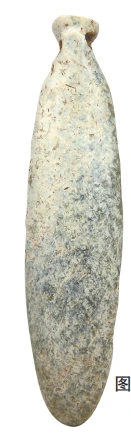
Insect heads beside willow leaves
The De Fu jade belongs beside two Chaoyang Museum pieces. Their faces and backs differ: one Chaoyang body has a shallow U-shaped section; the other carries raised curved lines.
Zhang separates these heads and necks from the earlier willow-leaf bi-shaped objects (匕形器) of Xinglongwa and Chahai. A similar leaf-like lower body does not erase that distinction. He suggests development from the earlier form, but the three museum pieces lack excavated contexts that could independently fix their place in that sequence.
Six objects, three different attachment positions
The measurements below belong to individual specimens. A dash means the cited description gives no measurement. All dimensions are millimetres; thickness ranges are retained. Museum custody is separated from archaeological findspot.
Scroll sideways to compare all columns.
| Object | Material | Length × width × thickness | Hole | Context and dating |
|---|---|---|---|---|
| De Fu, Zhang fig. 5 | Green jade | 80 × 20 × 6 | One neck hole, 3 mm | Museum survey; findspot unknown. Hamin Mangha-type attribution. |
| Chaoyang, Zhang fig. 3 | Opaque green jade | 103 × 23 × 6.2–7.5 | One neck perforation, 3.4 mm | Confiscated in 2015; findspot unknown. Hamin Mangha-type attribution. |
| Chaoyang, Zhang fig. 4 | Opaque green jade | 90 × 20 × 7.2–8.3 | One neck hole, 4.3 mm | Same confiscation; no excavated context. Hamin Mangha-type attribution. |
| Fuxingdi, catalogue item 14 · archived | Bluish-yellow jade | 121 × — × 3 | One near the lower edge, opposite the head | Collected from Fuxingdi, Liaoning, China. Hongshan attribution; no closed feature reported. |
| Sannai-Maruyama 15513 · archived | Stone; lithology unreported | 76 × — × — | One in the rounded upper end | Aomori, Japan. Exact find unit and object phase unreported. |
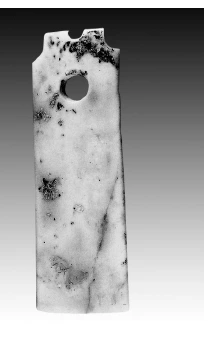
| Yuanjiazhuang gui · archived | Jade; curator identifies nephrite | 197 × 70 × 11 | One below the notched upper end | Changle, Shandong, China; M1 reported by Teng. Shandong Longshan attribution; no direct object date. |
Sources: Zhang 2024, p. 6, figs. 3–5 · archived; Collection of Ancient Chinese Cultural Relics I, printed p. 14, item 14 · archived; Sanmaru Search 15513 · archived; Teng 2015, p. 44, fig. 7 · archived, and Teng 2022, fig. 46 · archived.
A fork, a gourd, and a notched gui
Fuxingdi’s forked upper end carries an animal face, with ridges and straight lines extending down the body. Its single hole is near the opposite lower edge. The catalogue calls it a ceremonial object, but reports neither a mounting nor wear that identifies its use. At 3 mm thick it is the thinnest measured object here; that fact cannot supply a missing history of movement.
Sannai-Maruyama 15513 has a rounded head, a pinched waist, and a broad lower body, giving the stone a gourd-like silhouette. The official database places it among ornaments and perforated stone products. Its shape is useful beside the narrower Chinese pieces, while its material and missing section measurements keep it a separate comparison.
The Yuanjiazhuang gui is different again: a broad rectangular jade, with two small lobes divided by a notch above the hole. Teng Shu-p’ing reports personally examining it and identifies its find as tomb M1. The plain blade is the right-hand object in her figure 46; the decorated jade at left is a different piece. Its 11 mm thickness must remain part of any comparison.
Attachment before sound
A neck hole, an end hole and a hole below a notch meet different outlines. Their positions matter for a reconstruction, but a place to tie a cord does not establish how the cord moved. The cited descriptions report no diagnostic spinning wear or sounding trial for these six specimens.
Useful further work would compare contact around the holes, necks and notches with fixed bindings, worn suspension and rotating cords. Replicas must retain the original section and mass distribution. A successful sounding trial would establish capability; ancient function would still require agreement with the objects’ traces and contexts.
The comparative catalogue
Measurements are length × width × thickness in millimetres. A dash means unreported; ≈ marks an estimate. Groups and possible duplicate objects remain labelled. Download the specimen table.
View all 6 evidence entries
Scroll sideways to compare all columns.
| Object | L × W × T, mm | Material | Context | Reported traces |
|---|---|---|---|---|
| Fuxingdi · Fuxingdi animal-faced Y-shaped jade · archivedChina · object; minimum 1 | 121 × — × 3 | jade | surface | not reported |
| Defu · Incised-eye jade insect-head pendantChina · object; minimum 1 | 80 × 20 × 6 | green jade | unknown | not reported |
| Sannai Maruyama · 15513 · archivedJapan · object; minimum 1 | 76 × — × — | stone | unknown | not reported |
| Chaoyang Unprovenanced · Zhang2024 Fig.3China · object; minimum 1 | 103 × 23 × 6.2–7.5Reported thickness range 6.2–7.5 mm; width is maximum body width. Museum custody does not identify the findspot. | opaque green jade | Confiscated in 2015; archaeological findspot and excavated context unknown. | not reported |
| Chaoyang Unprovenanced · Zhang2024 Fig.4China · object; minimum 1 | 90 × 20 × 7.2–8.3Reported thickness range 7.2–8.3 mm; width is maximum body width. Museum custody does not identify the findspot. | opaque green jade | Confiscated in 2015; archaeological findspot and excavated context unknown. | not reported |
| Yuanjiazhuang · Yuanjiazhuang M1 gui · archivedChina · object; minimum 1 | 197 × 70 × 11 | jade (mineral not established) | burial | not reported |
Key sources
- Zhang Pengfei, “东北史前玉器‘匕形器’之命名探讨” [A discussion of naming prehistoric Northeast Chinese jade bi-shaped objects], China Cultural Relics News, 23 April 2024, p. 6, figs. 3–7. · archived Visual and typological naming argument: material, carving, drilling, Hamin Mangha comparators and proposed wearing. The three museum pieces lack excavated contexts; no trial of wearing or sounding is reported.
- Expert Committee of the Chinese Society of Cultural Relics, Collection of Ancient Chinese Cultural Relics, vol. I, English translation by Guozhen Wang (2019), printed p. 14, item 14. · archived Fuxingdi: 121 mm long, 3 mm thick, collected site provenance. Printed p. 14 is PDF page 25; no wear or performance diagnosis is given.
- Sannai-Maruyama Site, Sanmaru Search object 15513, “装飾品 / 有孔石製品” [ornament / perforated stone product]; report reference Sannai-Maruyama 40, fig. 91-16. · archived Official object image and saved database evidence; 76 mm length. Exact lithology, width, thickness, find unit, and phase remain unreported in the available entry.
- Teng Shu-p’ing, “從黃道、太一到四靈” [From the Ecliptic and Taiyi to the Four Spirits], National Palace Museum Monthly 390 (2015), pp. 42–61, p. 44, fig. 7. · archived Published photograph and 197 mm length / 11 mm thickness; Shandong Longshan attribution. Width and M1 identification come from the same curator’s 2022 discussion.
- Teng Shu-p’ing, “龙山时期‘神祖灵纹玉器’研究” [A study of Longshan-period jades with divine-ancestor motifs], Archaeological Studies XV (2022), pp. 449–487, fig. 46 and §V.1. · archived Attributed reproduction of the author’s article. Figure 46 gives 197 × 70 × 11 mm; text reports personal inspection and Yuanjiazhuang M1. The original grave inventory was not examined.