No. COOPER1930-001
James Bay Cree north-wind bullroarer
Canada · Rupert House (Waskaganish) and lower Harricanaw River, eastern James Bay; also Waswanipi, Obidjuan (Atikamekw), Lake of the Woods and Rainy Lake (Ojibwa) · North America · Subarctic
Weather / fertility magic
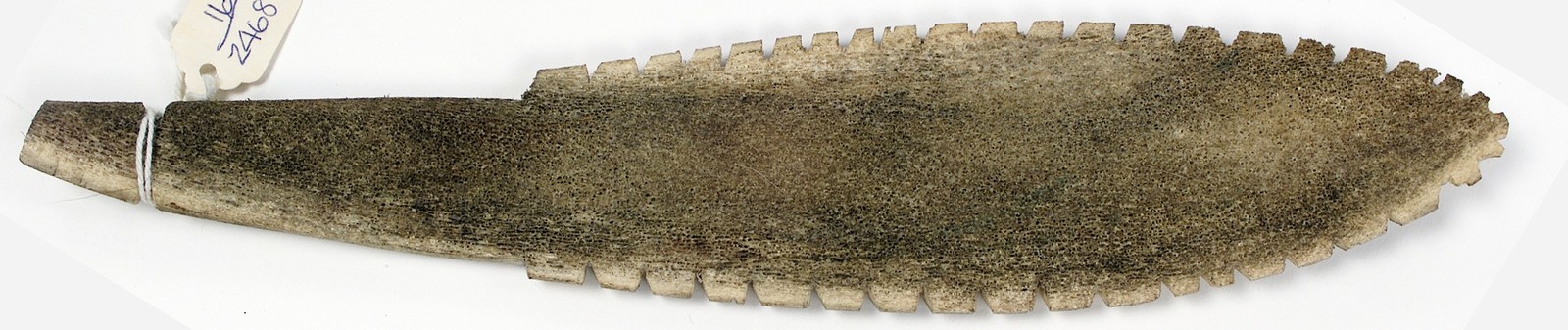
Source term: bullroarer
On the eastern shore of James Bay, the bullroarer was a tool for calling winter back. John M. Cooper, working through Cree and Ojibwa country from Lake of the Woods to Rupert House across four summers in the 1920s, found the flat, almond-shaped slat in common use - whirled, above all after the first thaw of late winter, to bring the cold north wind, so that a crust would harden over the softened snow and a hunter's snowshoes and toboggan could run easily again. By his day it had mostly slipped into children's hands, along with its companion the moose-bone buzzer; at Obidjuan, when cold was wanted, people also built a snow man - the figure of Kimucwuminaw, the North Wind being himself. Cooper weighed the chance that both little instruments were European imports and doubted it: they were too widespread on the continent, and their magical office too particular to the North.
Both the buzzer and the bullroarer are now more commonly used as children's toys, but are sometimes used, and were formerly used habitually, particularly after the first thaw of late winter, to bring the cold north wind to form a crust on the ice so that travel by snowshoe and transportation by toboggan would be less laborious.
Cooper, 'Field Notes on Northern Algonkian Magic', Proceedings of the 23rd International Congress of Americanists (1930), p. 515
Particulars
- Function
- Whirled - formerly habitually, after the first late-winter thaw - to bring the cold north wind so a crust forms on the softened snow for snowshoe and toboggan travel; now more commonly a children's toy.
Sources
- Cooper, 'Field Notes on Northern Algonkian Magic,' Proceedings of the 23rd International Congress of Americanists (New York 1928; Lancaster 1930), pp. 513-518, p. 515 View
- American Anthropologist 30 (1928), p. 728, abstract of Cooper’s field notes