No. EA-YAMAGUCHIDAI-HERA-001
Yamaguchidai site large hera-shaped pendant
Kawasaki, Kanagawa, Japan; Yamaguchidai site · East Asia
Function not recorded Candidate only
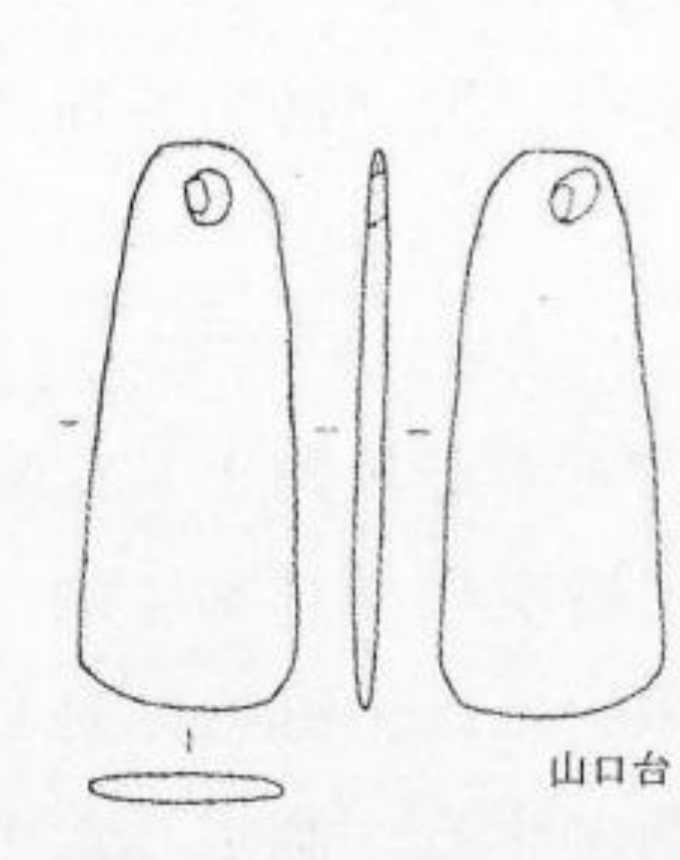
ヘラ状垂飾
Source term: ヘラ状垂飾; hera-shaped pendant; spatula-shaped pendant
ヘラ状垂飾 (hera-jō suishoku): 'spatula-shaped pendant'
Read the wear and the blade gives itself up. Around the hole of this hand-length slat of imported serpentinite, the cord-groove bites at a stubborn forty-five degrees across both faces — not the straight overhead rub a dangling pendant leaves, but the two-faced, angled scoring of a blade spun on a cord. Excavators lifted it from a pit at Yamaguchidai in Kawasaki, one of five such large Jōmon ornaments; the archaeologist who studied their wear read the groove instead as a cord held taut against the body, the mark of a personal emblem: precious foreign stone worn at the hip to mark who you were.
Particulars
- Object
- A large spatula-shaped pendant of imported serpentinite, more than 10 cm long, pierced near the top. Wear around the hole runs at nearly 45 degrees, on both faces. From a pit; one of five such pendants from Kanagawa and Gunma.
- Function
- Published as a hera-shaped pendant or waist ornament from a pit; the best-formed of its cluster for the whirled-blade reading.
Source
Kanagawa Prefecture archaeology lecture (2025), Fig. 2, after Tsubota 2017