No. EA-KUWANO-001
Kuwano spatula-shaped pendants (箆状垂飾) — Early Jōmon Japan
Awara City, Fukui Prefecture, Hokuriku (Honshu), Japan; Kuwano site, Early Jomon (c. 5050–4550 BC) · East Asia
Function not recorded Candidate only
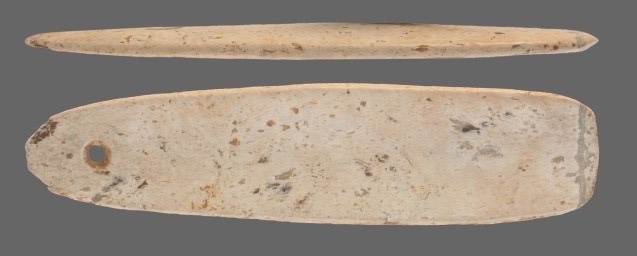
箆状垂飾 / 匙形器
Source term: herajō suishoku (spatula-shaped pendant)
箆状垂飾 (herajō suishoku): 'spatula-shaped pendant' — the Japanese term for the elongated end-pierced stone blade; also 匙形器 ('spoon-shaped object'), the same spoon metaphor as Chinese 匕形器.
At Kuwano, on the coastal plain of Fukui where Honshu faces the Sea of Japan, an Early Jōmon settlement seven thousand years old yielded an ornament set found nowhere else in Japan: seventy-one slit jade earrings and, beside them, five spatula-shaped pendants of tremolite — the same pairing of ring and thin end-pierced blade that defines the earliest jade cultures of Northeast China, a sea away. The largest pendant is a hand-length blade — thirteen centimetres of pale stone, eight millimetres thin, pierced once at its narrow top. The city's own exhibition text is admirably honest: use unknown; the hole suggests it hung from something. The stone itself appears to be continental, carried or copied across the water. And when the jade archaeologist Tang Chung looked for its match, he found it in a Chinese tomb at Xibenbaoleng, four thousand kilometres of coastline away — same grooved manufacture, same pecked pits, same worn edges. Kuwano is the eastern edge of the series: a class of hanging blades in a world that has not yet been asked to listen for it.
Particulars
- Object
- Five spatula-shaped tremolite pendants from the Kuwano site near the Sea of Japan coast of Fukui — the Japanese end of the early Northeast Asian jade package, whose ornament set (71 slit rings, tube beads, rod- and spatula-shaped pendants; Important Cultural Property) is unique in Japan. The measured specimen kw49, from pit 18 (overlapping slit rings), is 132.3 × 32.6 × 8.2 mm: an elongated blade of tremolite with a single perforation at the narrow upper end and a gently concave ('shoehorn-like') face. Pit 20 paired two spatula pendants with slit-ring pairs and a tube bead. Four pendants are light green-gray tremolite, one white; stone analysis suggests the material — and possibly the models — came from the continent. Date: terminal Initial to earliest Early Jōmon (早期末〜前期初頭), c. 5050–4550 BC.
- Function
- Published as pendants of unknown use ('use unknown; the narrow upper end is perforated, so suspension is inferred' — Awara exhibition text).
Source
Awara City Board of Education, Kuwano site special-exhibition guide (2016); Tang Chung (邓聪), 《桑野遺跡から見た縄文世界》, Awara forum lecture (2019), Fig. 7; 《桑野遺跡》, あわら市埋蔵文化財調査報告 3 (2019); Kumbani et al. 2019