No. EA-CHERTOVY-VOROTA-001
Devil's Gate nephrite blades, two cord-worn
Primorsky Krai, Dalnegorsk district, Russia; Chertovy Vorota (Devil's Gate) cave, Rudnaya culture (c. 5050–4550 BC) · Siberia · Russian Far East
Function not recorded Candidate only
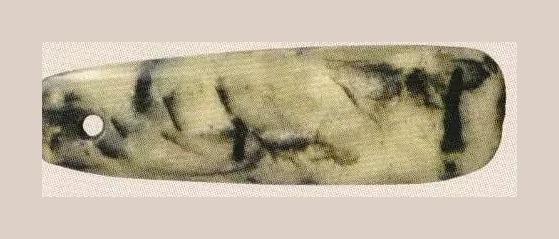
匕形器 (Chinese) / подвески (Russian)
Source term: bixingqi / podveski (pendants)
匕形器 (bǐxíngqì): 'bi-shaped object' — an elongated spoon- or tongue-shaped blade named after the ancient Chinese bi eating-spoon; thin nephrite blades pierced at one end.
The Devil's Gate is a cave in the limestone above the Krivaya river in eastern Primorye, where around 7,700 years ago a wooden structure burned with people inside it, sealing one of the Russian Far East's richest early Neolithic assemblages — including, among its jades, four small nephrite blades of the kind Chinese archaeology calls bi-shaped objects. They are the best-measured members of the whole class: all four exactly half a centimetre thick, from a flat narrow strip of eight centimetres down to a thumb-length piece. And they carry the class's only published wear evidence — inside the holes of the two smallest, the polish of a hanging cord. That is honest evidence for the ornament reading, and a built-in control: the scooped, cord-worn pieces hung quietly from someone's dress. But the longest piece is different — flat, slat-like, a centimetre wide — and for it no cord trace is reported. In a class where thickness is almost never published and wear almost never examined, the Devil's Gate offers the rare thing the bullroarer question actually needs: measurements, a control group, and one open case.
Particulars
- Object
- Four nephrite bi-shaped blades from Chertovy Vorota, a cave site above the Krivaya river in eastern Primorye whose burned wooden dwelling, human remains and jade ornaments define the Rudnaya culture. Line drawings and the Chinese synthesis give the full series — the only published thickness run in the class: fig. 1:7, 8.3 × 1.0 × 0.5 cm, a flat strip of long-oval section; 1:8, 7.0 × 1.7 × 0.5 cm; 1:9, 6.0 × 1.7 × 0.5 cm; and 1:10, 3.8 × 1.7 × 0.5 cm — the last three with shallow U-shaped concave sections and two-sided suspension holes, 1:9 and 1:10 with clear hanging-cord traces in the bore. Date: Rudnaya culture; human remains directly dated c. 5750 BC (5726–5622 BC); occupation span c. 5750–4750 BC.
- Function
- Published as pendants; two of the U-section pieces (1:9, 1:10) carry explicit cord-wear in the bore, the mark of ornaments worn on a cord; the flat strip (1:7) carries no such trace and stays open as a whirled blade.
Source
Chinese synthesis of Northeast Asian jade diffusion attributed to the Institute of Archaeology, CASS, Fig. 1 items 7-10, after the excavation drawings of Zh. V. Andreeva; Kawasaki 2003; Tang Chung, Awara lecture (2019); Kumbani et al. 2019; Siska et al., Science Advances 3(2) (2017): e1601877