Is This a Bullroarer? · Research study ·
The Jade Complex
Five forms, three of them worth a cord
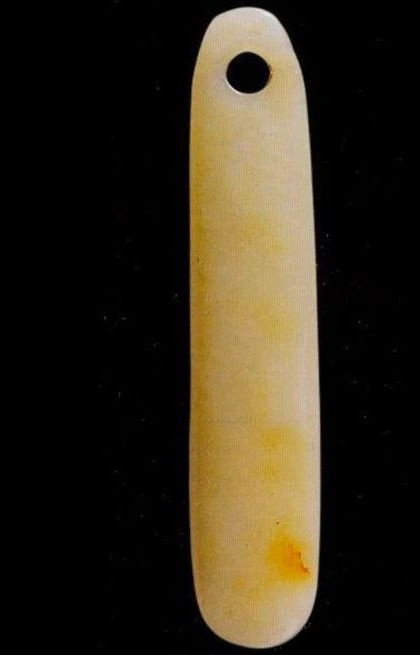
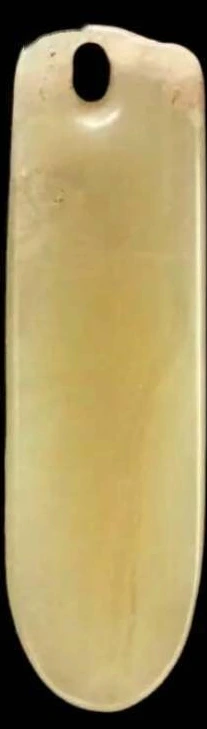
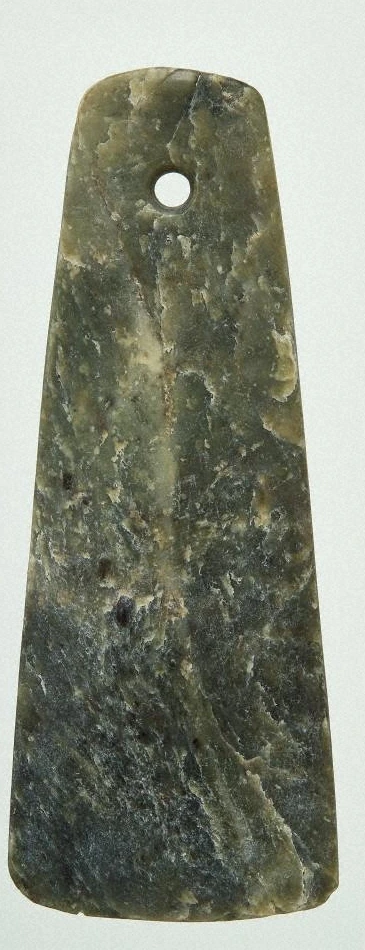
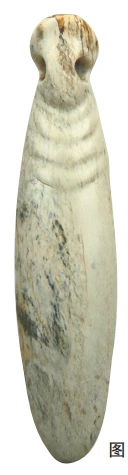
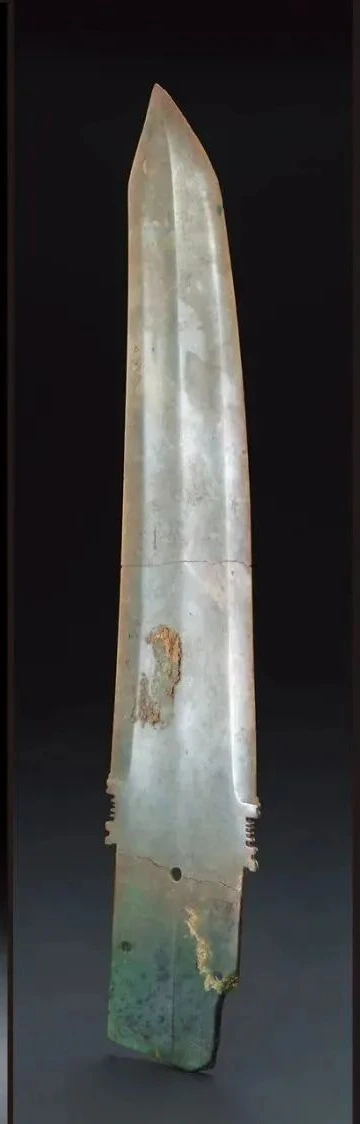
A pale blade from a Chinese grave, a hollowed strip from the Amur, a broad serpentinite pendant from Japan: each can look like a bullroarer at first glance. Put them beside one another and the differences become as interesting as the resemblance. Some were made for mounting. Others hung from cords. A few preserve wear that gives us a better question than shape alone.
Thin, end-pierced jade slats are among the first things anyone made from jade. With the slit ring they form the founding kit at Xiaonanshan on the Ussuri about nine thousand years ago, and the pair travelled to the Liao valley, the Amur and Jōmon Japan. Three of the five forms could have been bullroarers. The Jōmon spatulas make the strongest case, worn at the sides of the hole and not at its top; the plain slats and grooved blades follow. The hafted Chinese blades of the Bronze Age were not bullroarers.
In brief
- Is it a bullroarer? Possibly, for three of the five forms: the Jōmon spatulas most of all, then the plain slats and the grooved blades. The headed jades are open. The tanged Chinese blades are not; they were hafted.
- The oldest jade slats, from Xiaonanshan, date to about 9200–8600 years ago, among fishers and hunters, before millet farming in the West Liao. The slat and slit-ring kit appears at Xinglongwa about 8200 years ago, beside the earliest directly dated millet, and later on the Amur and at Kuwano in Japan.
- A grooved nephrite plate from Kondon, tied to a cord, turned in water like a spinner lure, and its excavators called it one. A tethered blade that turns is also how a bullroarer sounds; the plate was never tried in air.
- Five large Jōmon serpentinite spatulas are worn at about 45° on both faces of the hole and not at its top, where a hanging pendant wears. Bone replicas whirled for fifteen hours wore mainly at the sides of the hole.
- The tanged and toothed Chinese blades carry real hafting architecture and are the poorest bullroarer cases.
- “Jade Complex” names a family of shapes in nephrite, serpentinite and other stones, not a single culture.

A family resemblance in stone
The early core lies in northeast China, the Amur basin and the Russian Far East, with important comparisons in Jōmon Japan. At Chahai, in Liaoning, China, thirteen jade blades are reported. At Kuwano, in Fukui, Japan, five hollowed spatulate pieces occur alongside slit-ring ornaments. Later Chinese jade blades widen the comparison, but also bring different edges, grips and attachment systems.
The name groups a research problem across several peoples and periods. A knife, an ornament and a whirled blade can all be thin, polished and pierced. The useful distinctions are how the end was made, what the edge did and where contact left its marks.
Published interpretations
The published proposals include body ornaments, working implements, fishing lures and ceremonial blades. They concern different sets of objects, rather than one agreed class with several rival explanations. The five groups used here sort shapes across those publications; they are not five established ancient functional classes.
For the plain strips and broad spatulas, Japanese studies propose hair ornaments, waist ornaments or personal insignia, and carried or reworked tools. Their evidence includes find position, working edges, repair and cord-contact wear. Early Chinese jade bi have also been interpreted as food utensils. Wang Renxiang proposed that use for Xiaonanshan bi, comparing bone examples and a fish-scale deposit at Xinkailiu. The forum account published in 2025, p.149 · archived, gives no blade-specific wear or residue test. It also records disagreement over whether Xiaonanshan’s jades were chiefly ornaments or carried wider social and religious roles; that debate concerns the assemblage, rather than every blade individually.
The grooved blades have a regional fishing-lure interpretation, supported by the archaeologists’ account of a cord-tethered Kondon plate rotating in water. A tethered blade that turns is also how a bullroarer sounds; no hook fitting is recorded, and the plate was never tried in air. Tang Chung’s separate study of terminal wear at Kuwano and Xibenbaoleng proposes a shared use without identifying the task. Headed forms enter discussions of carved ornaments and ceremonial objects; later mounted blades are studied as weapons, edged implements and ritual or status objects. None of these readings rests on a test of how the objects moved, with the single exception of Kondon.
Five forms to compare
Scroll sideways to compare all columns.
| Form | Minimum specimens | The useful distinction | Present reading |
|---|---|---|---|
| Plain slats | 34 | Continuous outline; no differentiated head, grip or deep hollow | Most promising early subgroup; ornaments and later edged tools must be separated |
| Grooved blades | 17+ | Deliberately hollowed face or longitudinal channel | Suspension, terminal working wear and the Amur lure reading remain competing clues |
| Broad spatulas | 16 | Body widens below a narrower attachment end | Japanese wear sits where a whirled or taut cord rubs; Chinese forms need separate comparisons |
| Headed forms | 6 | Head, waist or fork interrupts the continuous outline | Too varied and sparsely documented for one functional verdict |
| Tanged and mounted blades | 41 | Shoulders, tangs or distributed back holes distinguish an attachment zone | Mounted or ceremonial blades are stronger explanations |
The numbers are specimen minima within this comparison, including fragments and counted same-form groups. They are not a census of East Asian archaeology. The grooved family exceeds the broad plates by only one specimen and ranks below them by separate inventory entries. The thirteen mixed-form Chahai blades are left unallocated; two possible Sannai-Maruyama duplicates are withheld.
Which ones deserve a cord
The early plain slats deserve the first close mechanical comparison: thin, flat pieces with a terminal attachment and without an obvious mounting system or working edge. That makes them good objects to investigate, rather than likely bullroarers by default. Kurawa’s two flat strips, reported near the back of a woman’s head, supply a strong ornament comparison within that visual family.
The grooved blades have unusually specific construction and wear evidence. Tang Chung compared the hollowed surfaces and worn terminal bevels of Kuwano and Xibenbaoleng. On the Amur, archaeologists described a grooved jade plate moving like a fish in water. These are different clues to test, not interchangeable proof of rotation in air.
The mounted blades are generally poor bullroarer cases. Taosi’s exceptionally thin jade dagger-axe still has a tang. The knives from Shangsunjiazhai and Zongri have holes distributed along their backs. A faithful explanation must account for those structures rather than ignore them.
The mark matters more than the name
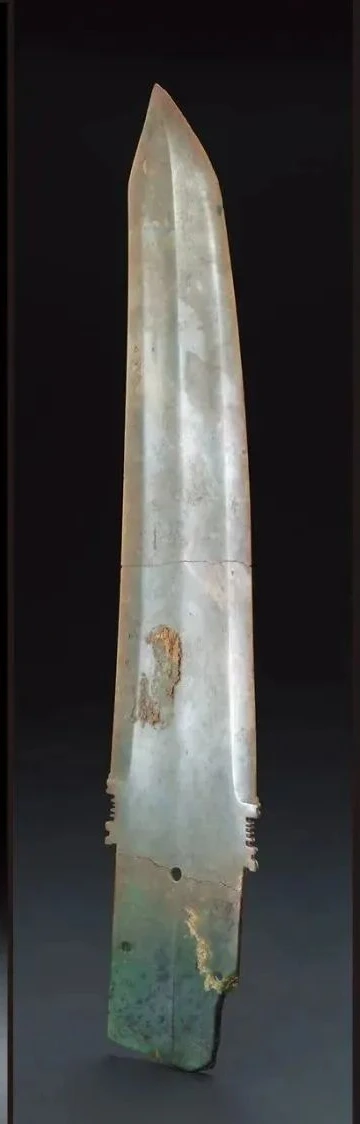
“Pendant,” “spatula,” “jade axe” and “fishing lure” are inherited interpretations as well as useful search terms. The observations beneath them matter more. The five large Japanese serpentinite pieces studied by Igarashi Mutsumi carry angled wear on both faces around their holes. There is none at the top of the hole, where a hanging pendant wears. He read it as a cord held somewhat taut against something, and proposed waist ornaments or insignia. Bone replicas whirled mechanically for fifteen hours wore mainly at the sides of the hole and only lightly at its top (Kumbani et al. 2019). The spatulas are worn where whirling wears; a cord tied taut against a belt or garment is the rival that would put the wear there too. On Hokkaido the Ainu still swung a spatula-shaped board to raise the wind in 1916, part of a weather practice that runs across northern Eurasia and North America and is likely far older than the spatulas themselves (Stone Spatulas).
The same discipline applies to context. Several blades in one grave are several objects but one assemblage. A house number does not establish a working floor; a ceremonial deposit does not identify a musical instrument. Measurements taken from drawings remain estimates, and an unreported wear study is not evidence of an unworn object.
The studies underneath the overview
Each form study brings its measurements, contexts, contact traces and alternative uses together. The plates preserve different examples side by side, while the tables keep the differences visible. A shared principal purpose is the question to test within a sufficiently narrow type; it is not a conclusion supplied by the name Jade Complex.
The most useful next step is a small, accurately measured comparison of bore, face and edge traces. A replica that sounds would establish mechanical capability. To recover ancient use, its traces must be compared with those left by wearing, binding, working and movement through water.
Key sources
- Tang Chung (鄧聰),2019. 東北アジアの早期軟玉文化情報革命の伝播. Awara forum booklet, PDFpp13–14, PlateVII. · archived Kuwano/Xibenbaoleng manufacture, measurements and terminal-bevel wear.
- Igarashi Mutsumi (五十嵐睦). アクセサリーから見た縄文時代, pp4,9. · archived Five-object angled-wear group and the waist-ornament interpretation.
- Zhao Binfu,Sun Mingming and Du Zhanwei. 饶河小南山墓葬出土玉器的年代和性质, 边疆考古研究14,pp69–78. · archived Xiaonanshan forms, disturbed old context and comparative Chinese examples.
- Okladnikov,A.P. and A.P.Derevyanko,1973. Далекое прошлое Приморья и Приамурья,pp121,124,135. · archived Novopokrovka blades and the original narrative of Kondon’s water trial.
- Zhao Zengjian, “Nine thousand years of Chinese jade culture: minutes of the Xiaonanshan Jade Culture Forum” (实证九千年中华玉文化——“小南山玉文化论坛”纪要), Palace Museum Journal 2025(1):144–149, especially149. · archived Primary account of Wang Renxiang’s food-utensil proposal and the meeting’s differing interpretations of early jade. The proposal is not a specimen-specific functional test.