Is This a Bullroarer? · Research study ·
Nordic Ship Razors
Seventeen Nordic bronze razors · Denmark, Sweden and northern Germany
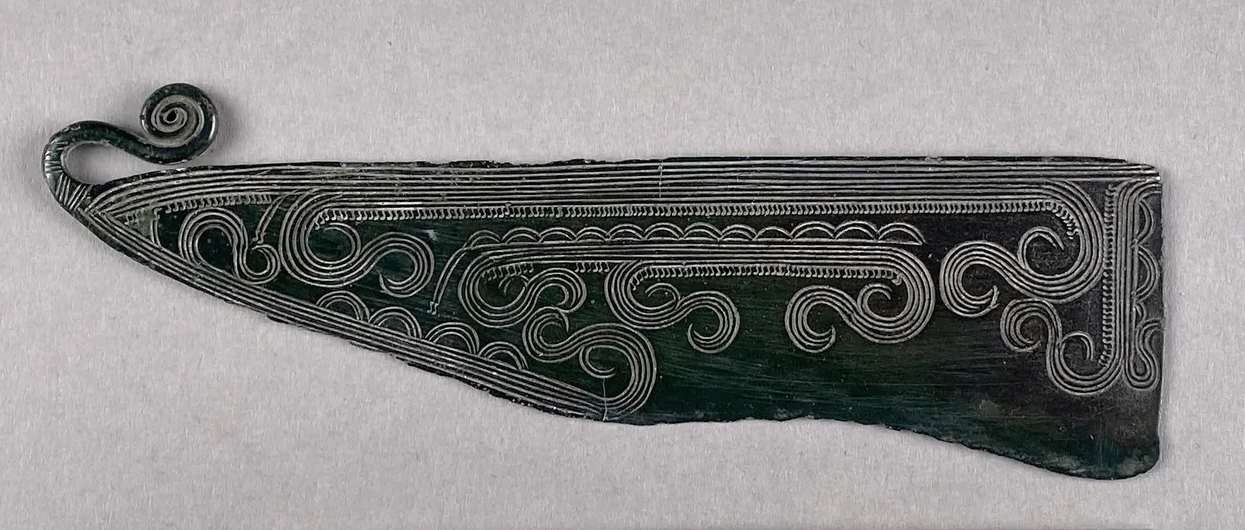
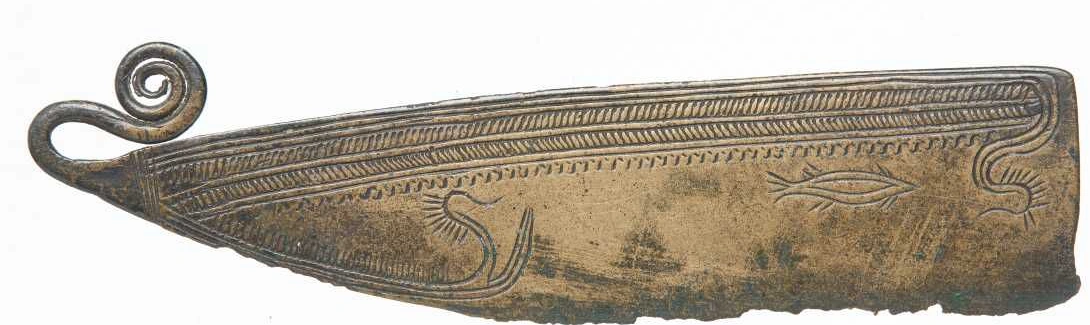
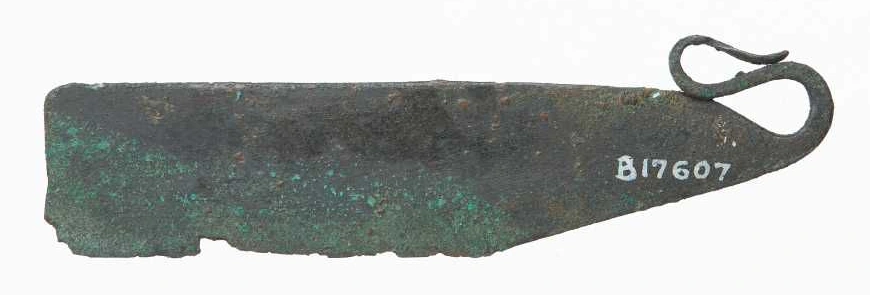
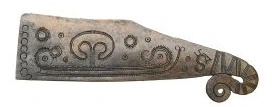
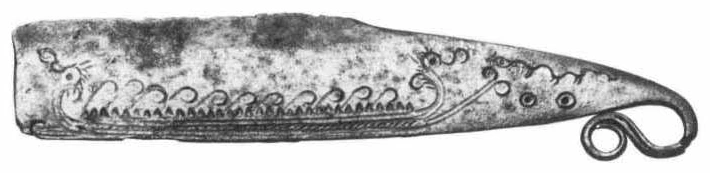
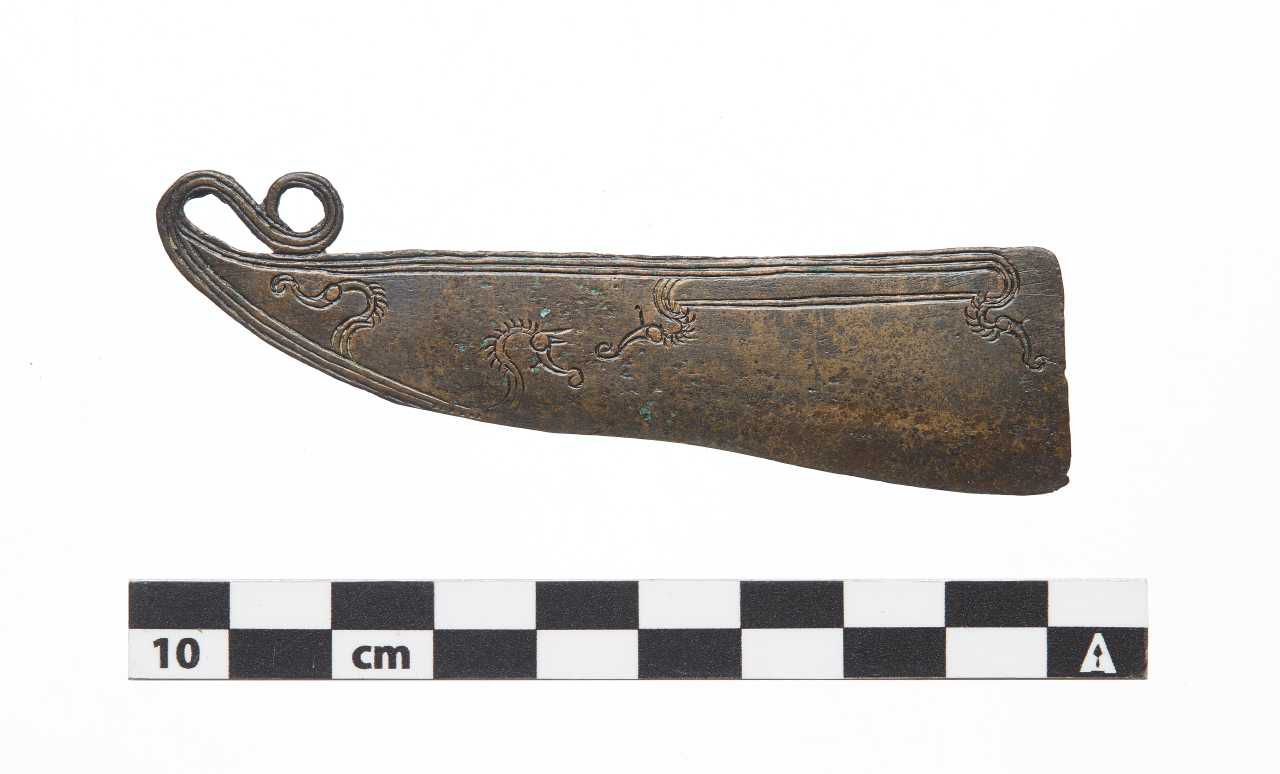
A ship can fit inside a hand. On the bronze razor from Hersum, its engraved hull runs for 6.4 centimeters; a bird’s head finishes one prow, a spiral the other. The picture travels on a personal implement only 8.9 centimeters long. Across this Nordic family, small blades carry an unexpectedly large world of vessels, animals and celestial signs.
These are razors. Their edges were sharpened until the sharpening cut into the pictures, and a replica shaves. The ships, suns and serpents engraved on them tell the sun’s journey, and nothing suggests they were ever whirled.
In brief
- Is it a bullroarer? No. They are razors.
- Nordic Bronze Age razors are thin bronze blades 9 to 15 centimetres long, and their flat outline invites the comparison with a bullroarer.
- Sharp convex edges, resharpening that wore away decoration, a fitted wooden case and a working replica all identify them as razors.
- Flemming Kaul reads their engraved ships, suns, fish, birds and serpents as one story: the sun carried by ship across the sky and drawn beneath the horizon at evening.
- Henrik Thrane suggests that a first shave marked a young man’s entry into adult life.

A world in the hand
These are razors with ships on them: the ship is an engraved motif, while the bronze body remains a cutting implement. Their recurved handles and broad faces give them a recognizable family resemblance. This selection brings together finds from Denmark, Sweden and northern Germany; it is a comparative group, not the complete Nordic razor corpus. Dronningehøj, Volstrup and Tåby are included as related motif companions rather than counted among its fourteen ship-bearing specimens.
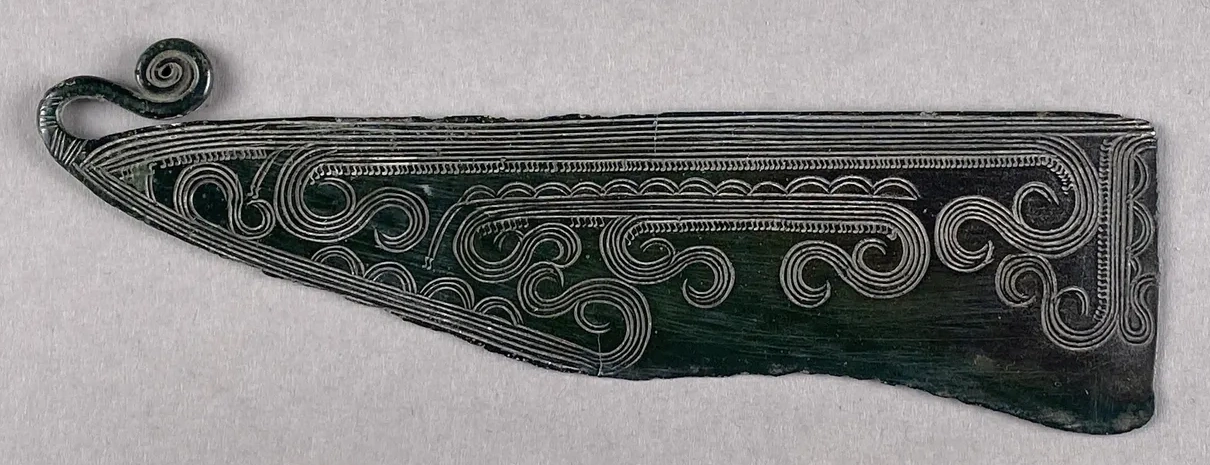
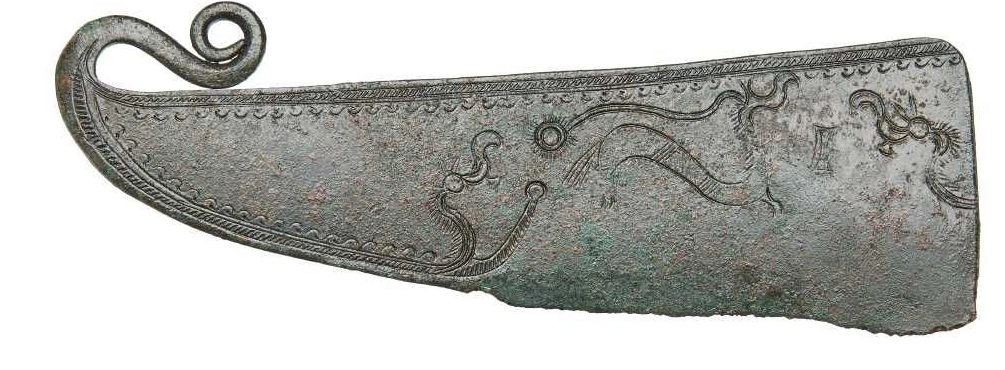
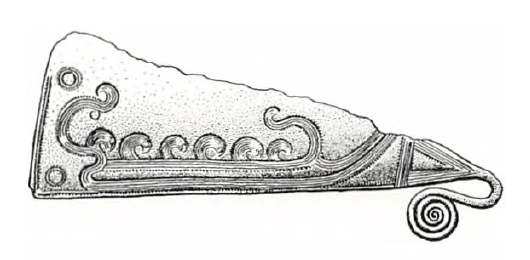
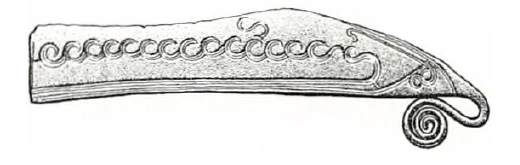
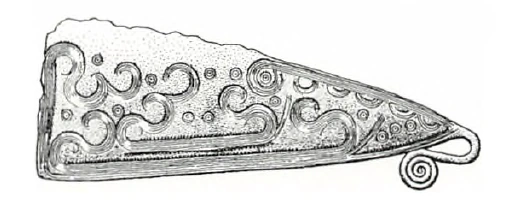
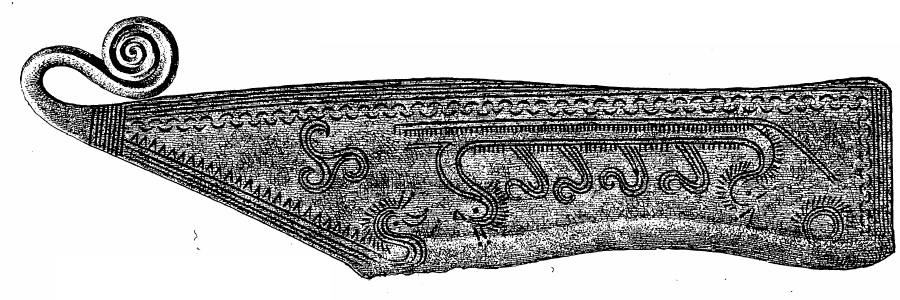
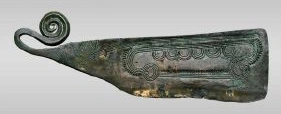
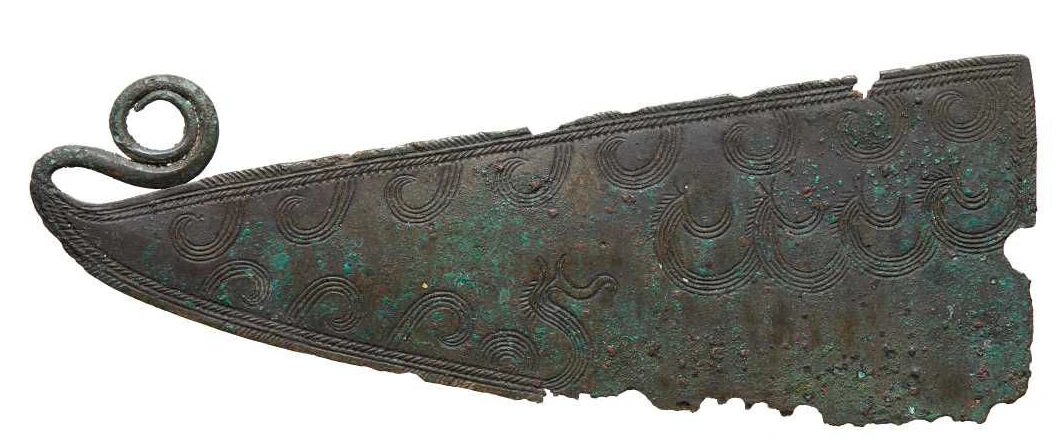
The measurements make their intimacy tangible. Honum is 13.4 centimeters long; Hjärpetan is 13 centimeters, Kabusa 11.5. Their surfaces offered room for fine lines rather than monumental pictures. At Hersum, the engraved ship occupies much of the blade’s length. Its animal-headed prow echoes the stylized bird of the handle. The Hersum description · archived distinguishes the 6.4-centimeter ornament from the 8.9-centimeter object—a useful distinction when comparing such small works.
Eight specimens, eight histories
Dimensions below are published measurements, not estimates from photographs. Dates usually describe archaeological types; they are not direct assays of the bronze. A broad period is retained where a narrower date has not been secured.
Scroll sideways to compare all columns.
| Object and country | Dimensions | Date or context | Motifs and observations |
|---|---|---|---|
| Honum, Denmark NM 14748 | 13.4 × 3.7 cm | Early period V, about 900–700 BC; plough find with tweezers | Ship, radiant circles, branching axe-or-tree motif |
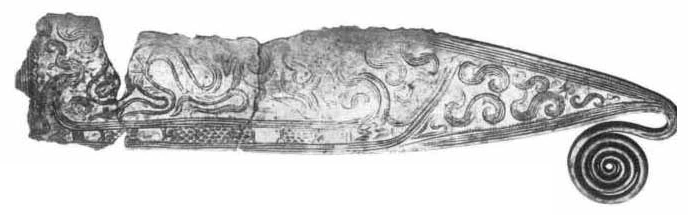
| Voldtofte, Denmark · archived NM 26340 | 14.8 cm long | Bronze Age; narrower date unestablished here | Ship and many-limbed figure; photograph and reconstructed drawing must be distinguished |
| Fjeldsted, Denmark · archived NM B 1534 | Not supplied in the cited account | Bronze Age | Ship and four-legged serpent |
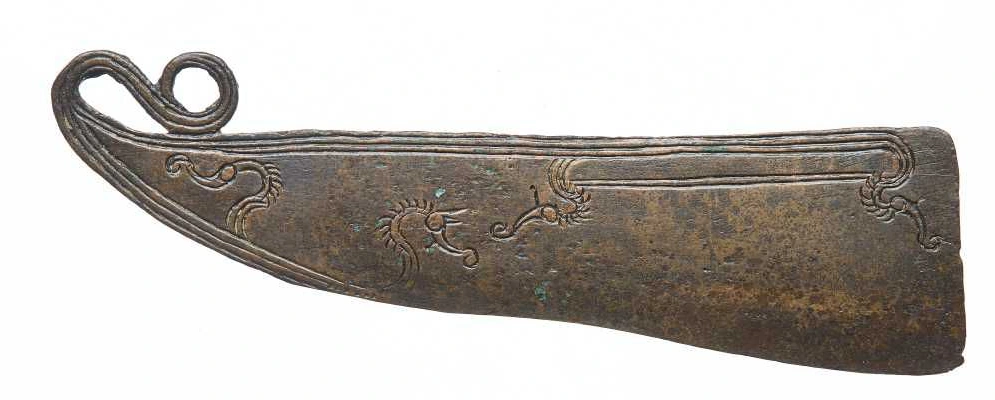
| Neder Hvolris, Denmark · archived NM B 17739 | 8.9 × 2.9 cm | Late Bronze Age, about 1100–500 BC | Ship; horse drawing a radiant circle; probable ancient break and repair |
| Hjärpetan, Sweden · archived 96920_HST | 13.0 × 3.8 cm | 900–700 BC; hoard | Stylized ships, S-shaped figures; visibly resharpened edge |
| Kabusa, Sweden · archived 412636_HST | 11.5 × 3.4 cm | 900–700 BC | Ship prows, running spirals, concentric circles; undecorated reverse |
| Hersum Hørhede, Denmark · archived NM B 17607 | 8.9 × 2.0 cm | Late Bronze Age; loose find | Bird-headed ship and handle; small edge nicks |
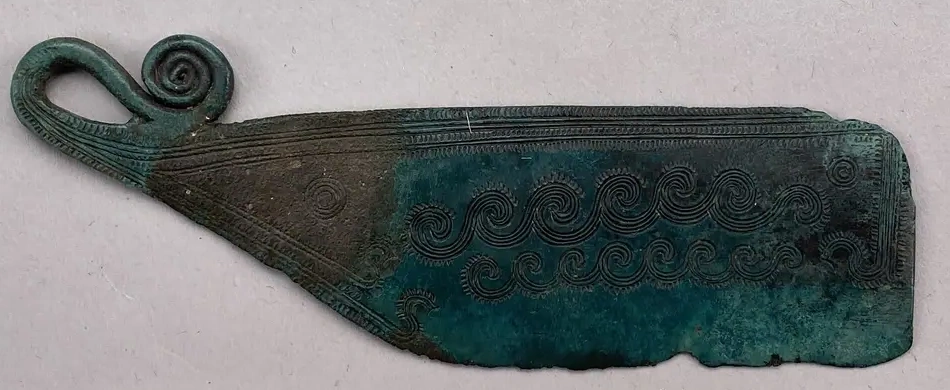
| Tåby, Sweden · archived C3996:12 | 9.5 × 2.4 × 0.1 cm | Period IV–V type, about 1100–700 BC; grave assay 190 BC–AD 140 | Swan-head handle; scroll with horse head, possible opposing head; ship not established; heavily chipped edge |
Honum’s early-period-V attribution and axe-or-tree reading are discussed by Åsa Fredell (2003, p. 51, fig. 4) · archived; its find with tweezers appears in A. P. Madsen (1872, p. 27, no. 15) · archived. The Tåby dates describe two conflicting kinds of evidence, not a continuous lifespan demonstrated for the razor.
The working edge
Henrik Thrane’s 1987 study · archived gives several reasons to take shaving seriously: sharp, generally convex edges; experiments that achieved a shave, though an uncomfortable one; and repeated sharpening that sometimes removed decoration. Those observations concern the wider razor family, not newly demonstrated wear on every specimen here. His Vester Skerninge example retained a fitted wooden case protecting the delicate edge. That particular case belongs to a comparative razor outside this seventeen-object selection.
Hjärpetan supplies an object-specific observation. Its museum description · archived identifies the slightly concave edge as clearly resharpened. A richly ornamented face and a maintained cutting edge coexist on the same object. Decoration was something a working implement could gradually lose.
Tåby adds a different kind of evidence. Olle Hörfors (2006, pp. 24–25) · archived describes an edge chipped by long use and about forty percent of the decorated surface damaged by flaking. The cremated person was probably a young adult woman. The razor’s Bronze Age form conflicts with a grave radiocarbon range of 190 BC–AD 140 (table 18, p. 81). Its presence therefore cannot simply identify a male owner or supply a secure Bronze Age burial date.
In a separate argument, Flemming Kaul (2013) places the appearance of horse-head-handled Nordic razors in the fifteenth century BC alongside a warrior ideal that included a clean-shaven face. He proposes adoption of elements of a Mycenaean lifestyle, rather than importation of these exact northern razors.
The sun’s journey
On Neder Hvolris, a horse draws a radiant circle by a double line beside a ship. The National Museum of Denmark · archived presents this horse as one of the sun’s helpers. Ships, fish, serpents and water birds belong to the same interpreted celestial world.
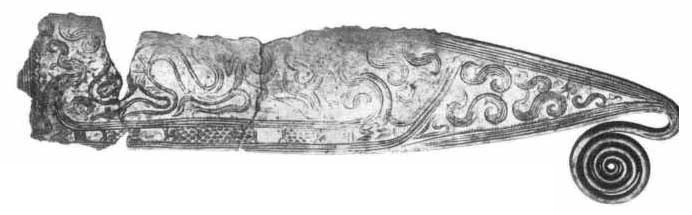
Kaul’s reconstruction assembles the different scenes into a cycle. As the Swedish History Museum explains · archived, a fish helps raise the morning sun; a bird follows; a horse takes over around midday. Toward evening a serpent or dragon draws ship and sun beneath the horizon. The night ship sails leftward without a visible sun, before the fish returns at dawn. Direction and the presence or absence of a solar sign matter to this reading. It is an archaeological reconstruction of a myth, rather than a surviving Bronze Age narrative.
Individual designs permit more specific readings. At Kongshøj on Røsnæs, Kaul interprets two sun signs beside a ship as successive positions of one sun. At Sakshøj, three ships and several solar signs suggest several stages of its movement (Kaul 2006, pp. 76–77, fig. 19 · archived). These miniature compositions can compress time as well as space.
Creatures and ceremony
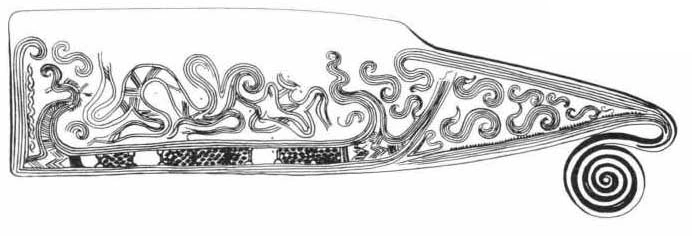
Fjeldsted’s four-legged serpent and Voldtofte’s human-looking limbs are different creatures. The reconstructed Voldtofte drawing interprets damaged ornament; it should not turn the figure into a certain serpent. Thrane’s figures 4 and 8 · archived preserve that distinction.
Thrane also suggests a first shave marking adult male life. That proposed initiation, the practical shaving experiments and Kaul’s solar interpretation answer different questions: ceremony, cutting and imagery.

A cutting tool with a cosmology
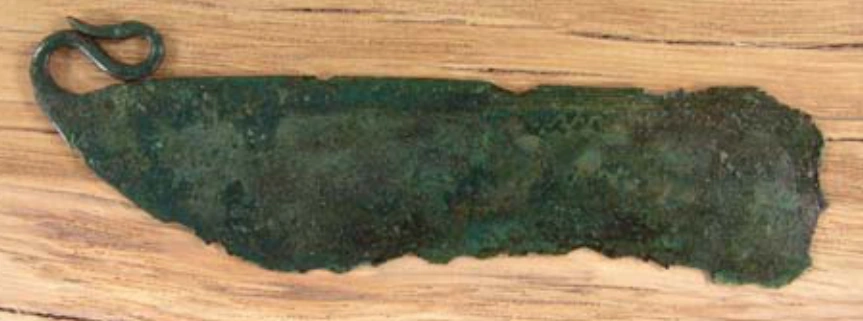
A broad thin body and a recurved handle make a cord attachment physically conceivable on some specimens. That resemblance makes comparison with a bullroarer worth asking about. It provides very little evidence of ancient sounding by itself. A handle capable of retaining a cord does not show that a cord was attached; a successful modern spin would establish mechanical capacity, not prehistoric use.
For these razors, sharpening, cutting-edge damage and the grooming interpretation carry more weight than the proposed acoustic use. No original cord, diagnostic rotational cord wear or object-specific sounding experiment is established by the sources used here. A faithful replica trial could test the sounding question; object-specific wear consistent with repeated whirling would matter more to the historical one. Neither result should be inferred from the religious imagery.
The razors remain compelling on their own terms. A maintained edge, a small ship and an animal helper can belong to the same object. Shaving could change a person’s appearance while the engraved surface carried a picture of the world. These miniature picture worlds put celestial movement beside the intimate work of caring for a body.
Download the full 17-object comparative table · Fourteen ship-bearing razors and three related motif companions are labelled separately.
Key sources
- Henrik Thrane, ‘Broncealderbarbering,’ Fynske Minder (1987), pp. 14–27, especially figs. 4, 5 and 8 and notes 2 and 45. · archived Shaving trials and discomfort; sharpening; Vester Skerninge case; Fjeldsted and Voldtofte; initiation explicitly presented as suggestion.
- Swedish History Museum, ‘A Nordic Bronze Age razor.’ · archived Museum account of Kaul’s solar-cycle interpretation; not evidence of sound production.
- Flemming Kaul, ‘Billeder fra en svunden tid: Glimt fra bronzealderen i Nordvestsjælland,’ Fra Nordvestsjælland 2005–2006 (2006), pp. 55–98, especially pp. 76–78, fig. 19 and p. 97 note 15. · archived Primary interpretation of Kongshøj and Sakshøj imagery and individual find identities.
- Flemming Kaul, ‘The Nordic razor and the Mycenaean lifestyle,’ Antiquity 87 (2013), pp. 461–472. Abstract supports fifteenth-century appearance and emulation of a warrior grooming ideal, not importation of the northern objects.
- Åsa Fredell, ‘Bronze Age Imagery Through Water and Fire,’ Current Swedish Archaeology 11 (2003), p. 51, fig. 4; A. P. Madsen, Afbildninger af danske Oldsager og Mindesmærker: Broncealderen, Suite af Knive (1872), p. 27, no. 15 and pl. 24. · archived Honum’s period-V attribution and axe-or-tree motif; Madsen supplies find with tweezers. Original Madsen scan linked beside the table.
- Olle Hörfors, Tåby skola, Östergötlands länsmuseum Rapport 2006:70, pp. 16–18, 24–25, 30–31 and 81 (table 18). · archived C3996:12 dimensions, edge damage, probable female burial and conflicting calibrated grave date.
- National Museum of Denmark, collection descriptions: Honum NM 14748; Neder Hvolris B 17739; Hersum Hørhede B 17607. Individual collection descriptions and measurements are linked in the specimen table.
- Swedish History Museum, Hjärpetan 96920_HST and Kabusa 412636_HST, collection descriptions. · archived Object measurements, periods, motifs and Hjärpetan’s resharpened edge; each exact object linked in the table.