No. EA-MITSUGOSAWA-NAKA-HERA-001
Mitsugosawa-naka site large hera-shaped pendant
Takasaki, Gunma, Japan; Mitsugosawa-naka site pit 75 · East Asia
Function not recorded Candidate only
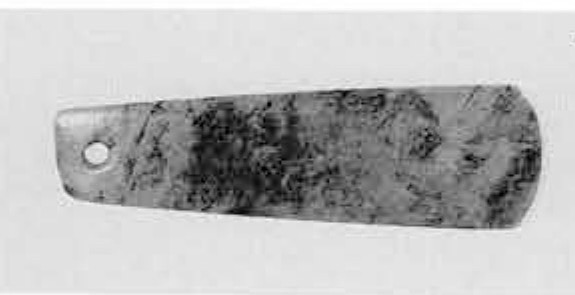
ヘラ状垂飾
Source term: ヘラ状垂飾; hera-shaped pendant; spatula-shaped pendant; report label 玉斧
ヘラ状垂飾 (hera-jō suishoku): 'spatula-shaped pendant'
Its excavation table called it a complete jade axe (玉斧) — but the serpentinite is barely thicker than a ruler, 7.5 millimetres and 62 grams, and a later specialist read the wear instead of the label. Around the single hole at its top, both faces carry the same oblique forty-five-degree scars that mark the whole Kantō cluster of five: not a cord chafing above a dangling weight, but a taut cord pressing the thin stone against the body. The verdict: a waist-worn emblem of standing — rare imported stone, one owner. Whether it ever spoke as a bullroarer, no test has settled.
Particulars
- Object
- A thin serpentinite blade, 12.6 × 3.8 × 0.75 cm and 62 g, pierced once at the narrow top; like the rest of its group of five, both faces are worn in a slant of nearly 45 degrees around the hole. From pit 75. Late Early to initial Middle Jōmon.
- Function
- Two labels in tension: its excavation report calls it a complete 'jade axe' (玉斧), a later synthesis a hera-shaped pendant worn at the waist — and at 12.6 × 3.8 × 0.75 cm it is blade-thin.
Source
Kanagawa Prefecture archaeology lecture (2025), Fig. 2, after Tsubota 2017; Mitsugosawa-naka site report, Fig. 194, PL. 89 and table, no. 75土-1