Is This a Bullroarer? · Research study ·
Tanged Jade Blades
Jade and stone ge, zhang, and pierced knives from China
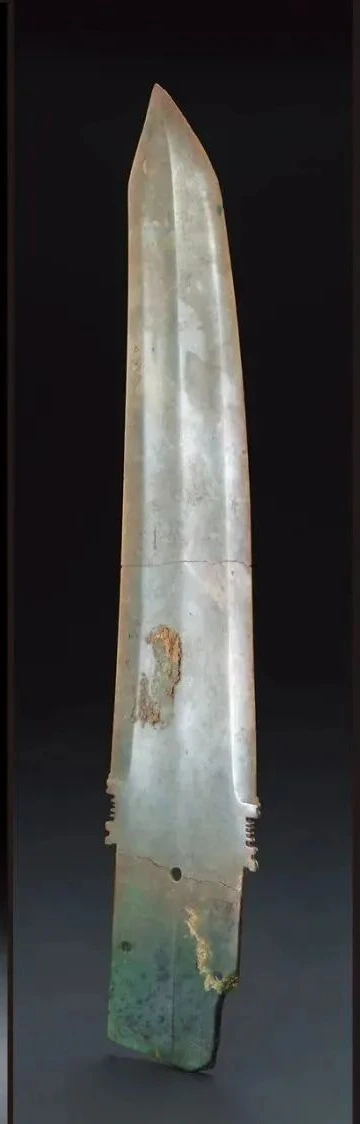
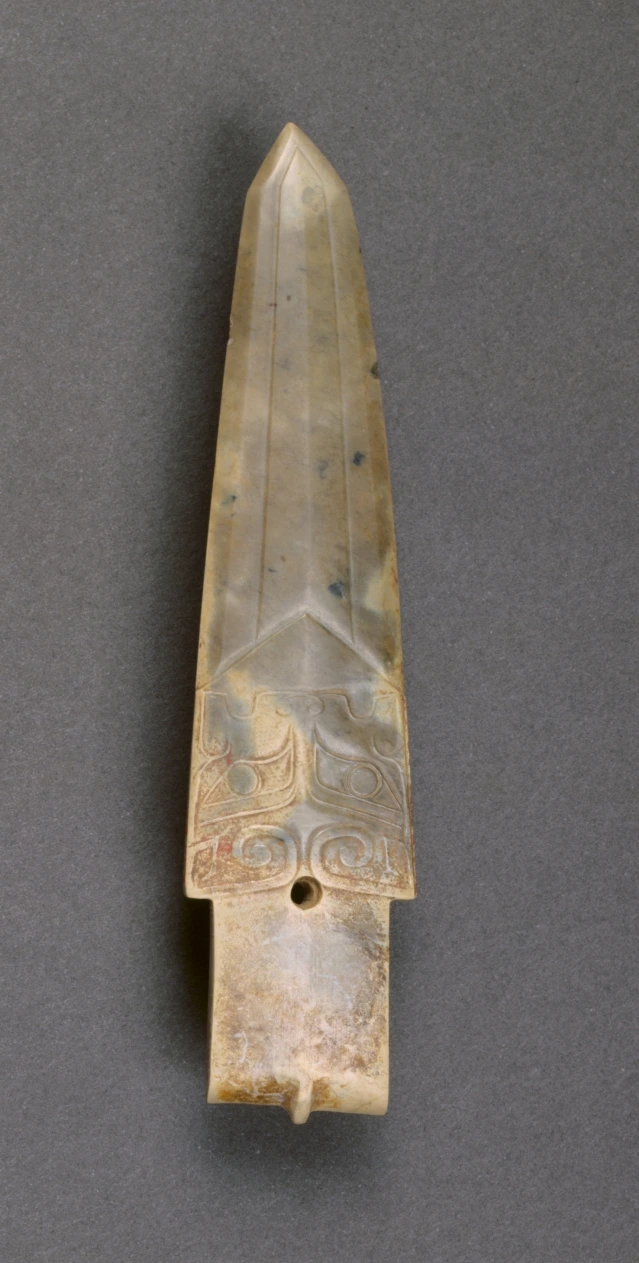
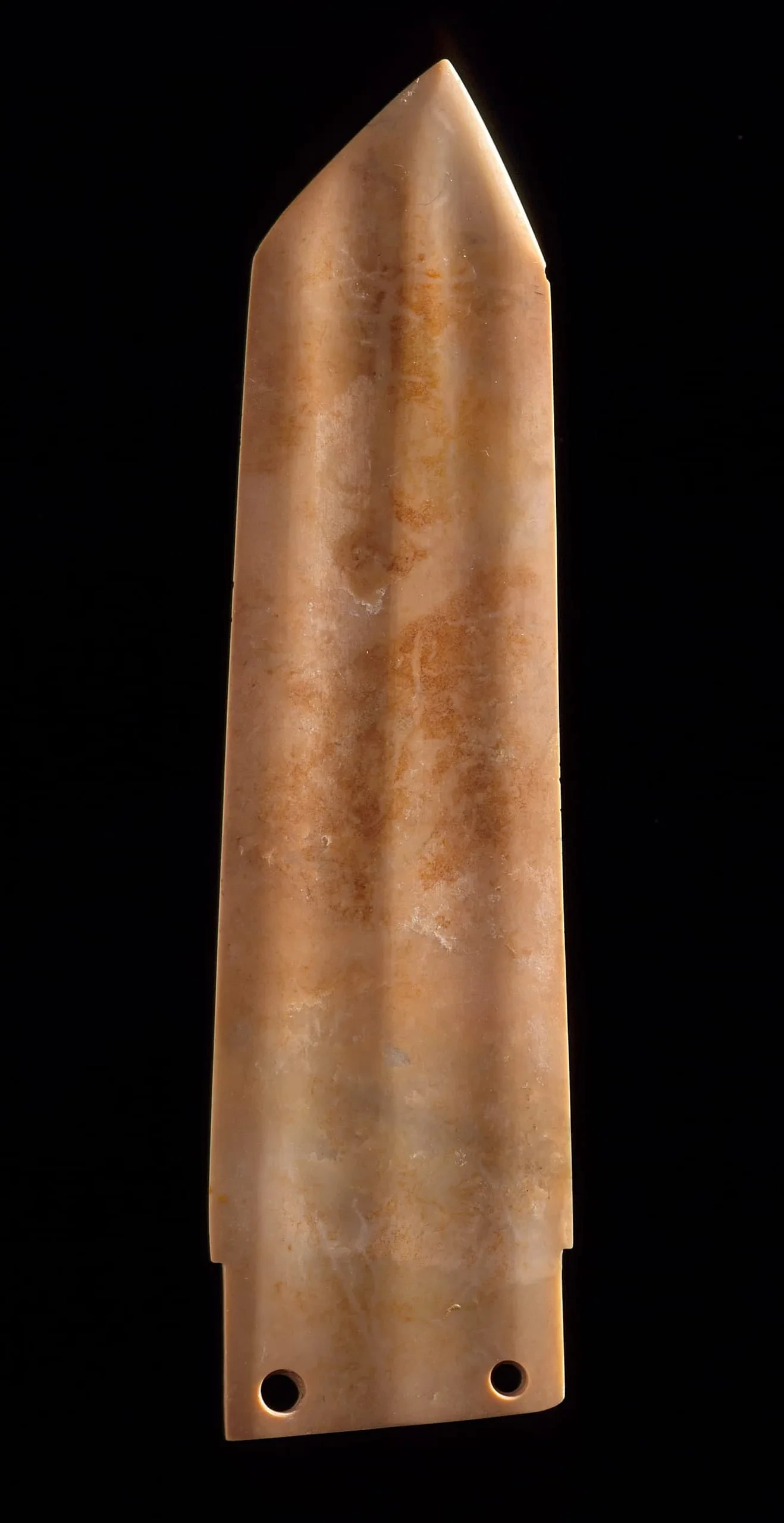
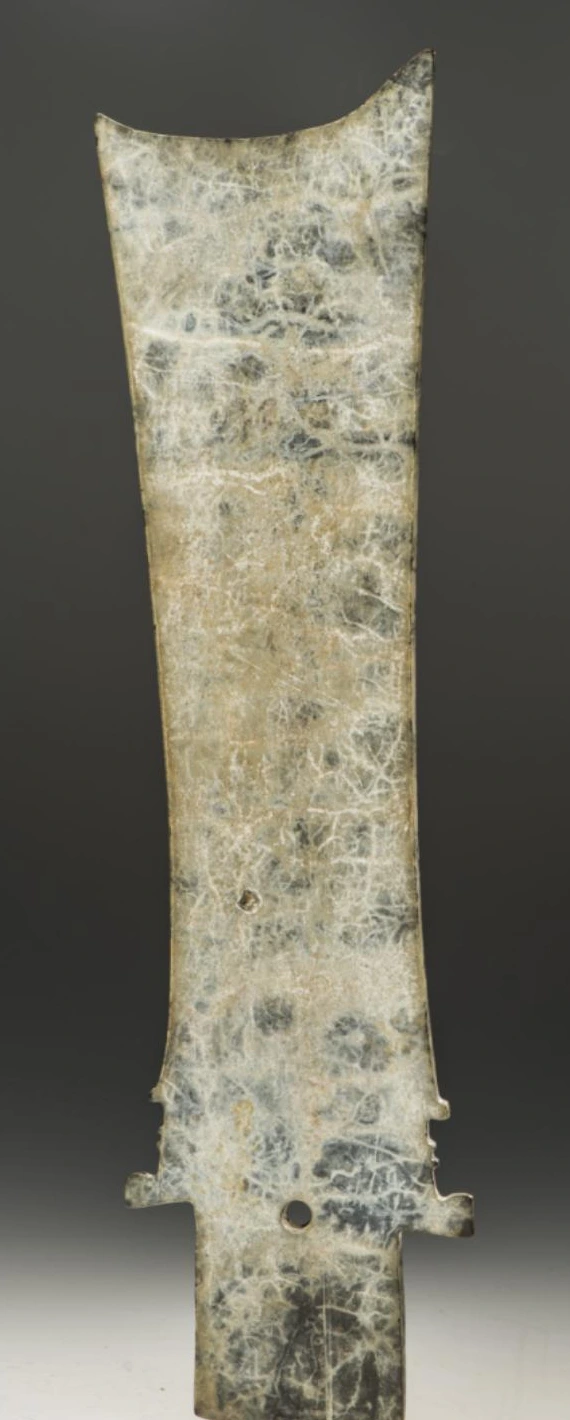
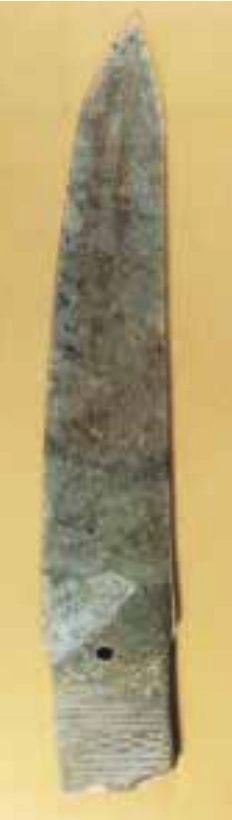
At Taosi North in Shanxi, China, a jade blade only two millimetres thick lay between the coffins of an early Spring and Autumn burial. Its pointed body looks wonderfully slight. At its base, though, the stoneworker left a short squared tang and drilled a hole where tang and blade meet. The tang and hole make mounting a concrete possibility to compare with suspension; thinness alone cannot decide how the blade moved.
Mounted or handheld ceremonial blades currently offer the strongest explanation for this varied group. Tangs, shoulders, teeth and distributed back holes provide attachment evidence; none of the examined descriptions establishes ancient bullroarer use.
In brief
- Is it a bullroarer? No. Tangs, teeth and shaft holes show these blades were hafted.
- Taosi M7:139 combines a measured 2 mm thickness with a distinct 29 mm tang: a thin blade can still be designed for a haft.
- Niumendong’s 542 mm jade blade has a toothed grip and three axial holes; Wang Yuchang interprets the holes as fastenings for a wooden shaft.
- Jiaojia’s knife has three plugged back holes and one open end hole, preserving a possible change of attachment whose timing remains unknown.
Where these objects were found

Published interpretations
The literature considers tool and weapon forms alongside ceremonial uses. A ge is a dagger-axe form; a jade ge need not have served in combat. For zhang, Zhu Naicheng (2014, p. 86) · archived reconstructs a short wooden handle aligned with the blade, using an Erlitou grave plan and a Sanxingdui bronze figure holding a zhang. He interprets their use as ceremonial display and also considers upright installation on a support. Neither reconstruction proves the mounting of every specimen here.
Qin Xiaoli (2017, pp. 85–90) · archived treats zhang, gui, large yue and jade knives as weapon-shaped ritual jades. Her authority interpretation rests on associated grave goods and changing regional distributions. These are contextual and typological comparisons, rather than cutting or sounding tests.
Niumendong exposes the uncertainty within the names. Wang Yuchang · archived observes that it resembles a zhang, knife and gui without fitting any neatly, and cites Zhu’s descriptive alternative, waisted-grip, toothed-rib, terminal-edged implement. Wang reads its three holes as wooden-shaft fastenings. The Qinghai catalogues call the back-pierced pieces knives, while Shandong University Museum · archived explicitly calls Jiaojia’s knife ceremonial. Hole arrangement and bevels support reconstructing attachment and an edge; the exact grip, action and ancient use still need object-specific evidence.
Attachment ends · further comparisons
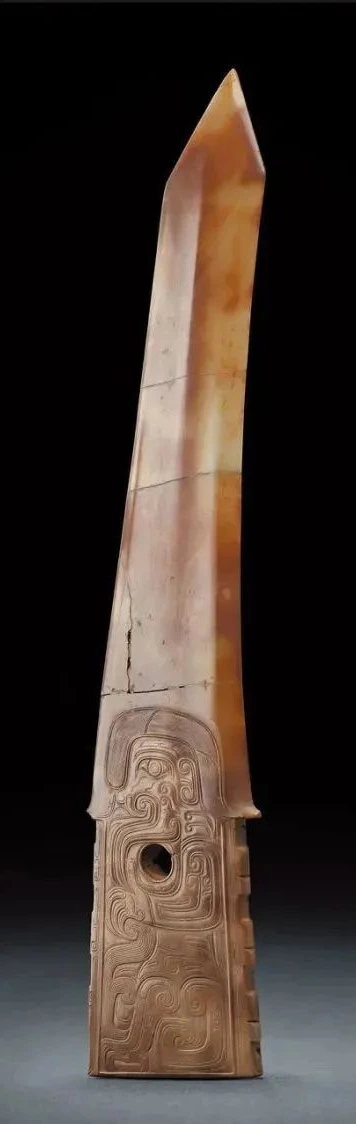
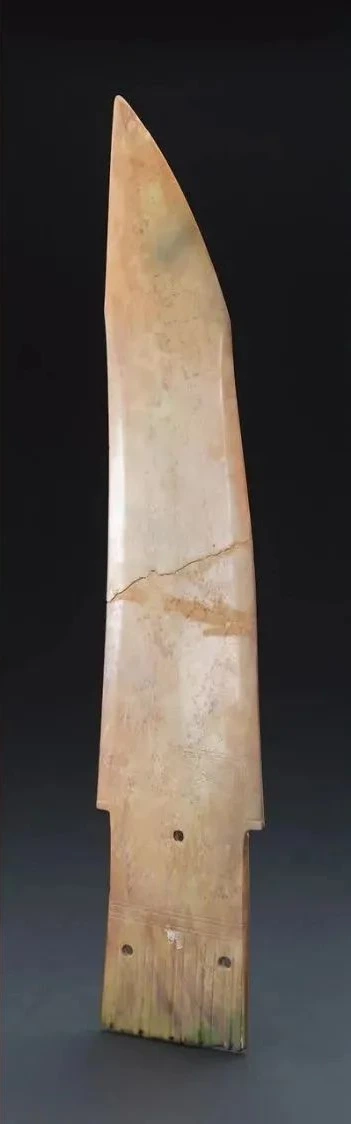
Three kinds of attachment
The comparison covers at least 41 specimens, including one fragment. It brings together several physical families rather than one ancient culture or one demonstrated use. The important division is between the free blade and the part intended to meet a hand, handle, shaft or binding. A tang is the shaped base that can enter or lie against a mounting; shoulders stop that mounting from sliding farther onto the blade.
Pointed ge, conventionally called dagger-axes, have a blade and tang. Toothed zhang often put an elaborate shoulder above a narrower base and carry a broad, sometimes concave terminal edge. Back-pierced knives place several holes beside a long edge, spreading possible attachment across the object. These arrangements deserve separate reconstructions. A cord through one convenient hole would bypass much of their design.
The objects below range from Dawenkou-period Jiaojia in eastern China to later Zhou burials in Shanxi. The dates refer to the stated burial, cultural attribution or museum assessment; they are not ten directly dated manufacturing events.
Ten blades, measured separately
Length comes first, then width and thickness. Ranges are retained; “unreported” means the cited description does not supply the measurement. The Hulinshan and second Taosi lengths describe surviving objects, without restoring their missing parts.
Scroll sideways to compare all columns.
| Object | Dimensions, mm | Attachment and edge | Material and context |
|---|---|---|---|
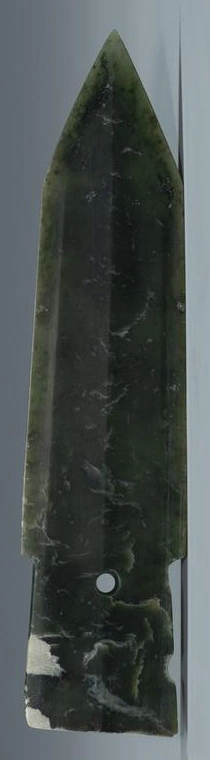
| Taosi North M7:139 | 192 × 37 × 2 | Short tang 29 × 31; one junction hole | Jade; between coffins in M7; early Spring and Autumn burial |
| Taosi North M7:141 | 192 surviving × 64 × 6 | Damaged tang with hole; triangular point | Stone; same M7 coffin interval; separate object |
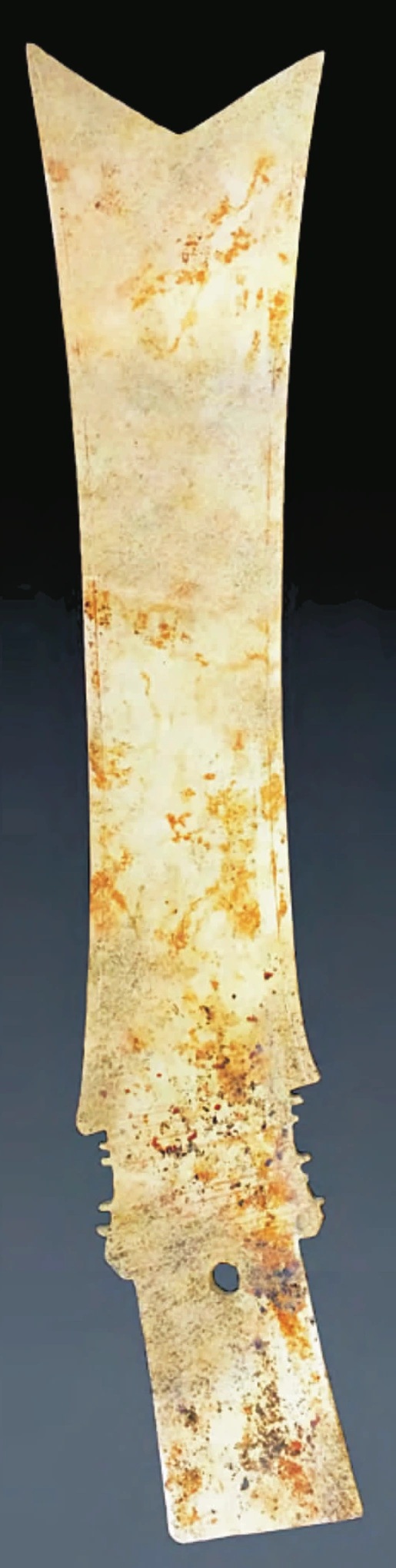
| Beizhao M63:114 · archived | 560 × 94; thickness unreported | Long tang, toothed shoulders, three reported tang holes | Jade; M63, late Western Zhou burial; manufacture may be earlier |
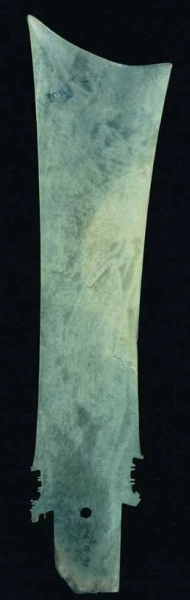
| Niumendong, Wang photos 4–5 · archived | 542 × 99 maximum × 1–2 | Waisted toothed grip; three holes along basal axis | Jade; reported sitefind; Qijia attribution, manufacture debated |
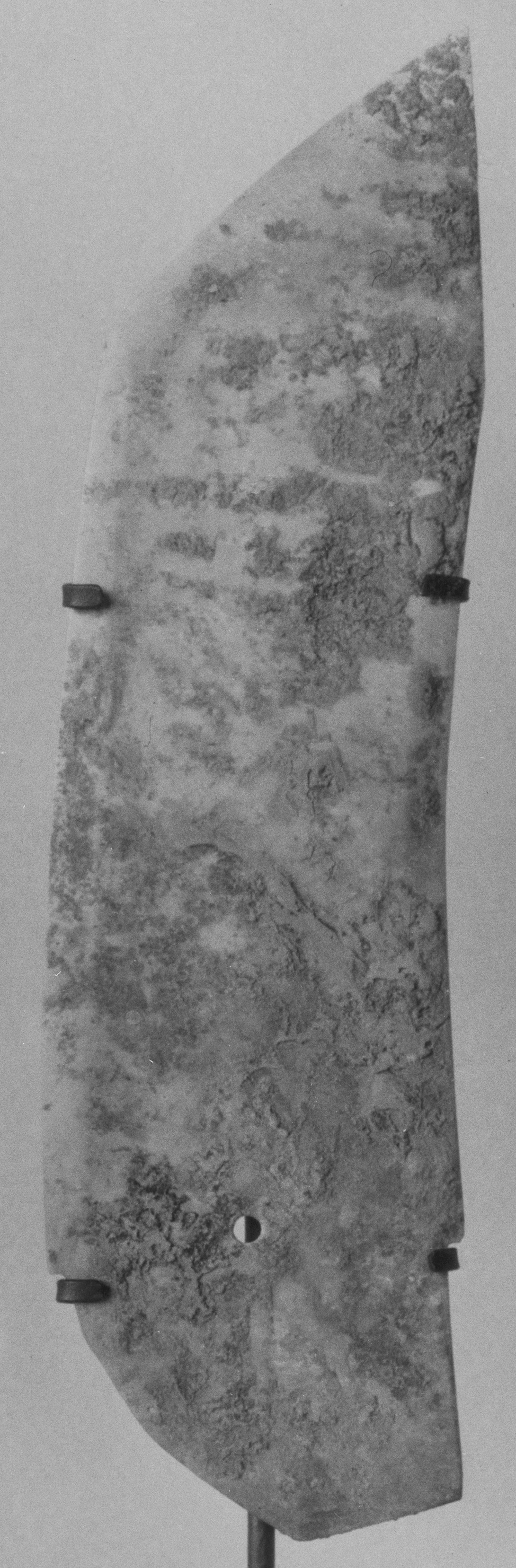
| Hulinshan M13 · archived | 514 surviving × 138 × 15 | Shoulder teeth and basal eye; damaged distal corners | Stone; grave 13, Fujian; Bronze Age cemetery |
| Yangzhuang, 1958 find · archived | 660 × 130 × 4 | Toothed shoulders, short narrow tang, one eye | Jade; Zhengzhou find; early Shang attribution, no sealed grave |
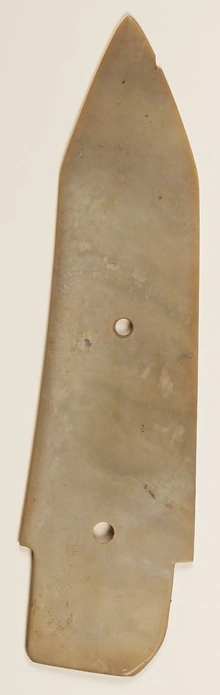
| Ashmolean EA1956.1613 · archived | 233 × 62 × 4 | Stepped shoulders; tang eye and second body hole | Jade; findspot unrecorded; Shang Anyang-period museum attribution |
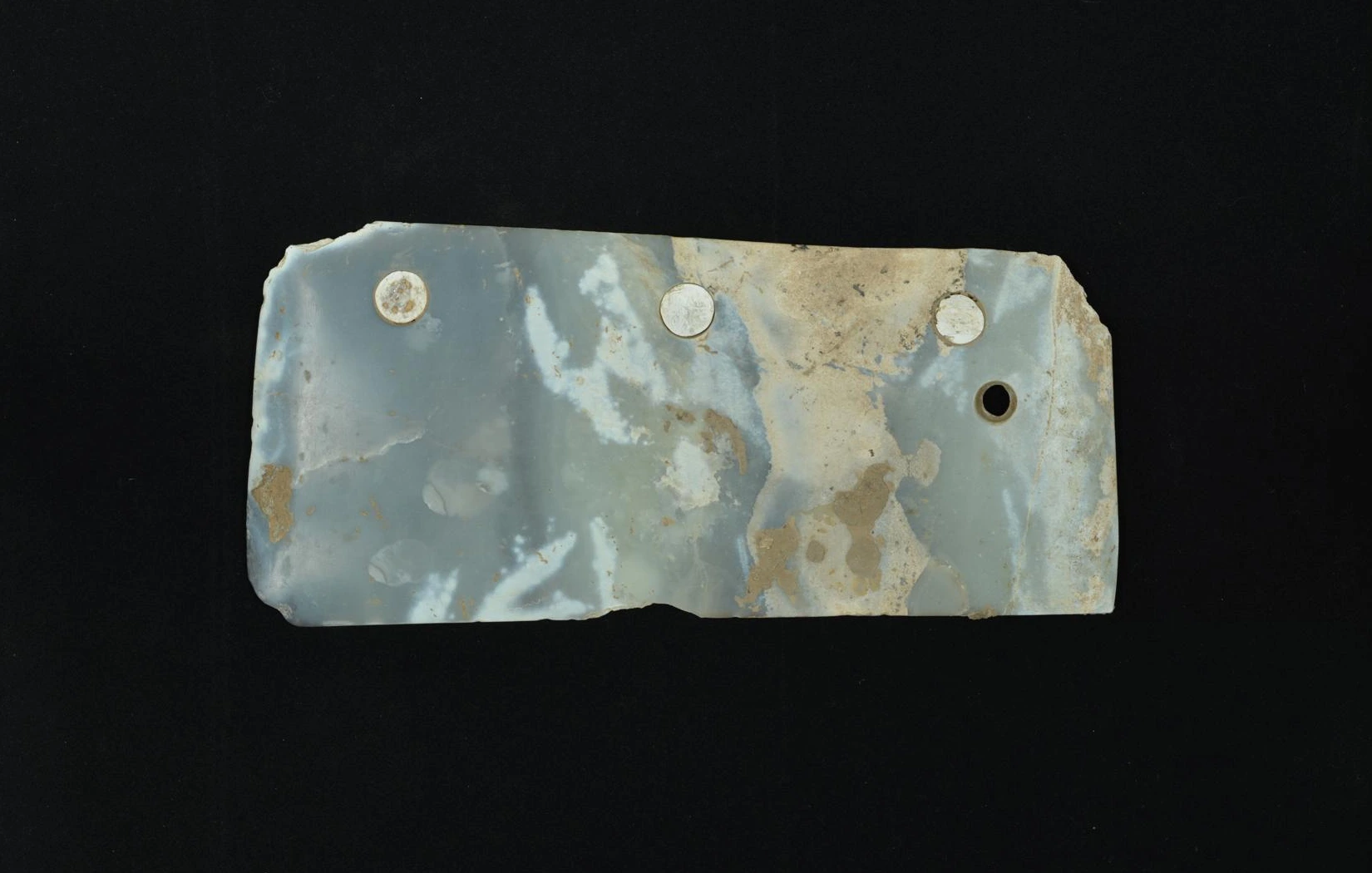
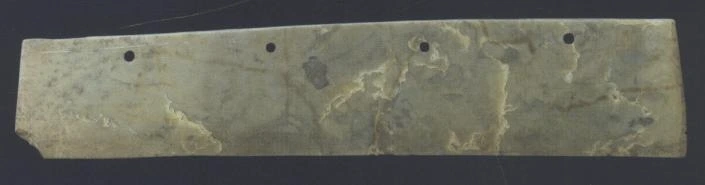
| Shangsunjiazhai, catalogue 150 · archived | 540 × 85–103 × 8 | Four 10–12 mm holes along back; curved beveled edge | Jade; cemetery provenance, exact grave unreported; Qijia attribution |
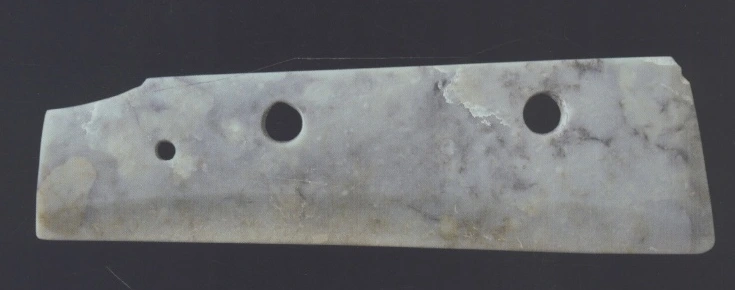
| Zongri, catalogue 151 · archived | 187 × 37–56 × 5 | Two 12 mm back holes, 60 mm apart; smaller 5 mm end hole | Jade; site provenance, exact feature unreported; Qijia attribution |
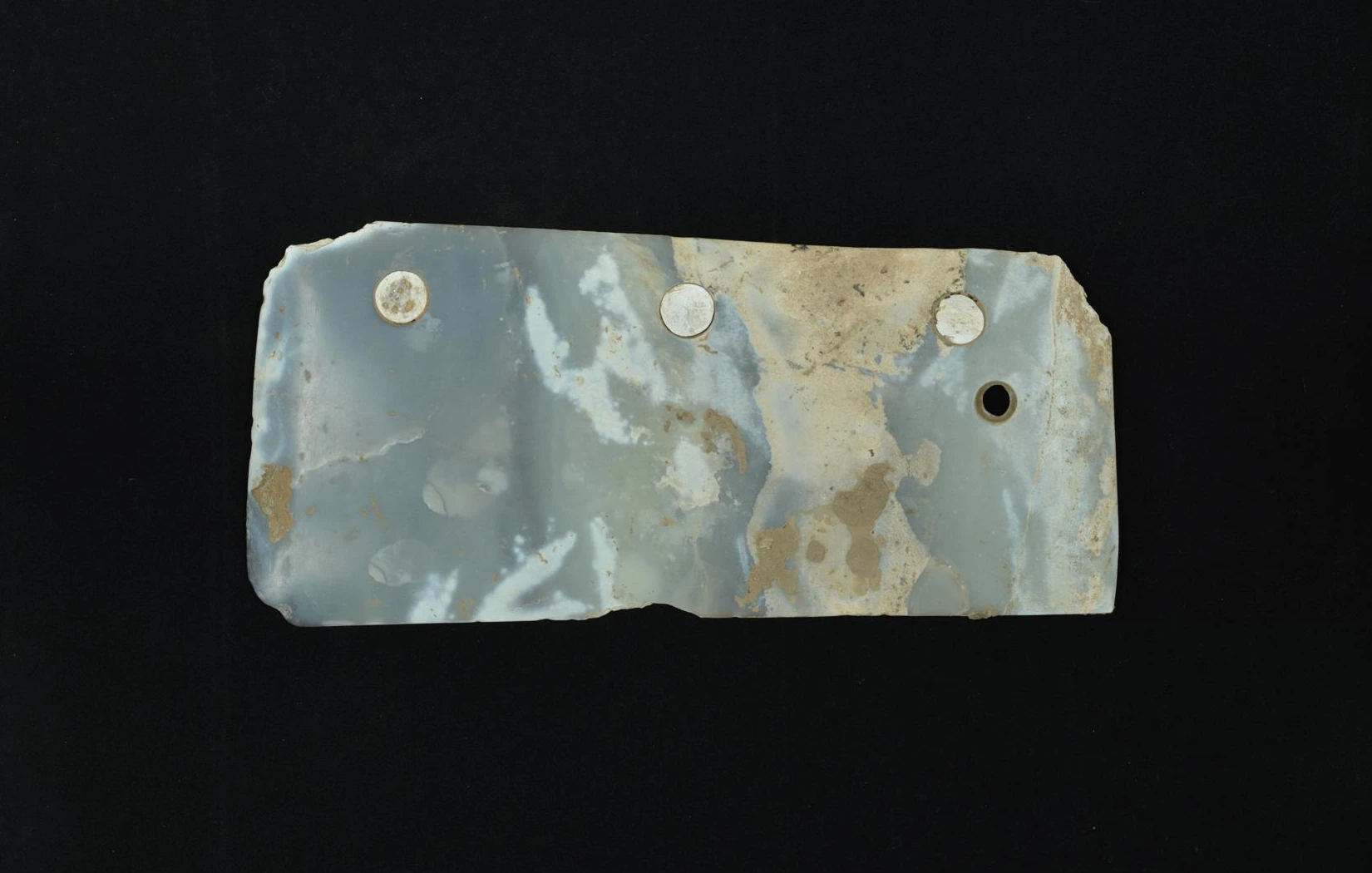
| Jiaojia museum knife · archived | 214 × 90–100 × 4 | Three plugged back holes; one open short-end eye | Jade; excavated 2016; Dawenkou attribution, about 5,000 years ago in museum account |
A two-millimetre dagger-axe
The excavators describe Taosi M7:139 as ridgeless, with a short straight tang and a sloping blade converging on a triangular point. Its 163 mm blade is joined to a 29 mm tang. The drawing gives both face and edge views, making the thinness unusually well grounded. Yet the tang and junction hole are equally real. A transverse haft is a concrete rival to a freely suspended sounding blade. The report places this object in the northern interval between coffins, apart from the jades arranged on the body. Taosi excavation report, §III(2)2, Fig. 37:11.
The second ge from the same grave, M7:141, is stone, 6 mm thick, and has a damaged tang. It cannot inherit the jade specimen’s exceptional thinness. At Beizhao, also in Shanxi, M63:114 extends the comparison to a 560 mm jade ge with toothed shoulders and a long tang. Du Jinpeng reports three tang holes and a low central ridge. This is a much more elaborate mounting region; its numerical thickness is unreported. Du 2026, p. 11 · archived.
Teeth and a grip on a thin sheet
Niumendong in Gansu supplies the most arresting thin blade: 542 mm long and only 1–2 mm thick. Its waist and small sharp teeth create a differentiated grip. Three holes run along the basal axis, at 88, 142 and 188 mm from the grip. Wang describes their interiors as unfinished: that is a manufacturing observation, not evidence that binding or cord wear was absent. His shaft-binding interpretation is not a surviving wooden mount. The blade has been repaired from two sections. Wang 2022, photos 4–5 and accompanying description · archived.
Thinness varies substantially within these shouldered forms. The Yangzhuang blade from Zhengzhou is 660 mm long and 4 mm thick. Hulinshan M13 in Fujian preserves 514 mm of stone at 15 mm thick. Both have shaped basal attachment regions, but neither thickness nor a shared ceremonial name makes them mechanically interchangeable. Zhu’s handle reconstruction supplies a model to compare with each object’s shoulders and eye. Yang Boda 2013, p. 19 · archived; Zhu 2014, pp. 86, 90 · archived; Qin 2017, p. 90 · archived.
Holes along the back
The Qinghai knives offer a different arrangement. Shangsunjiazhai’s four holes follow its straight back above a curved edge beveled from both faces. Zongri catalogue 151 has two large back holes and a smaller hole near the narrow end. Several attachment points along a back can secure a blade differently from a single terminal cord. Neither catalogue entry reports a preserved mounting or a wear study. Their polished surfaces cannot supply those missing observations. Gu Fang, ed., 2005, vol. 15, entries 150–151 · archived.
Jiaojia in Shandong makes this especially interesting. Shandong University Museum describes a nearly rectangular ceremonial knife with lenticular sections: thickest in the middle, thinner toward the edges. Three evenly spaced back holes are closed with round jade plugs; an additional hole on a short side stays open. The plugs preserve an alteration in the object’s construction. A change of attachment is possible, but the description does not date the plugging or establish what passed through the remaining eye. Shandong University Museum, “Jade knife,” 2025 · archived.
Inspection, reuse, and further tests
Published inspection can go beyond names. Studying the related yue from Fu Hao’s Shang tomb, Wang Qing, pp. 61–62 · archived, reports band-like abrasion from haft bindings on M5:15, but no hafting or lashing traces visible under light on M5:462. He also identifies earlier-made jades reburied in the Shang tomb through form and manufacturing technique. These observations concern those particular objects: they show why working use, ceremonial use and later reuse must be examined separately. They are not tests of the ten blades above.
For those blades, mass, complete sections, hole walls and contact around tangs, teeth and shoulders would help distinguish a fixed mount from moving cord. Jiaojia also needs a sequence for its drilling and plugging. The cited descriptions supply no sounding experiment for these specimens. Replica trials preserving the measured section and attachment architecture could establish capability; comparison with ancient wear, residues and context would still be needed to identify historical use.
Long blades · holes along the back
Tangs and shoulders · six more blades
The comparative catalogue
Measurements are length × width × thickness in millimetres. A dash means unreported; ≈ marks an estimate. Groups and possible duplicate objects remain labelled. Download the specimen table.
View all 41 evidence entries
Scroll sideways to compare all columns.
| Object | L × W × T, mm | Material | Context | Reported traces |
|---|---|---|---|---|
| Taosi North · M7:139China · object; minimum 1 | 192 × 37 × 2Reported total length 192 mm; blade 163 × 37 mm, tang 29 × 31 mm, thickness 2 mm. Width 37 mm refers to the blade. | jade (mineral not established) | burial | not reported |
| Taosi North · M7:141China · fragment; minimum 1 | 192 × 64 × 6Surviving length192mm; broken tang. | stone | burial | not reported |
| Beizhao · M63:114 · archivedChina · object; minimum 1 | 560 × 94 × — | jade (mineral not established) | burial | not reported |
| Beizhao · M63:60 · archivedChina · object; minimum 1 | — × — × — | jade (mineral not established) | burial | not reported |
| Beizhao · M63:111 · archivedChina · object; minimum 1 | — × — × — | jade (mineral not established) | burial | not reported |
| Yinshanling · Fig37:5China · object; minimum 1 | 180 × — × — | stone | mixed | not reported |
| Changchun Baijia · photographed ge · archivedChina · object; minimum 1 | — × — × — | jade (mineral not established) | unknown | not reported |
| Maogang · Fig2:7 · archivedChina · object; minimum 1 | 325 × — × 6 | stone | dwelling | not reported |
| Bamashan Qinnei · chamber5:4 · archivedChina · object; minimum 1 | 220 × 54 × — | stone | burial | not reported |
| Shuyuanjie · M2 long ge · archivedChina · object; minimum 1 | 725 × — × — | jade (mineral not established) | burial | not reported |
| Baijiazhuang · 1955 grid ge · archivedChina · object; minimum 1 | 572 × 93 × 10 | jade (mineral not established) | burial | not reported |
| Hulinshan · M13 zhang · archivedChina · object; minimum 1 | 514 × 138 × 15 | stone | burial | not reported |
| Guangze Zoumaling · Fig6:e · archivedChina · object; minimum 1 | — × — × — | jade (mineral not established) | unknown | not reported |
| Tongbai Yuehe · M1:142 · archivedChina · object; minimum 1 | 252 × — × —Secure Shao L252mm. Indexed unbanked2023 crosswalk256.3×54–69×3.04mm; earlier exhibit257×62×4mm; the discrepancy is unresolved. | jade (mineral not established) | burial | not reported |
| Zengcheng Moyishan · M70 blade · archivedChina · object; minimum 1 | 159 × 40 × 5 | jade (mineral not established) | burial | not reported |
| Zengcheng Moyishan · M66 blade · archivedChina · object; minimum 1 | — × — × — | jade (mineral not established) | burial | not reported |
| Zengcheng Honghualin · Honghualin collected zhang · archivedChina · object; minimum 1 | — × — × — | jade (mineral not established) | unknown | not reported |
| Nanyang Wangchenggang · 2019 exhibited zhang · archivedChina · object; minimum 1 | 378 × 98 × 6 | jade (mineral not established) | unknown | not reported |
| Luoquanyu · YL10 · archivedChina · object; minimum 1 | 248 × 72 × 6–10thickness6–10mm; length248; width72; basal width64. | stone | ritual deposit | not reported |
| Shangwanjiagou · Yang plateI upper · archivedChina · object; minimum 1 | 326–335 × 54 × 5.5–6length326–335mm; thickness5.5–6mm; distal width54,base47,shoulders69,waist45. | stone | surface | not reported |
| Simatai · Yang Fig2 · archivedChina · object; minimum 1 | 258–275 × 78 × 4–5length258–275mm; thickness4–5mm; blade width78 versus exhibit72; basal43. | jade (mineral not established) | unknown | not reported |
| Wangjiawuchang · Fig8:1 · archivedChina · object; minimum 1 | — × — × — | jade (mineral not established) | surface | not reported |
| Wangjiawuchang · Fig8:2 · archivedChina · object; minimum 1 | — × — × — | jade (mineral not established) | surface | not reported |
| Donglongshan · M83:1 · archivedChina · object; minimum 1 | 276 × — × —2022:276×50–70×3mm;2025:278×70×5mm; retain discrepancy. | jade (mineral not established) | burial | not reported |
| Huadizui · H40 zhang · archivedChina · object; minimum 1 | 300 × — × 10.1 | jade (mineral not established) | ritual deposit | not reported |
| Dafanzhuang · Deng Fig38 · archivedChina · object; minimum 1 | 329 × 98 × 6–11Fig38 thickness6–11mm; Fig37 thickness6–10mm; modern caption mismatches larger blade. | stone | unknown | not reported |
| Dafanzhuang · Deng Fig37 · archivedChina · object; minimum 1 | 275 × 80 × 6–10Fig38 thickness6–11mm; Fig37 thickness6–10mm; modern caption mismatches larger blade. | stone | unknown | not reported |
| Xinzheng · 1981 collected zhang · archivedChina · object; minimum 1 | 392 × 102 × — | jade (mineral not established) | surface | not reported |
| Zhengzhou Yangzhuang · 1958 Yangzhuang zhang · archivedChina · object; minimum 1 | 660 × 130 × 4 | jade (mineral not established) | unknown | not reported |
| Maquan Unnamed Site · Wang photo11 · archivedChina · object; minimum 1 | 247 × 40–57 × 2–7photo11 width40–57mm, thickness2–7mm; photo12 width28–42mm, thickness2–8mm. | jade (mineral not established) | unknown | not reported |
| Unprovenanced Wang Photo7 · Wang photo7 · archivedChina · object; minimum 1 | 318 × 53–82 × 2–7width53–82mm; thickness2–7mm. | jade (mineral not established) | unknown | not reported |
| Lianzhu · Wang photo1 · archivedChina · object; minimum 1 | 165 × 80 × 3 | jade (mineral not established) | burial | not reported |
| Daishan · Wang photo6 · archivedChina · object; minimum 1 | 340 × 45 × 3 | jade (mineral not established) | surface | not reported |
| Niumendong · Wang photos4–5 · archivedChina · object; minimum 1 | 542 × 99 × 1–2Reported length 542 mm, shorter edge 521 mm, blade width 99 mm, middle width 93 mm, tooth gap 75 mm, thickness 1–2 mm; body repaired in two parts. | jade (mineral not established) | Reported 1976 Niumendong sitefind; no sealed feature established. | not reported |
| Unprovenanced Cma1983.2 · CMA1983.2 · archivedChina · object; minimum 1 | 181 × 44 × — | nephrite (institutional identification) | unknown | not reported |
| Unprovenanced Met24.51.15 · Met24.51.15 · archivedChina · object; minimum 1 | 168 × 41 × — | jade (mineral not established) | unknown | not reported |
| Unprovenanced Lacma M.70.76.4 · LACMA M.70.76.4 · archivedChina · object; minimum 1 | 190.5 × — × — | jade (mineral not established) | unknown | not reported |
| Unprovenanced Ashmoleanea1956.1613 · AshmoleanEA1956.1613 · archivedChina · object; minimum 1 | 233 × 62 × 4 | jade (mineral not established) | unknown | not reported |
| Shangsunjiazhai · catalogue150 · archivedChina · object; minimum 1 | 540 × 85–103 × 8Reported 540 × 85–103 × 8 mm; four 10–12 mm holes along the long back. The 13 mm bevel width is not body width. | jade (mineral not established) | Shangsunjiazhai cemetery provenance; individual grave unreported. | not reported |
| Jiaojia · museum jade knife · archivedChina · object; minimum 1 | 214 × 90–100 × 4Reported 214 × 90–100 × 4 mm; three plugged back holes and one open short-side hole. The plugging sequence is undated. | jade (mineral not established) | Jiaojia, excavated 2016; exact feature and inventory number unreported. | not reported |
| Zongri · catalogue151 · archivedChina · object; minimum 1 | 187 × 37–56 × 5Reported individual width range 37–56 mm, thickness 5 mm. Two long-back holes plus one smaller end hole. Measurements and wear observations belong to this catalogue specimen. | jade (mineral not established) | unknown | not reported in catalogue151; surface alteration is not use wear |
Key sources
- Shanxi Provincial Institute of Archaeology et al., “Excavation report of M7 in Area I, Taosi North cemetery, Xiangfen, Shanxi,” Wenwu 2018(9), pp. 4–21, §III(2)2, Fig. 37:11, 17; §V(1). Original report reproduced at the linked page. Separate dimensions and identity for jade M7:139 and stone M7:141; early Spring and Autumn dates the burial.
- Du Jinpeng, “New evidence for the origins of the Zhang surname from an archaeological perspective,” Zhongyuan Wenhua Yanjiu 2026(3), pp. 5–14, p. 11. · archived M63:114 dimensions, teeth, ridge, three tang holes and late Western Zhou burial; cites the 1994 excavation report.
- Wang Yuchang, “A preliminary study of Qijia-culture jade yazhang in Gansu museum collections,” republication 13 May 2022, photos 4–5. · archived Niumendong measurements, repair and unfinished bore interiors; shaft-binding interpretation and discussion of zhang/knife/gui labels, citing Zhu’s descriptive alternative. Dating is typological.
- Gu Fang, ed., Zhongguo chutu yuqi quanji [Complete Collection of Unearthed Jades in China], vol. 15 (Science Press, 2005), catalogue entries 150–151. · archived Original object entries supply the Shangsunjiazhai and Zongri dimensions, back holes, bevels and site provenance.
- Shandong University Museum, “Jade knife” (玉刀), 27 April 2025. · archived Exact Jiaojia object, dimensions, lenticular sections, three plugs and open end eye. The sequence and date of plugging are not supplied.
- Zhu Naicheng, “The circulation and distribution of yazhang and the traces of Xia history,” Gugong Wenwu Yuekan 373 (2014), pp. 86–99, especially pp. 86 and 90, Fig. 10a–b. · archived Short longitudinal handle reconstructed from the Erlitou grave plan and Sanxingdui bronze figure; ceremonial display and possible upright support. Hulinshan M13 photograph reproduced from the excavation publication.
- Qin Xiaoli, “Yazhang and their significance in the formation of early Chinese states,” Zhongyuan Wenhua Yanjiu 2017(4), pp. 85–94, p. 90. · archived Weapon-shaped ritual-jade interpretation based on associated finds and distributions; Hulinshan M13 surviving dimensions, separate from M19.
- Yang Boda, “An examination of excavated Xia and Shang jades: Notes on reading jade II,” Gugong Xuekan (2013), p. 19. · archived Yangzhuang’s own 660 × 130 × 4 mm measurements and find circumstances.
- Ashmolean Museum, Jade ceremonial blade, EA1956.1613, collection entry. · archived Museum dimensions 233 × 62 × 4 mm and Shang Anyang-period attribution; no excavated findspot supplied.
- Wang Qing, “妇好墓出土玉器中的遗玉略论” [On inherited jades excavated from Fu Hao’s tomb], Museum, pp. 58–72, especially pp. 61–62. · archived Firsthand study: band-like binding abrasion on M5:15, no hafting/lashing traces seen under light on M5:462; inherited-jade attribution based on form and manufacturing technique. These are related yue comparisons, not the ten table specimens.