Is This a Bullroarer? · Research study ·
Jade Slats and Stone Strips
Plain, unheaded plates from northeast Asia and later China
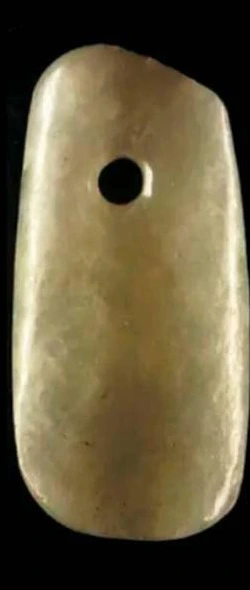
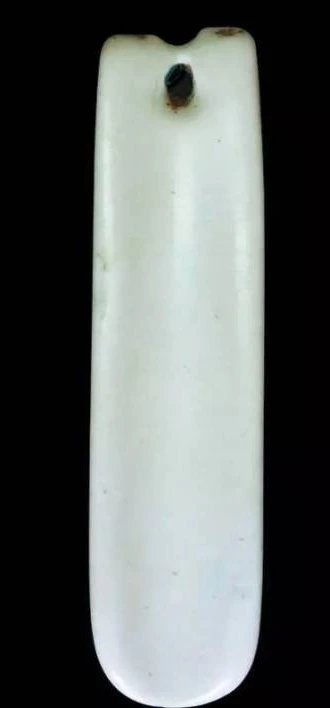
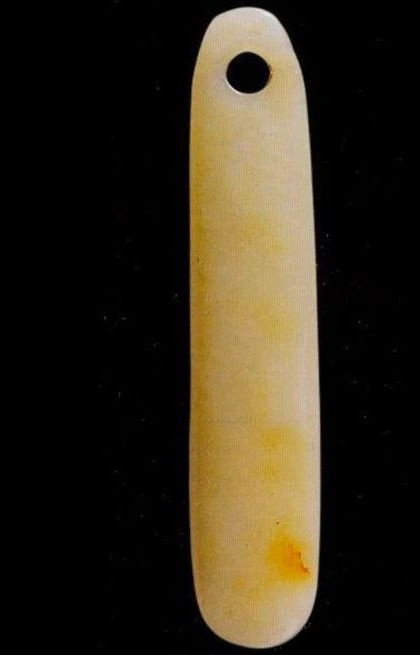
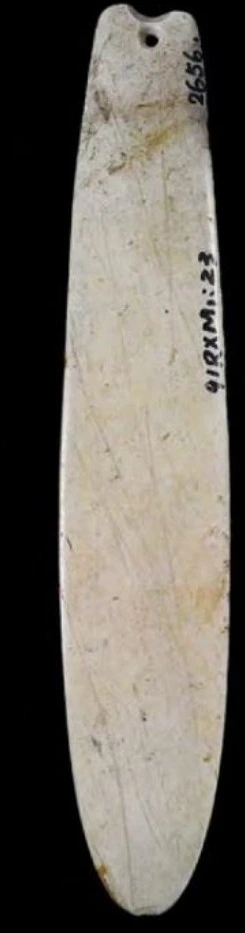
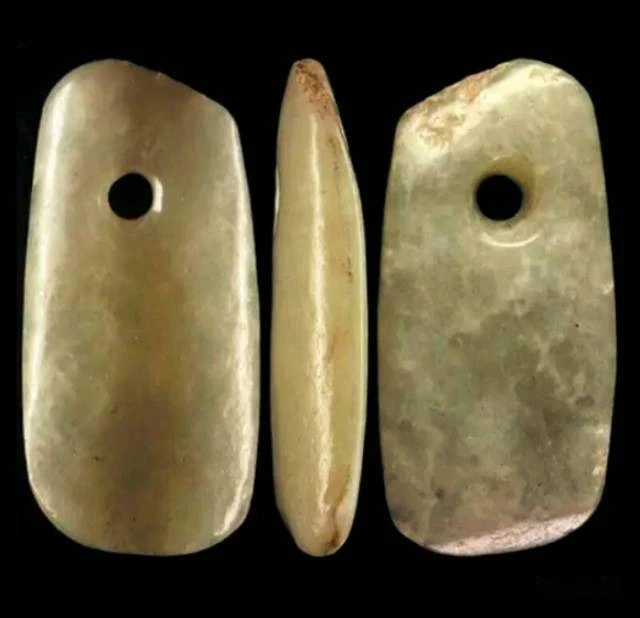
A polished strip, a little hole, a cord: ancient stone objects begin with the same arrangement as a bullroarer. Look sideways, however, and the resemblance changes. One strip is almost a rod; another is a sheet. They are also among the oldest jade objects in the world: thin slats like these were made at Xiaonanshan on the Ussuri about nine thousand years ago. The comparison begins with how different they are from one another.
The plain slats are the founding form of the jade complex, and the thinnest of them have a bullroarer’s section: flat on one face, convex on the other, like the shale bullroarer from Tuv in Norway. Graves place them on the body, at the head or neck, which shows how they were carried rather than how they were used. Later Chinese strips grow into edged, axe-like blades that are a different case.
In brief
- Is it a bullroarer? Possibly. The thinnest slats have a bullroarer’s length, end hole and section; some were also worn on the body.
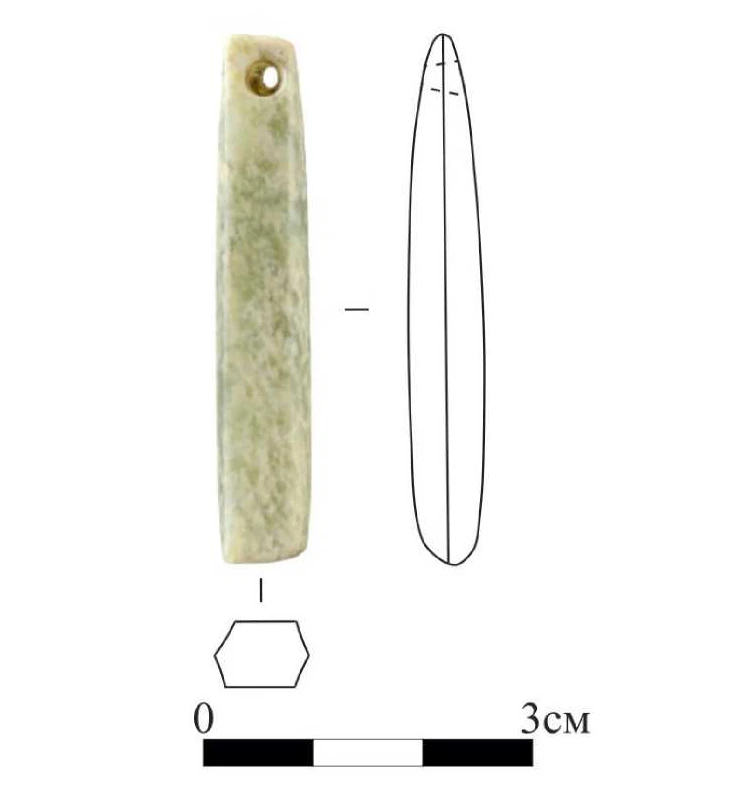
- Chertovy Vorota in Russia has an 83 × 10 × 5 mm plain nephrite strip: slender in front view, relatively thick in section.
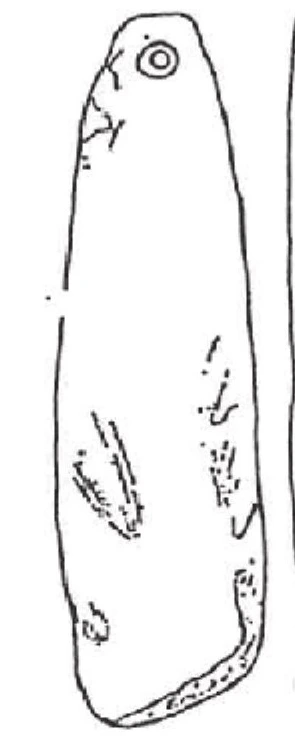
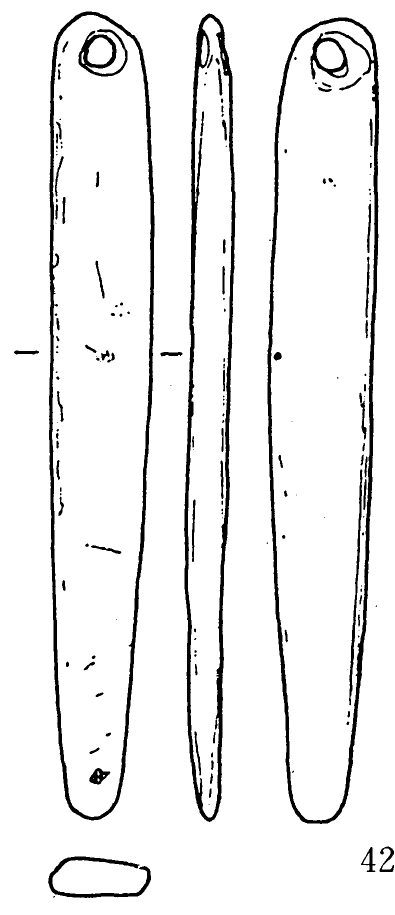
- Two strips at Kurawa, Japan, were reported beside the back of an adult woman’s head, supporting an ornament interpretation.
- Bicun A017 in China is 297 mm long but only 3–4 mm thick; its published identification is a jade yue, an axe-like blade.
Where these objects were found

Small strips, carefully suspended
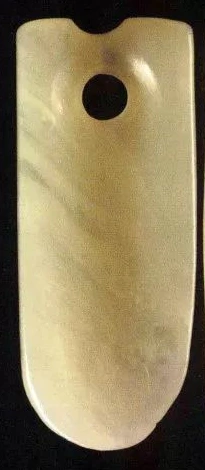
The early comparisons lie in northeast China, the Russian Far East and Japan. They have a continuous body without a separate head, shoulders or tang. Some are nephrite; others are serpentinite, rhyolite or incompletely identified stone. Their names—pendant, perforated axe, or bi-shaped object—combine descriptions with interpretations, rather than establishing one use.
At Xiaonanshan in northeast China, M1:23 has a flat back, slightly convex front and a tiny hole drilled from both faces. Its companion M1:24 has curved edges but no hole described or drawn. Both came from the badly disturbed 1991 discovery: their nominal burial association cannot establish an intact pair or borrow the dates of later excavations. Zhao, Sun and Du describe the objects on p.71 · archived.
At Kurawa on Hachijō Island, Japan, both faces and thin profiles of the two strips are drawn, but the published passage gives no individual measurements. Their reported position beside a woman’s head gives the comparison an unusually useful body context. Fukuda 1999, p.26, fig.5:42–43 · archived.
Published interpretations
The published explanations vary with place and period. For Kurawa in Japan, Fukuda reports Fujita’s hair-ornament interpretation · archived: two strips lay beside the back of an adult woman’s head. That position supports wearing them, but does not reconstruct how they were fastened. Fukuda also cautions against directly equating Kurawa with the differently ended Sannai-Maruyama strips.
For Hokkaido’s perforated axes, Tatsuta considers ornaments, then favors portable tools or stone carried for reworking · archived. His reasons include reworked fractures, redrilling and smooth, apparently cord-related wear above the holes of two Nakano B objects he examined. This explains a carried attachment; it does not identify Heiwa’s thin strips individually.
For Xiaonanshan’s bi-shaped jades, Wang Renxiang proposed eating utensils · archived, comparing bone bi and a fish-scale deposit of the Xinkailiu culture. The published forum account names no individual specimen and reports no food-residue or wear test. It cannot identify the two disturbed 1991 strips by itself.
The later Chinese pieces are published as yue (axe-like blades), zhang (blades or scepters) and ge (dagger-axes). Their edges and deposits inform tool and ceremonial readings; the names alone do not prove use. The studies cited here report no acoustic trial or diagnostic spinning wear. Testing selected strips as bullroarers is this study’s proposed experiment, distinct from those published interpretations.
Small strips · faces and profiles
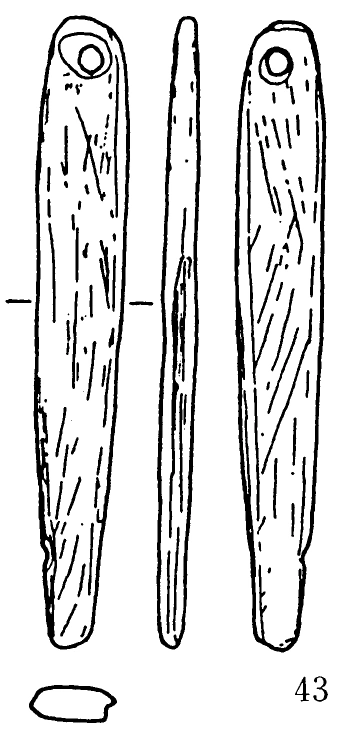
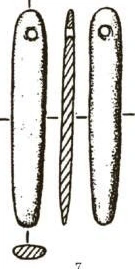
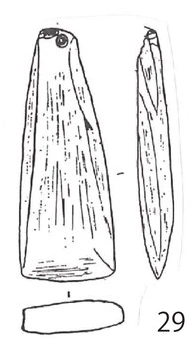
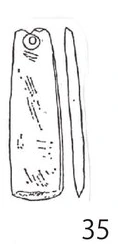
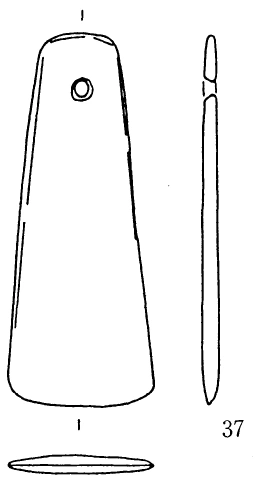
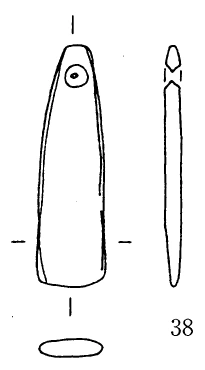
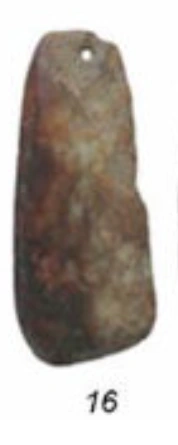
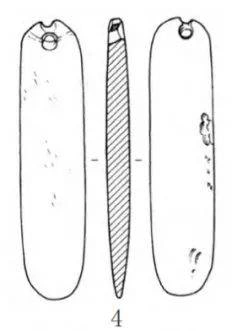
Eleven specimens and one useful counterexample
Dimensions below are length × width × thickness in millimetres. Reported means a published numeric dimension, not a new measurement. Estimated identifies measurements taken from drawings. A dash means unavailable; it does not mean zero.
Scroll sideways to compare all columns.
| Object and place | Dimensions, mm | Measurement basis | Attachment and context |
|---|---|---|---|
| Heiwa no.29, Japan | 68 × 24 × 9 | Reported; Tatsuta p.28 | End hole; saw-cut manufacture traces; Initial Jōmon pottery attribution. |
| Heiwa no.34, Japan | about 60 × 18 × 6 | Estimated by Tatsuta from a drawing, p.28 | End hole; possible Hidaka jade, identification uncertain. |
| Chertovy Vorota fig.1:7, Russia | 83 × 10 × 5 | Reported; Deng and Deng 2017 | End hole; long-oval section without concavity; Neolithic site attribution. |
| Xiaonanshan M1:23, China | — × — × — | No body dimensions given in cited description | About 2 mm biconical hole; disturbed 1991 assemblage. |
| Kurawa fig.5:42 and :43, Japan | — × — × — | No numeric dimensions extracted | Two objects, one reported grave context; each has an end hole. |
| Sannai-Maruyama fig.4:37, Japan | about 70–74 × 28 × 3–4 | Estimated from published drawing scale | Upper hole; broad, straight ends distinguish it from Kurawa. |
| Xinhua K1:8, China | 125/114 × 38 × 2–3 | Reported; 2002 brief p.9; unequal side lengths | 4 mm end hole; edged terminal and side; ordered jade deposit. |
| Bicun A017, China | 297 × 80 × 3–4 | Reported; Wang 2018 p.73; edge 1 mm | Upper bore; sitefind without a secure excavation feature. |
| Baojingwan T11③B:249, China | 190 × 74 × 3.5 surviving | Reported; 2004 report p.146 | End bore; three sharpened edges; incomplete, refitted blade. |
| National Palace Museum 購玉000821 | 221 × 21 × 3 | Reported museum dimensions | Inset eye; Western Zhou attribution; findspot unrecorded. |
| Counterexample: Xiaonanshan M1:24 | — × — × — | No body dimensions given in cited description | No hole described or drawn; not an independently examined absence. |
The Japanese measurements come from Tatsuta’s table · archived and Fukuda’s figures 4–5 · archived; the Russian dimensions are in Deng and Deng’s description of fig.1:7 · archived. The later Chinese specimens are documented in the sources below. None of these selected objects has a published mass in the evidence used here.
Larger blades, sharper edges
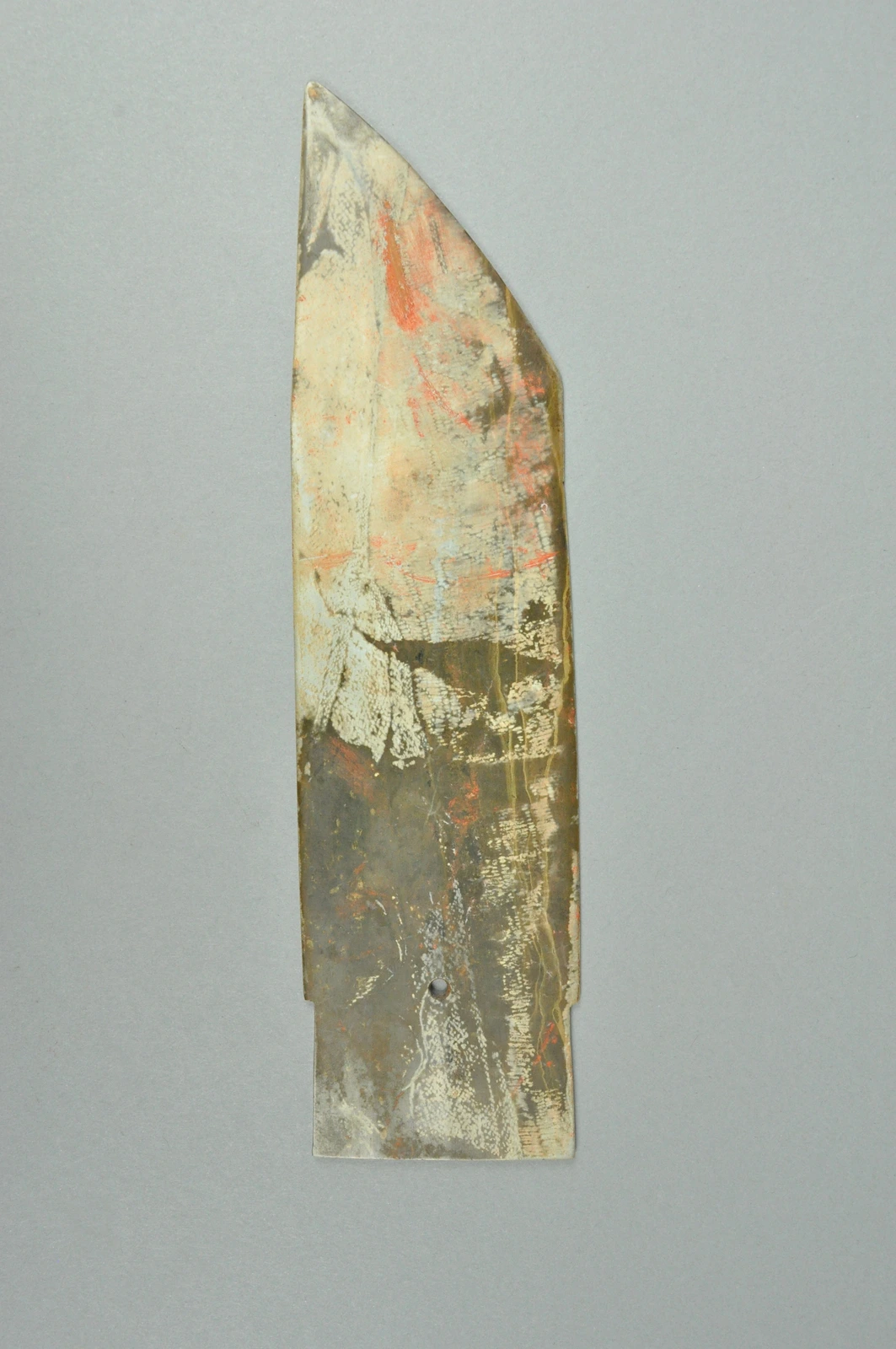
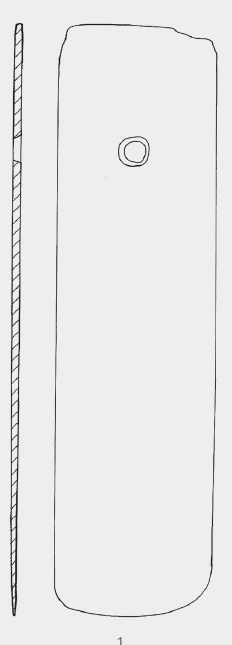
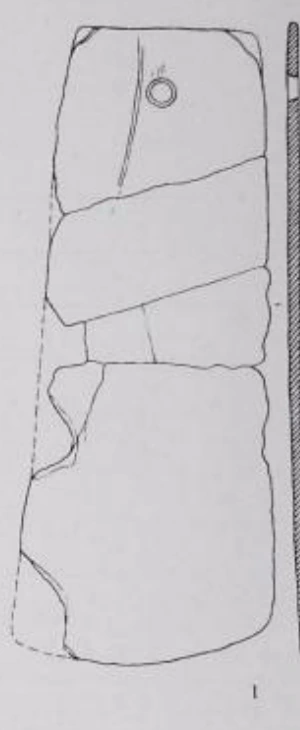
The later Chinese objects belong beside the early strips as comparisons, not as an assumed continuation of their function. At Bicun in Shanxi, A017 combines a broad plane with an exceptionally thin body. Wang Xiaoyi calls it a yue, an axe-like blade, and distinguishes such nearly parallel-sided examples from trapezoidal ones. Its Late Longshan attribution follows the site and comparison: A017 was not one of the paper’s three formally excavated pieces. Wang 2018, pp.72–74 · archived.
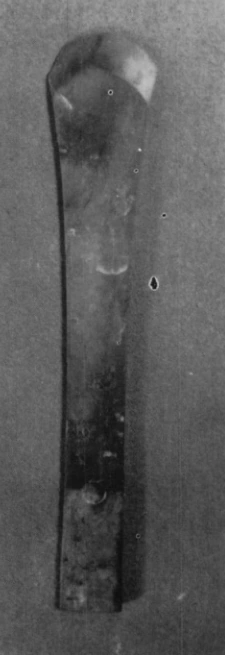
At Baojingwan on the Guangdong coast, the 3.5 mm body of T11③B:249 was polished smooth and sharpened on three sides. The report calls a long groove beside its hole a sawing trace. The refits and missing margins matter: the surviving blade cannot supply a complete original outline or balance. Its ceremonial or hafted yue interpretation remains stronger than an acoustic identification. Baojingwan report, pp.146–147, fig.98:1 · archived.
Xinhua in Shaanxi supplies different evidence. Its thin K1:8 stood with other jades arranged vertically in an ordered deposit; a small central hollow held bird bones. The excavators called the object a zhang, a blade or scepter. This treatment supports a valued or ceremonial object, but cannot identify its earlier performance. The National Palace Museum’s ridgeless jade ge adds a further warning: its eye lies well inside the strip, leaving a substantial short tail. A replica must preserve that arrangement. Xinhua excavation brief, pp.5–6,9 · archived.
Later Chinese blades · continuous outlines


What a cord can tell us
Wear belongs to the object on which it was observed. Tatsuta’s Nakano B observations cannot be transferred to Heiwa’s thin slats. Likewise, cord traces on the grooved Chertovy Vorota specimens do not establish wear on its plain fig.1:7. Unreported wear remains unknown.
The useful experiment would begin with each object’s measured section, mass and actual hole position. Replicas should be compared under free suspension, body contact, fixed binding and whirling; microscopic cord-contact traces should then be judged without knowing which treatment made them. Sustained rotation and sound would establish capability. Agreement between archaeological wear and the experimental traces could begin to identify use. That is the distinction these stone strips make especially clear: a possible vibrating blade is a physical proposition; an ancient bullroarer is a historical one.
The comparative catalogue
Measurements are length × width × thickness in millimetres. A dash means unreported; ≈ marks an estimate. Groups and possible duplicate objects remain labelled. Download the specimen table.
View all 35 evidence entries
Scroll sideways to compare all columns.
| Object | L × W × T, mm | Material | Context | Reported traces |
|---|---|---|---|---|
| Chertovy Vorota · Fig.1:7Russia · object; minimum 1 | 83 × 10 × 5Reported dimensions; not measured from the image. Thickness describes the specimen, not a demonstrated uniform slab. | nephrite | Cave dwelling assemblage with human remains; no individual body position established for this blade. | not reported |
| Heiwa · Tatsuta no.29Japan · object; minimum 1 | 68 × 24 × 9Parenthesized fragment dimensions are preserved sizes; no.28 unmeasured. | rhyolite (some identifications uncertain) | unknown | not reported; 擦切痕 are saw-cut manufacture traces, not cord wear. |
| Heiwa · Tatsuta no.34Japan · object; minimum 1 | 60 × 18 × 6 ≈Tatsuta2020 shaded-table value: measured by author from published excavation drawing, not a direct specimen measurement. | rhyolite; possible Hidaka jade | unknown | not reported; 擦切痕 are saw-cut manufacture traces, not cord wear. |
| Heiwa · Tatsuta no.35Japan · object; minimum 1 | 45 × 14 × 3 ≈Tatsuta2020 shaded-table value: measured by author from published excavation drawing, not a direct specimen measurement. | rhyolite (some identifications uncertain) | unknown | not reported; 擦切痕 are saw-cut manufacture traces, not cord wear. |
| Xiaonanshan · M1:23China · object; minimum 1 | — × — × —No body dimensions reported in the cited description. The chronology of later Xiaonanshan burials is not an individual date for this specimen. | jade (nephrite attribution) | Nominal 1991 M1 assemblage, badly disturbed; stratigraphy and original coexistence are unreliable. | not reported |
| Xiaonanshan · M1:24China · object; minimum 1 | — × — × —No body dimensions reported in the cited description. The chronology of later Xiaonanshan burials is not an individual date for this specimen. | jade (nephrite attribution) | Nominal 1991 M1 assemblage, badly disturbed; stratigraphy and original coexistence are unreliable. | not reported |
| Xinglongwa · Blade captioned as Xinglongwa H128China · object; minimum 1 | — × — × —No verified individual numeric dimensions; captioned photographs have not been crosswalked to the original excavation catalogue. | jade/nephrite | Captioned as Xinglongwa H128; house attribution does not establish dwelling floor versus intramural grave deposition. Site attribution remains provisional because nearby captions conflict with Xinglonggou. | not reported; pecking, polishing and H125 redrilling are manufacturing/repair observations. |
| Niudaokou · Niudaokou jade blade at the southern limitChina · object; minimum 1 | 57 × 14 × 5 | jade | unknown | not reported |
| Wangxinggou · Wangxinggou collected yellow jade bi-shaped object — bullroarer-form candidate · archivedChina · object; minimum 1 | 65 × 12 × — | yellow jade | surface | not reported |
| Honggelitu · Honggelitu burial/cairn — bullroarer-form candidateChina · object; minimum 1 | — × — × — | jade/nephrite likely | burial | not reported |
| Xinglonggou Collected · Xinglonggou collected bi-shaped jade object — bullroarer-form candidate · archivedChina · object; minimum 1 | — × — × — | jade | surface | not reported |
| Niuheliang 5 · N5SCZ1:2 / object 373China · object; minimum 1 | 94 × 25 × 6 | white jade | burial | not reported |
| Mikamine · Mikamine site no.268 slate pendantJapan · object; minimum 1 | 59 × 19 × 6 | slate | unknown | not reported |
| Uril Bukinsky · Fig1.6.5:16 / Fig9 · archivedRussia · object; minimum 1 | 38.5 × 16.3 × 3 | jasper | unknown | not reported |
| Rokutanda Minami · Rokutanda Minami jade-workshop pendantJapan · object; minimum 1 | — × — × — | stone | unknown | not reported |
| Vetka2 · MA-547 / Вет-II-05/5264 · archivedRussia · object; minimum 1 | 47 × 7 × 4 | light-green nephrite (predominantly tremolite) | dwelling | not reported |
| Kurawa · Fig5:42Japan · object; minimum 1 | — × — × — | stone; lithology not identified in inspected passage | burial | not reported |
| Kurawa · Fig5:43Japan · object; minimum 1 | — × — × — | stone; lithology not identified in inspected passage | burial | not reported |
| Sannai Maruyama · Aomori bulletin4 Fig4:37Japan · Possible duplicate; excluded from counts | ≈70–74 × ≈28 × ≈3–4Approximate dimensions estimated from the published drawing scale, not reported specimen measurements. | serpentinite | unknown | not reported |
| Sannai Maruyama · Aomori bulletin4 Fig4:38Japan · Possible duplicate; excluded from counts | ≈46 × ≈12–16 × —Approximate dimensions estimated from the published drawing scale; thickness unreported. These are not reported specimen measurements. | serpentinite | unknown | not reported |
| Xinglonggou · Xinglonggou House 22 jade bi-shaped blades (匕形器)China · group; minimum 2 | — × — × — | jade/nephrite | unknown | not reported |
| Unprovenanced Npm53593 贈玉000428 · NPM53593 贈玉000428China · object; minimum 1 | 107 × 32 × 4 | jade (mineral not established) | unknown | not reported |
| Xizhufeng · Wang Qing Fig9:1 (grave/accession unresolved) · archivedChina · object; minimum 1 | — × — × — | jade (mineral not established) | unknown | not reported |
| Bicun · A017 · archivedChina · object; minimum 1 | 297 × 80 × 3–4Reported 297 × 80 × 3–4 mm; cutting edge 1 mm. Repeated figures show the same specimen. | jade (mineral not established) | Bicun sitefind; no secure excavation feature for A017. | not reported |
| Unprovenanced Npm購玉000821 Detail440 · NPM購玉000821 Detail440China · object; minimum 1 | 221 × 21 × 3 | jade (mineral not established) | unknown | not reported |
| Unprovenanced Penn30 8 12 · Penn30-8-12 · archivedChina · object; minimum 1 | — × — × — | jade (mineral not established) | unknown | not reported |
| Unprovenanced Penn30 8 10 · Penn30-8-10 · archivedChina · object; minimum 1 | — × — × — | jade (mineral not established) | unknown | Source reports worn groove leading from end to bore |
| Sanxingdui · K2③:314附4 · archivedChina · object; minimum 1 | 200 × 44–58 × 7Reported 200 × 44–58 × 7 mm; width range retained. A single oblique bevel and a small edge chip are reported. | jade (mineral not established) | ritual deposit | not reported |
| Shangtaicun · catalogue184 · archivedChina · object; minimum 1 | 300 × 34–43 × 5–7Reported 300 × 34–43 × 5–7 mm; width and thickness ranges retained. | jade (mineral not established) | unknown | Source explicitly sharp cutting edge and use traces; no rotational wear identification |
| Fuhao Yinxu · M5:462 · archivedChina · object; minimum 1 | 161 × 42 × 4Reported 161 × 42 × 4 mm; 42 mm is top width, not a measured maximum body width. The limited under-light hafting observation concerns M5:462 alone. | jade (mineral not established) | burial | Under-light examination found no hafting/lashing traces; not a comprehensive wear absence |
| Alagou Dongfeng · M26:22 · archivedChina · object; minimum 1 | 89 × 30 × 5 | stone | burial | not reported |
| Hake · M3:33 · archivedChina · object; minimum 1 | — × — × — | jade (mineral not established) | burial | not reported |
| Liyang Variant Locality · Liyang gui Fig19 · archivedChina · object; minimum 1 | 210 × 48 × 7currentmuseum width49mm versus original48mm; eye61mm from butt. | jade (mineral not established) | unknown | not reported |
| Baojingwan · T11③B:249 · archivedChina · fragment; minimum 1 | 190 × 74 × 3.5Reported surviving 190 × 74 × 3.5 mm; incomplete, refitted blade. Phase attribution is not a direct object date. | tremolite (reported 透闪石质) | T11, layer III B; Phase II attribution. | not reported |
| Xinhua Shenmu · K1:8 · archivedChina · object; minimum 1 | 125/114 × 38 × 2–3125 and 114 mm are unequal side lengths, not a range; width 38 mm, thickness 2–3 mm and bore 4 mm are reported. | jade (mineral not established) | K1 ordered jade deposit: 36 pieces refitted to 32 objects, set upright around a central hollow containing bird bones; no human skeleton reported. | not reported |
Key sources
- Tatsuta Osamu, ‘On perforated stone axes’ (有孔石斧について), Bulletin of the Okhotsk Museum ESASHI 11 (2020):25–32, especially pp.26–28 and fig.3. · archived Primary comparative study. Table p.28 explicitly shades dimensions measured from drawings: Heiwa no.34 is shaded; no.29 is not. The author's direct smooth-wear observations concern Nakano B, not Heiwa no.34.
- Zhao Binfu, Sun Mingming and Du Zhanwei, ‘The date and nature of jades from the Xiaonanshan burial at Raohe’ (饶河小南山墓葬出土玉器的年代和性质), Frontier Archaeology Research 14:69–78, especially pp.69–72 and fig.1:34–35. · archived Authors examined the jades. The 1991 assemblage was badly disturbed and mostly recovered afterward. M1:23 has a roughly 2 mm biconical hole; M1:24 has no bore described or drawn. Publication indexed 2013/2014; volume and pages are secure.
- Deng Cong (Tang Chung) and Deng Xuesi, ‘The spread of Neolithic slit jade rings in northeast Asia: Chertovy Vorota in the Russian Far East’ (新石器时代东北亚玉玦的传播), Northern Cultural Relics 2017(3):17–23, fig.1:7–10. · archived Author-supplied scholarly article republished by the Institute of Archaeology, CASS. Distinguishes the plain long-oval fig.1:7 from three hollow-section pieces; cord traces belong only to 9–10. The underlying 1991 excavation report is not treated as directly read.
- Fukuda Tomoyuki, ‘Slit-ring ear ornaments at the northern end of Honshu’ (本州北端の玦状耳飾り), Aomori Research Bulletin 4 (1999), p.26, figs.4:37–38 and 5:42–43. · archived Directly read archaeological synthesis, reporting Kurawa grave placement and citing Fujita Fujio 1996 for the hair-ornament interpretation. Sannai-Maruyama dimensions are later drawing-scale estimates, not Fukuda's numeric measurements.
- Wang Xiaoyi, ‘A preliminary view of jades from Bicun, Xing County, Shanxi’ (山西吕梁兴县碧村遗址出土玉器管窥), Palace Museum Journal 2018(3):71–80, pp.72–74, fig.5:1; chronology p.80. · archived A017:297 × 80 × 3–4 mm, edge 1 mm. Fig.9:4 repeats the same object. It is a sitefind, not one of the paper's formally excavated specimens.
- Guangdong Provincial Institute of Cultural Relics and Archaeology and Zhuhai Museum, Baojingwan, Zhuhai: Excavation Report of an Island Prehistoric Site (珠海宝镜湾), Science Press,2004, pp.146–147, fig.98:1 and plate51:4; phase context pp.153,156. · archived T11③B:249 is explicitly incomplete and refitted.190 × 74 × 3.5 mm are surviving maxima. Three sharpened edges, single-sided bore and interpreted sawing trace are original descriptions. Late Neolithic Phase II is contextual, not a direct object date.
- Shaanxi Provincial Institute of Archaeology, ‘Excavation brief of the Xinhua site, Shenmu, Shaanxi,1999’ (陕西神木新华遗址1999年发掘简报), Archaeology and Cultural Relics 2002(1):3–11, pp.5–6,9, fig.15:8. · archived K1:8 is called 玉璋, jade zhang;125/114 × 38 × 2–3 mm,4 mm biconical hole. K1 held36 pieces refitting to32 objects, arranged upright; central hollow contained bird bones. These are deposition observations, not proof of acoustic use.
- National Palace Museum, Taipei, Jade ge dagger-axe (玉戈), 購玉000821N000000000, digital collection no.440. Institutional object record:221 × 21 × 3 mm; Western Zhou,1046–771 BCE; continuous ridgeless strip. No findspot stated. Inset hole position is visible in exact photographs, not a published numeric distance.
- Zhao Zengjian, “Evidence for nine thousand years of Chinese jade culture: proceedings of the Xiaonanshan jade-culture forum” (实证九千年中华玉文化——“小南山玉文化论坛”纪要), Palace Museum Journal 2025(1):144–149, p.149. · archived Published account of Wang Renxiang’s eating-utensil proposal, comparing Xinkailiu bone bi and a fish-scale deposit. No individual Xiaonanshan bi, food-residue analysis or diagnostic wear test is specified.